
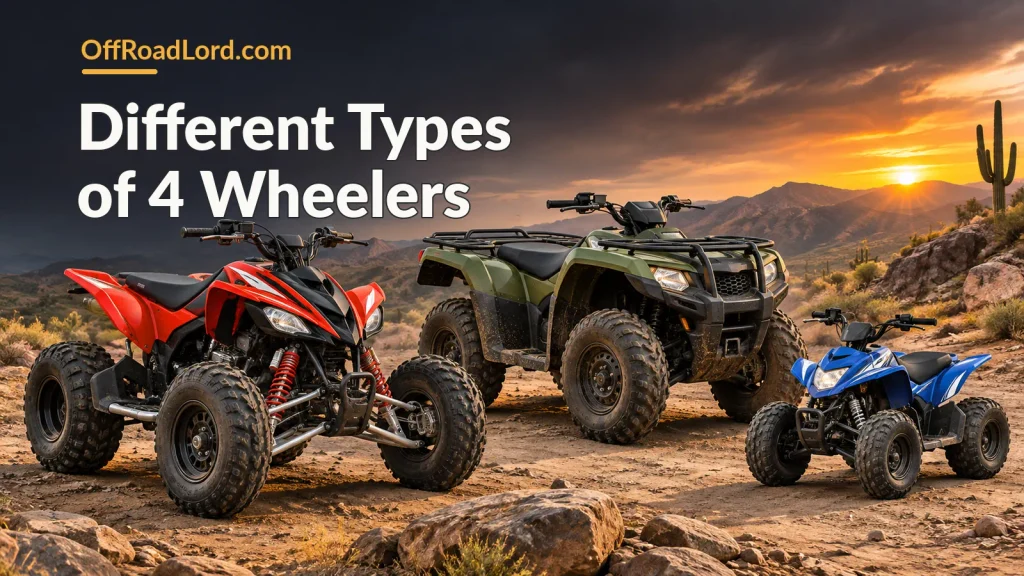
There are several different types of 4 wheelers, but the most useful starting point is sport, utility, recreational/trail, youth, and factory-approved two-passenger ATVs. You’ll also see mud, hunting, and touring labels. Those describe a machine’s intended use or equipment; they aren’t all separate official vehicle classes.
For this guide, a four-wheeler means a four-wheeled ATV with handlebars and a seat you straddle, not a side-by-side with a steering wheel or a 4×4 truck. If you’re sorting out the terminology first, my ATV definition guide covers the basics. Here, I’ll focus on the design differences that actually change what you should buy.
Types of 4 wheelers compared
These are practical shopping categories, so they overlap. For example, a utility ATV can be a good trail machine, and a touring ATV can also have work-oriented equipment. Passenger permission comes from the specific vehicle’s factory designation, not its category name.
| Category | Best fit and typical features | Passenger rule | Documented example |
|---|---|---|---|
| Sport | Active recreation, tracks, dunes; responsive handling and sport-focused suspension | Single rider unless the manufacturer specifies otherwise | 2026 Yamaha Raptor 700 |
| Utility | Property jobs, racks, towing equipment and trail use; check exact load ratings | Many are single-rider machines | 2026 Honda FourTrax Foreman 4×4 |
| Recreational / trail | Comfort and control on everyday trails; often overlaps with utility | Check the actual seating designation | 2026 Yamaha Grizzly (utility/trail crossover) |
| Youth | Age-appropriate size and controls for supervised younger riders | One young operator on an approved model | 2026 Yamaha Raptor 110, ages 10+ |
| Two-up / touring | Two people in line; designated passenger position, handholds and footrests | One operator plus one passenger when factory-approved | 2026 Polaris Sportsman Touring 570 |
| Mud-focused | Deep-mud-oriented tires, clearance and drivetrain choices | Still check Type I versus Type II | 2026 Polaris Sportsman 850 Mud Edition |
The official difference: Type I, Type II and youth classes
Here’s the distinction I’d check before comparing engines or accessories. The Specialty Vehicle Institute of America (SVIA) describes Type I ATVs as designed for one operator, with no passenger. Type II ATVs have a manufacturer-designated passenger position behind the operator. A long seat or a rear cargo rack doesn’t convert a Type I into a two-up machine.
The U.S. Consumer Product Safety Commission (CPSC) goes a step further. Type I includes Category G (adult general recreational/utility), Category S (adult sport/recreational), Category Y (youth), and Category T (transitional). Type II falls under adult Category G. Those are official classifications. Terms like “mud ATV,” “hunting ATV,” and “trail ATV” are useful shopping descriptions, not substitutes for a factory classification.
That distinction matters because a sport-oriented machine can be Category S while a recreational/utility model can be Category G, and both can still be single-rider Type I ATVs. Read the vehicle’s identification and warning labels, its owner’s manual, and the manufacturer’s passenger instructions before deciding who can ride it.
Sport ATVs: when riding performance comes first
A sport quad is built around rider input and lively handling rather than hauling equipment. Look for the suspension setup, ground clearance, transmission, tire choice and how the machine responds on the terrain you actually ride. Tracks, open sand and recreational trails put different demands on an ATV.
The 2026 Yamaha Raptor 700 and YFZ450R show why “sport” isn’t one universal specification: Yamaha describes the Raptor’s 686cc engine and mixed-terrain focus, while the YFZ450R has a 449cc engine and race-oriented chassis. Their suspension and riding purposes aren’t interchangeable just because both are sport models.
Choose a sport ATV when recreational handling and your preferred riding terrain matter more than racks, towing or passenger accommodations.
I’d avoid shopping by a claimed top speed: engine displacement, gearing, tires, terrain and rider conditions all change the result. Nor does the word “sport” guarantee a specific transmission or that every model is two-wheel drive.
Utility ATVs: for work, hunting and general trails
Utility four-wheelers usually put more emphasis on carrying gear, working at low speeds and being useful off the trail. Depending on the model, they can offer front and rear racks, a hitch, selectable four-wheel drive, a winch or other task-oriented equipment. Many are comfortable enough for ordinary recreational riding, too.
To see why exact ratings matter, look at the 2026 Honda FourTrax Foreman 4×4. Honda lists an 848-pound towing capacity, an 88-pound front rack limit and a 176-pound rear rack limit for that configuration.
Those three figures describe different limits; you cannot treat them as a single payload number or transfer them to every utility ATV. Honda also describes selectable 2WD, 4WD and a locking-front-differential mode on this model.
Choose a utility ATV if you routinely haul tools, tow within the manufacturer’s rating, plow with an approved setup, or need traction for uneven property and hunting access. For regular heavy cargo and multiple occupants, a UTV may be the better tool. Crucially, utility does not mean passenger-approved.
Recreational and trail ATVs: a crossover, not one rigid class
If you mostly ride marked trails and occasionally do light property work, a recreational or rec/utility ATV may suit you better than a race-focused quad or a highly specialized mud build. You’re usually trading some track emphasis for trail comfort, versatile tires and equipment that can serve more than one purpose.
Yamaha calls the 2026 Grizzly a trail-ready utility model, which illustrates the overlap. I would compare the actual steering effort, suspension, transmission behavior, overall width and service needs rather than insisting that “recreational” is a stand-alone official classification.
Youth ATVs: match the rider’s age and fit
A youth ATV is not simply a cheap or small adult quad. Youth machines are built for smaller operators, with age-specific limitations and controls. The CPSC identifies youth ATV categories Y-6+, Y-10+ and Y-12+, along with Category T transitional machines intended for riders 14 or older with adult supervision, or 16 or older alone. Those are not blanket invitations for every child of that age to ride every ATV.
For example, Yamaha identifies the 2026 Raptor 110 as intended for riders ages 10 and up, with a CVT transmission. Another youth model may have a different age label, dimensions and operating controls.
Check whether the rider can properly reach and operate everything, read the exact model’s warning label and manual, and follow the manufacturer’s minimum age. Engine size alone is not a reliable age rating.
The ATV Safety Institute warns against children operating adult-size ATVs. Supervision, protective equipment and training matter even on an age-appropriate machine. My separate ATV sizing-by-age guide gives more sizing context, but use the current manufacturer’s label as the deciding authority.
Two-passenger ATVs: buy a genuine two-up model
If you need to carry a friend, spouse or another adult on the same quad, look for an actual Type II ATV. The passenger sits behind the operator, not alongside them.
A purpose-built two-up machine has a manufacturer-approved passenger position and supporting equipment, which commonly includes handholds and passenger footrests.
The 2026 Polaris Sportsman Touring 570 is a documented example. Polaris shows the passenger seat and handholds; its 2026 owner’s manual tells passengers to grip the handholds and place their feet firmly on the footrests. Check passenger age and fit requirements, combined occupant/cargo limits, and any changes to handling before riding together.
Don’t assume a single-rider utility quad is safe for two people because the seat appears long. For more factory-approved examples and comparison criteria, see my two-seater ATV buying guide.
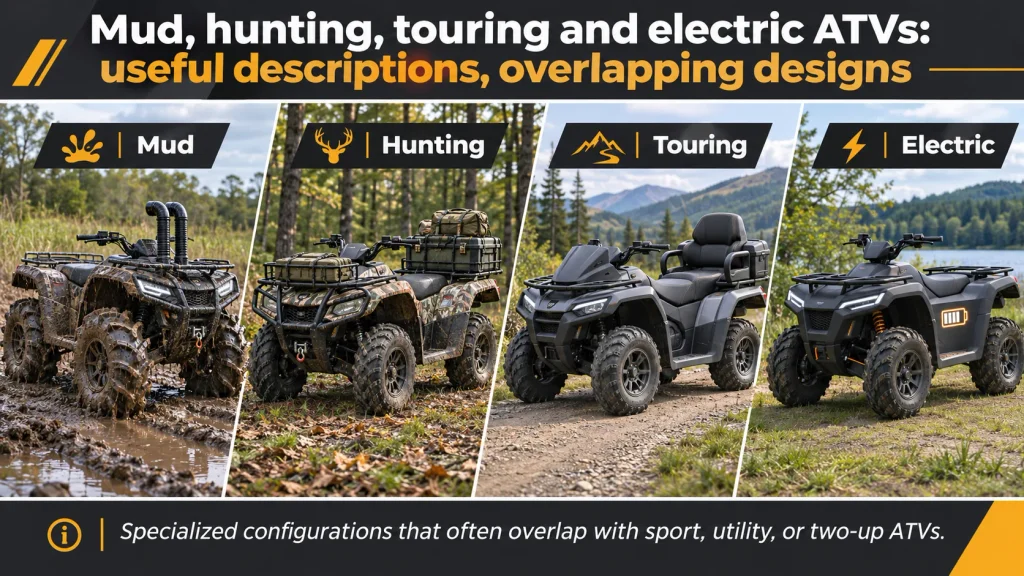
Mud, hunting, touring and electric ATVs: useful descriptions, overlapping designs
Mud-oriented setups
Some manufacturers offer dedicated mud trims. Polaris, for instance, listed Sportsman 850 and XP 1000 Mud Edition models for 2026. Specialized tires, clearance and drivetrain tuning can be useful in that setting, but a mud build may be less appealing for routine hard-packed trails. Check the vehicle’s tire limits and trail rules before fitting aggressive tires.
Hunting and touring setups
A “hunting ATV” is often a utility or rec/utility machine equipped for gear, racks and appropriate off-road access. A “touring ATV” usually emphasizes longer recreational rides, and some touring models are factory-approved two-up ATVs. Neither label by itself tells you the towing rating or passenger capacity.
Electric ATVs
Electric is a power source, not an automatic new class of four-wheeler. The CPSC explains that battery-powered vehicles meeting the ATV definition are subject to ATV requirements.
A children’s electric ride-on toy and a real motorized youth ATV should not be treated as equivalent. For any electric model, check its actual manufacturer classification, age label, battery/range limitations and service support.
Two-wheel drive versus four-wheel drive
2WD and 4WD are drivetrain configurations, not separate official ATV types. In a typical 2WD setup, the engine drives two wheels; a 4WD system can send drive to four. The extra driven wheels may help you get moving on loose, wet or uneven ground, but they won’t create unlimited traction or overcome unsuitable tires, poor technique or unsafe slopes.
Choose based on where you actually ride. On relatively firm recreational terrain, a suitable 2WD sport quad may be enough. Muddy property, snow work and some steep or loose trails can make selectable 4WD valuable.
Check how the exact model engages 4WD, whether it has a differential lock, and how locking modes affect steering. Honda’s 2026 Foreman 4×4 is a concrete example of selectable 2WD, 4WD and 4WD with a locked front differential.
I’d budget for the right ATV tire design for the terrain rather than assuming a drivetrain badge will solve every grip problem.
Which four-wheeler should you buy?
Start with your most demanding regular job, then verify the exact machine against your rider, trail and storage limits.
- Fast-paced recreation or track riding: Start with a sport ATV. Check suspension, controls, and whether its transmission suits your experience. A race-oriented setup may be the wrong everyday work vehicle.
- Casual trails and weekend outings: Compare recreational/utility machines and trail-suitable sport ATVs. The better choice depends on fit, steering effort, comfort, trail width and terrain, not just engine size.
- Farm or property maintenance: Start with a utility ATV. Write down the heaviest load you need to tow and carry, then check towing capacity, front rack, rear rack and total vehicle load separately.
- Hunting or remote access: Consider a utility/rec-utility setup with suitable tires, cargo restraints and sufficient rated capacity. Confirm access rules and that the route is appropriate for an ATV.
- One ATV for two people: Make factory-approved Type II seating nonnegotiable; then confirm passenger footrest fit and combined load rating. Otherwise compare a side-by-side.
- A younger rider: Use the exact youth age label and physical fit first, followed by adult supervision, training and protective gear. Never substitute an adult ATV.
- Frequent deep mud: Consider a purpose-built mud trim only if your trails and maintenance tolerance justify it. A specialized setup can compromise general-use convenience.
- Tight storage or a small trailer: Measure your usable doorway, trailer deck, tie-down arrangement and the exact ATV including accessories. My ATV size chart and ATV weight guide help with the next step.
- Limited purchase budget: Compare the actual new or used vehicle’s condition and total ownership cost, not just the advertised price. Dealer setup, transport, maintenance, tires, insurance where applicable and repair access can change the decision.
Check size, speed, price and maintenance by exact model
There is no trustworthy universal “sport ATV price,” “utility ATV top speed” or “youth ATV weight” that fits every machine. Look up the model year and trim rather than borrowing numbers from an unrelated quad.
For one tangible example, Honda lists the 2026 Foreman 4×4 at 82.9 inches long, 47.4 inches wide and 635 pounds curb weight. Curb weight includes standard equipment, required fluids and a full tank of fuel.
That’s not the same as a manufacturer’s dry weight, and it doesn’t include every accessory or cargo item you’ll add. Measure your transport setup with the fully loaded ATV in mind.
For price, get an out-the-door quote for the exact configuration rather than assuming the listed MSRP includes destination, setup, taxes and registration. For a used machine, I would check its VIN and ownership records, maintenance history, tires, brakes, steering, suspension, fluid leaks and signs of damage before treating a low price as a bargain.
Also confirm that the parts and servicing you need are available near you. You can compare makers in my ATV brands overview, then verify the shortlist against the actual manufacturer’s catalog.
ATV versus side-by-side UTV: don’t confuse the categories
A conventional ATV has handlebars and straddle-style seating. A side-by-side UTV generally has a steering wheel, foot pedals, side-by-side or bench seating and manufacturer-designed passenger restraints.
Both can be built for work or recreation, but they are different vehicle formats. Honda’s ATV buyer’s guide makes the same distinction.
I’d consider a UTV if you regularly need side-by-side seating, multiple passengers or a cargo bed. I’d consider a conventional ATV when compact size and straddle-style riding fit your intended work or trails. See what a UTV is for a fuller explanation.
Before you ride
Use an ATV matched to the rider’s age and size, follow its passenger rating, wear appropriate protective gear and take hands-on instruction. The ATV Safety Institute’s rider guidance calls for a DOT-compliant helmet, goggles, gloves, long sleeves and pants, and over-the-ankle boots.
It also advises staying off paved roads except lawful crossings, using designated trails and supervising riders under 16. My ATV safety guide covers the broader riding precautions.
Once you’ve settled on the right category, check three things before paying: the factory rider/passenger designation, the exact model’s size and capacity ratings, and whether it suits the terrain and access rules where you’ll actually ride. Those checks usually narrow the choice more effectively than a category label alone.

Calvin Anderson, founder of Off-Road Lord, is a seasoned off-roading enthusiast from Tucson, Arizona. With over a decade of hands-on experience and a deep understanding of off-roading vehicles and trails, Calvin’s insights provide a trusted guide for fellow adventurers.