
For the 2025 Can-Am Defender HD7, HD9 and HD10 models covered here, the regular maintenance schedule starts at one year, 200 operating hours or 1,900 miles (3,000 km), whichever comes first.
The 2026 Defender HD11 XT, XT CAB and XU have the same basic regular-service interval, but their oil capacity, oil-change procedure and severe-duty schedule are different.
I’ve separated the two generations below so you can find the right service information without buying the wrong oil or following a procedure meant for another engine.
If you have a MAX, PRO, X mr, 6×6 or another model year, start with the BRP operator’s guide directory rather than assuming these figures apply.
Can-Am Defender maintenance schedule
Keep track of the date, engine hours and odometer at each service. You don’t get to wait until all three limits are reached. For example, if you put 200 hours on a recreational Defender in eight months but only drive 800 miles, the hours trigger the regular service.
2025 Defender HD7, HD9 and HD10 service intervals
This schedule covers the standard-series 2025 HD7 (base, DPS, XT), HD9 (base, DPS including CAB, XT, XU) and HD10 (DPS, Limited, XT, XU). The 2025 operator’s guide, pages 129–138, uses service groups A, B and A+. Use the groups together, not as alternatives.
| Service | When due (first limit reached) | What to do |
|---|---|---|
| Regular A | 1 year / 200 h / 1,900 mi (3,000 km) | Routine scheduled service, including engine oil and filter replacement. |
| Regular A + B | 2 years / 400 h / 3,700 mi (6,000 km) | Repeat A and add B tasks; then repeat the alternating pattern. |
| Severe duty or deep mud/water A+ | 6 months / 100 h / 900 mi (1,500 km) | Use the appropriate extra-service chart; retain A and B at their normal thresholds. |
| Initial gearbox oil changes, regular use | First 1,900 and 3,700 mi (3,000 and 6,000 km) | Replace oil at both milestones. |
| Initial gearbox service, severe duty or deep mud/water | First 900 and 1,900 mi (1,500 and 3,000 km) | Follow the early replacement entries in the applicable chart. |
| Gearbox and front differential, regular use | A / B | Check and correct level at A; change oil at B. The initial gearbox exceptions above still apply. |
| Rear final drive (HD7 only), regular use | A / B | Check and correct level at A; change oil at B. |
| Brake fluid | 2 years | Replace. |
| Coolant | 5 years / 7,500 mi (12,000 km) | Replace. |
The factory’s mileage figures are rounded. The severe-duty tables have separate inspection and replacement entries for oil, filters, CVT and other parts.
Use the severe-duty chart on printed pages 133–135 or the deep mud/water chart on pages 136–138 to establish each task before extending a service interval. The six-month A+ visit isn’t a replacement for the annual A service.
2026 Defender HD11 service intervals
The following is for the 2026 XT, XT CAB and XU with the three-cylinder HD11 engine. The HD11 operator’s guide, sections 4-6 through 4-11, specifies the following normal-use milestones.
| When | Main work due |
|---|---|
| First 1,900 mi (3,000 km) | Change front differential and gearbox oils. |
| 1 year / 200 h / 1,900 mi (3,000 km) | Change engine oil and filter. Service the air intake, inspect the belt and clutch system, brakes, cooling, battery, steering and suspension; check applicable cab equipment and diagnostic modules. |
| 400 h / 3,700 mi (6,000 km), regardless of age | New spark plugs. |
| 2 years, regardless of use | New brake fluid. |
| 2 years / 400 h / 3,700 mi (6,000 km) | Renew gearbox and front differential oils; service the disconnect unit and CARB vent pre-filter if fitted. |
| 5 years / 7,500 mi (12,000 km), regardless of hours | New coolant. |
For severe operation, BRP specifies half of the regular intervals for these HD11 models. That puts the recurring oil-and-filter service at six months, 100 hours or 1,500 km (about 930 miles), whichever is reached first.
Consult the manual or your dealer for how the severe-use rule applies to the initial drivetrain service and special calendar-only tasks. Don’t apply the HD11 half-interval rule indiscriminately to the older HD10 charts.
What to inspect before every ride
A service appointment doesn’t replace your daily inspection. Walk around the machine before starting it and look for oil or coolant on the floor, a soft tire, loose wheel hardware or damage from the last outing.
- Check oil using the engine-specific method below; check coolant when cold and brake fluid at the reservoir.
- Inspect the air intake, radiator, CV boots, tires, wheels and visible suspension parts.
- Check lights, restraints, doors, steering, throttle and brakes. Make sure the cargo bed is latched and loads are secured.
- Clear vegetation and debris from cooling openings and the exhaust area once it is safe to touch.
Use the vehicle’s tire-pressure label for its load and tire setup, not a generic UTV pressure. The full checklists are in the 2025 guide, pages 21–24 and HD11 guide, section 2-76 onward. Correct any unsafe condition before driving.
Break-in period and first service
Both generations covered here have a 10-hour or 300-km (200-mile) vehicle break-in. Keep the accelerator below three-quarters travel, vary your speed, and avoid prolonged hard running or overheating.
A new CVT belt needs its own 50-km (30-mile) bedding-in period without heavy pulling or aggressive acceleration. New brakes need roughly 40–50 moderate applications to bed in.
Break-in describes how you operate the vehicle. It is not the same as a mandatory 10-hour engine oil change.
Pay attention to the early gearbox and front differential services listed above, and ask your dealer about any additional delivery inspection specific to your machine. See the 2025 break-in instructions and 2026 HD11 break-in instructions.
Can-Am Defender oil change: interval, type and capacity
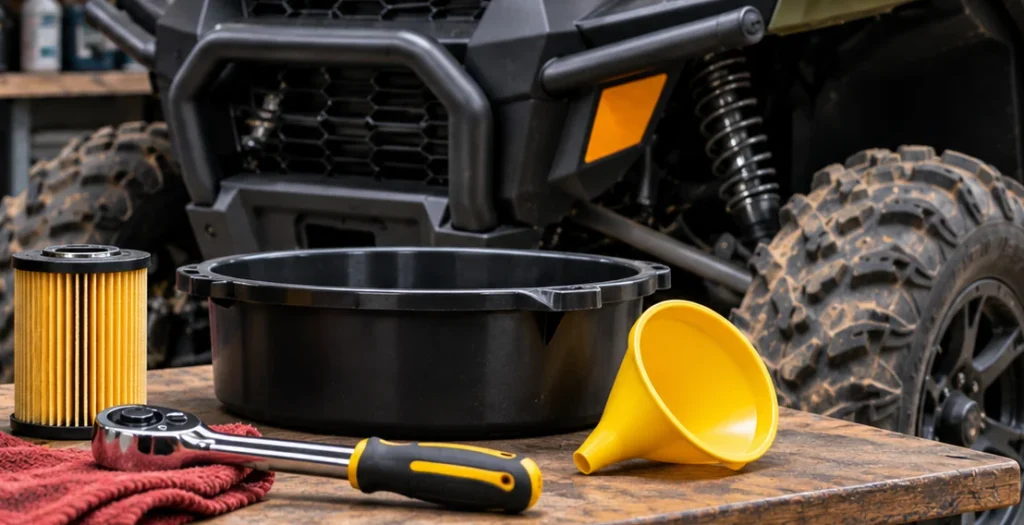
The HD11’s regular oil service is due at 200 hours, 1,900 miles or a year. For the 2025 standard series, replace the oil and filter at the A service (see the regular-duty oil row).
If you use a 2025 machine for severe duty or deep mud, follow its specific chart rather than treating the recreational interval as sufficient. Changing oil earlier is a reasonable preventive choice, but it is different from a factory-mandated first oil change at a particular mileage.
The engine-oil maintenance sections of both guides recommend synthetic 5W-40 for general use, 0W-40 for cold conditions and 10W-50 for hot conditions. For a substitute, they specify suitable four-stroke synthetic oil meeting API SN or JASO MA2. Match the oil to the conditions and manual for your vehicle.
The 2025 specification table also uses the term synthetic blend for general-purpose 5W-40; I would follow the oil requirements in the maintenance procedure when choosing a replacement. The 2025 oil recommendations and HD11 oil recommendations give the details.
How much oil does a Defender take?
| Engine and configuration | Listed oil capacity | Source |
|---|---|---|
| 2025 HD7 | 2.7 L / 2.85 US qt | 2025 specifications |
| 2025 HD9/HD10 without heater or HVAC | 2.0 L / 2.1 US qt | 2025 specifications |
| 2025 HD9/HD10 with heater or HVAC | 2.1 L / 2.22 US qt | 2025 specifications |
| 2026 HD11 without HVAC | 3.2 L / 3.4 US qt | HD11 oil and filter refill |
| 2026 HD11 with HVAC | 3.4 L / 3.6 US qt | HD11 oil and filter refill |
The 2025 figures come from the lubrication specifications referenced by its oil-change instructions; the HD11 figures are explicitly for an oil-and-filter change. Neither is a reason to pour in more oil if the dipstick shows a full engine. These aren’t separate dry-engine fill quantities.
Notice what happens when you add a heater or climate control: even the oil capacity can change. If you’re considering a cab-equipped model, my guide to side-by-sides with air conditioning covers the HD10 Limited and other cab options.
2025 Defender HD9 and HD10 oil change
For the V-twin, gather the correct cartridge filter, new filter-cover O-ring and drain-plug sealing ring, suitable oil, drain pan and torque wrench. Park level, secure the vehicle, and shut it down after warming the engine. Protect yourself from hot oil and keep dirt out of the openings.
In broad terms, the job involves draining the crankcase, replacing the filter and seals, cleaning the magnetic plug, refilling and checking for leaks.
The factory V-twin procedure on pages 149–152 supplies the exact order, filter orientation and tightening specifications. It calls for a 60-second idle after filling and an immediate level recheck after stopping.
For the ordinary V-twin dipstick check, the guide specifies a cold engine on level ground. Wipe and fully screw in the dipstick before reading it; don’t overfill.
The single-cylinder HD7 has a different filter procedure and its ordinary oil check is warm. If you have a 2024 Defender, use its 2024 model-specific operator’s guide; don’t assume the 2025 procedure or quantity carries over.
Why the HD11 oil change is different
The 2026 HD11 uses dry-sump lubrication instead of the earlier V-twin’s wet sump. It has two engine-oil drain plugs, and BRP specifies evacuating oil from the filter housing with a vacuum/pressure pump before removing the filter cover. Skipping that step can spill oil into a difficult-to-clean area behind the HVAC belt housing.
Use the HD11 oil-change and filter instructions, sections 4-29 through 4-33, for the full procedure, seals and separate plug torques. I’d have the job done by a shop if I didn’t have the right evacuation equipment or wasn’t comfortable identifying the plugs.
The HD11 dipstick has separate COLD and WARM ranges. The cold range is only a check that the engine has enough oil to start. For the operating level, the HD11 level-check procedure uses a fully warmed engine (cooling fan has run), at least 20 seconds of idle, then a 60-second wait after shutdown. Check the WARM marks with the dipstick fully seated, and add small amounts only as needed.
Transmission, front differential and rear final drive
Engine oil is not gearbox oil. For the covered models, the gearbox takes synthetic 75W-140 gear lubricant and the front differential uses synthetic 75W-90; the stated equivalent grade for each is API GL-5. The 2025 HD7 also has a separate rear final-drive oil service using 75W-90. Don’t assume an independent rear oil fill exists on the HD9 or HD10.
Check for seepage around plugs, housings and axle seals. Milky oil or evidence that water reached a vent means the vehicle needs inspection, not just a top-up.
Different gearcases have different level-setting procedures, so use the applicable 2025 gearbox procedure and 2025 differential specifications, or HD11 drivetrain procedures to confirm oil quantity, plug location and torque. An HD11 with a disconnect unit has its own additional service.
Coolant and radiator maintenance
Under normal use, both guides specify coolant replacement at five years or 12,000 km (7,500 miles). They recommend XPS extended-life premix or an appropriate 50/50 distilled-water and ethylene-glycol antifreeze mixture with corrosion protection for aluminum engines.
Check the coolant cold; never open a hot pressure cap. Keep the radiator free of grass, mud and dust using low-pressure water rather than a pressure washer. Repeated coolant loss, overheating or a damaged hose needs investigation before further operation.
See the 2025 cooling instructions and HD11 cooling instructions for access and bleeding procedures.
Air filter, CVT belt and other mechanical maintenance
Air intake and CVT
Dust control is one of the simplest ways to protect a Defender. Inspect the engine filter before riding and service it more often in sand, crop debris or dusty groups.
On the 2025 standard models, BRP cautions against compressed air on the paper element; clean the housing without letting dirt into the intake and replace a damaged or heavily contaminated filter.
Use the 2025 air-filter instructions or the HD11 maintenance procedures rather than applying one cleaning method to every filter.
The CVT (continuously variable transmission) transfers engine power through a belt and pulleys. The HD11 annual service includes inspecting and servicing those components, with specific bearing lubrication requirements.
Belt replacement depends on condition, not a universal mileage. A burning-rubber smell, poor engagement or slipping under load deserves attention; stop and investigate before putting the machine back to work.
Keep the CVT ventilation clean, never lubricate the belt contact surfaces, and use low range for heavy pulling and prolonged slow travel. Clutch disassembly is a job for someone with the correct tools and service information.
Brakes, spark plugs, steering and suspension
Look for uneven pad wear, leaks, torn CV boots, loose ball joints and play in the wheel bearings. Correct anything that affects steering or braking before riding.
For both generations the normal brake-fluid change is every two years and the specified fluid is DOT 4. The HD11 calls for new plugs at 400 hours or 6,000 km regardless of age; for the 2025 models, use the plug and engine-specific valve clearance rows in the regular maintenance chart.
The HD11 uses self-adjusting hydraulic valve lifters, so don’t transfer an HD10 valve adjustment schedule to it.
Lubricate only the points your manual identifies. On 2025 models without double-bonded bushings, BRP recommends servicing the stabilizer-bar and A-arm bushings at 1,000 km (620 miles).
For HD11, inspect bushings and bearings at regular service and lubricate greaseable points. On cab models, include the HVAC filter and door hardware; check the compressor belt where applicable. Leave brake bleeding, clutch work or safety-critical suspension repairs to a qualified technician if you cannot perform the procedure correctly.
Battery and storage
Inspect battery terminals and the battery hold-down during routine servicing. If the Defender will sit for a season, clean and dry it, follow the storage section of your model’s guide, and use a maintainer compatible with its battery type if needed.
Before returning to work, inspect the vehicle again and check whether calendar-based service has come due. An unused machine still ages.
Severe-use maintenance: farm work, dust and mud
Commercial use, rental operation, repeated loads above 75% of rated capacity and prolonged high-speed use qualify for severe-duty service in the two manuals. The HD11 guidance also identifies demanding activities such as towing, sand, water and rock crawling.
If you’re using a Defender as a daily workhorse, don’t judge its maintenance needs only by miles. My farm UTV guide explains why service access and downtime matter when choosing a utility machine.
After deep mud or water, clean the radiator, intake and CVT areas, shocks, drive boots and exhaust surroundings. Inspect vent hoses for water; if you find any, have the affected components inspected.
Dust exposure also calls for more frequent air-filter care even when you haven’t reached the next main service.
Both guides address frequently operating at or below -13°F (-25°C). Repeated cold starts and short runs that never bring the engine fully up to temperature can dilute oil.
For the cold operating cycles described in the manuals, BRP recommends an oil change at least monthly. See the 2025 severe-use definitions and HD11 severe-use definitions.
How to reset the Can-Am Defender maintenance-required message
A maintenance icon is a service reminder, not proof of a mechanical fault. Complete the applicable service first. If another warning or active code is present, investigate it separately.
| Applicable display | Reset with the maintenance icon visible |
|---|---|
| 2025 4.5-inch LCD | Hold the lower button on SETTINGS to enter the menu; use that button to select RES MAINT and hold it again. Manual, page 103. |
| 2025 7.6-inch display | Use the keypad MENU button to enter SETTINGS; select RES MAINT and hold MENU. Manual, page 108. |
| 2026 HD11 4.5-inch LCD | Enter SETTINGS with the lower button, then select and hold RES MAINT with that button. Manual, section 3-52. |
If your screen or controls differ, look up the exact display in your operator’s guide. The CODES menu on the covered displays shows active faults; resetting the service reminder does not repair those faults. A diagnostic scan and software checks are also part of the HD11 regular maintenance schedule.
Where to find the correct owner’s manual or service manual
Go to the official BRP operator’s guide portal, choose Side by Side, then the model year and exact Defender family. Check the covered-model list inside the guide against your vehicle identification number (VIN), trim and equipment. A model-year title alone isn’t sufficient.
The operator’s guide is the owner’s manual: it contains the schedule, operating instructions and selected maintenance jobs. A workshop or service manual provides deeper repair information, including disassembly and diagnostic procedures.
A parts catalog identifies replacement parts and assemblies but isn’t a repair procedure. Ask an authorized Can-Am dealer about factory workshop documentation and diagnostic access for your VIN; don’t buy a service manual just because it says Defender on the cover.
How much does Defender maintenance cost?
I’d budget for the oil and filter, seals, intake filters, gearbox and differential lubricants, coolant and brake fluid, plus wear parts and labor when needed. Get a quote that separates the actual scheduled work from optional extras.
Compare parts and labor for the same service scope, not a basic oil change against a full annual inspection. The HD11’s additional equipment and oil quantity are worth factoring in. If you’re still comparing vehicles, my Ranger 1000 versus Defender HD10 comparison covers other work-use differences; use the exact factory maintenance schedule for the service budget.
Keep a simple record with your model year, date, hours, odometer, service completed, oil specification and parts used. For a used Defender with an uncertain service history, establish a baseline with a qualified inspection rather than assuming the previous owner changed everything. The next time the reminder appears, you’ll know what was actually done and what is due next.

Calvin Anderson, founder of Off-Road Lord, is a seasoned off-roading enthusiast from Tucson, Arizona. With over a decade of hands-on experience and a deep understanding of off-roading vehicles and trails, Calvin’s insights provide a trusted guide for fellow adventurers.