
If you’re shopping for a side-by-side for kids, the first decision isn’t the brand. It’s whether you need a battery-powered ride-on toy for supervised play or a genuine youth UTV for off-road driving. They may look alike, but they have very different speeds, age restrictions, costs, and riding rules.
For younger children, I’d start with a toy whose exact manual supports their age, combined rider weight, and riding surface. For a child who is at least 10 and can properly fit the controls and restraints, a youth UTV such as the 2027 Polaris RANGER 150 EFI is a different, much more serious option.
Neither the vehicle’s appearance nor a parent-controlled speed setting makes an underage child eligible to drive it.
First, choose the right kind of kids’ side-by-side
| Your situation | Start with | The deciding check |
|---|---|---|
| Child age 3–8, supervised backyard play | Battery-powered ride-on toy | Exact toy’s age range, two-rider limit, terrain instructions, and ability to operate it |
| Child age 9 | No age-matched recommendation among the examples below | Verify another exact model approved for age 9 and the child’s fit; don’t move straight to a 10+ UTV |
| Child age 10 or older, learning actual off-road driving | Purpose-built youth UTV | Manufacturer’s minimum operating age, seated fit, training, safety gear, and available off-road space |
| Child under 3 or a toddler | Age-approved toddler toy, not either model class by default | Do not assume a 3+ electric ride-on or 10+ UTV is suitable |
| Child younger than 10 as passenger | Check the specific vehicle’s passenger rules | The 2027 Polaris youth UTV manuals prohibit passengers under 10 |
That distinction also separates a toy “buggy” from an off-highway machine. A real youth UTV has an engine or vehicle-grade drivetrain, restraints, a protective structure, and instructions for off-road operation; it isn’t just a more powerful toy. If you’re unsure how a UTV differs from an ATV, my UTV explanation covers the basic vehicle layout.
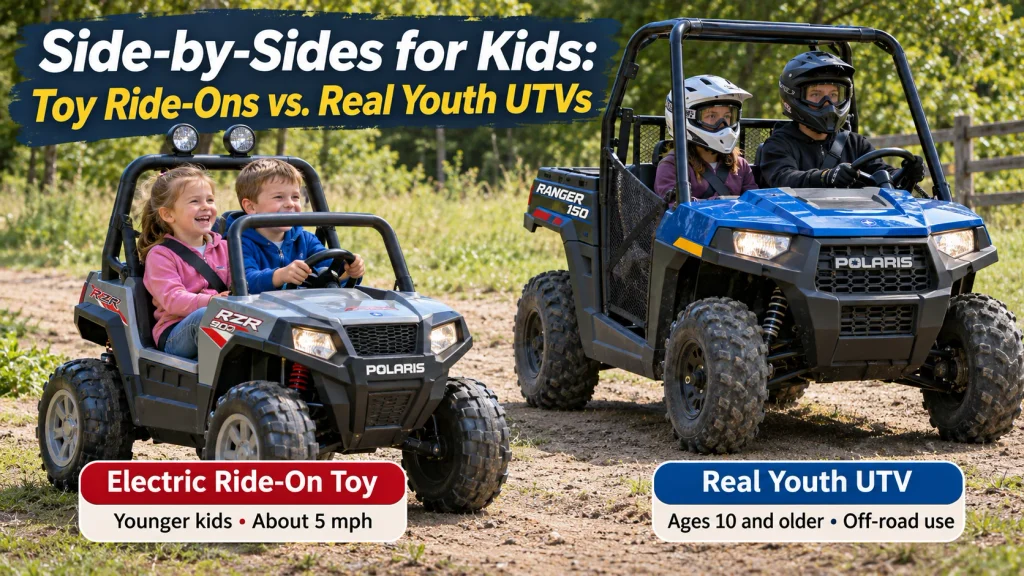
Battery-powered side-by-sides for kids: two toy configurations worth comparing
These are researched examples, not personally tested products. I chose exact Peg Perego configurations with accessible manufacturer instructions, rather than treating every vehicle advertised as a kids’ UTV as equivalent.
Prices below are US manufacturer page listings checked November 7, 2026, not confirmed checkout prices; both pages gave inconsistent stock messages.
| Exact toy and maker | Age and seats | Total rider limit | Drive and parent controls | US listing |
|---|---|---|---|---|
| Peg Perego Polaris RZR 900 Grey (manual) | Ages 3–8; two seats | 130 lb combined | 12V, two forward settings, around 5 mph maximum; physical high-speed lockout, no handheld parent remote | From $499.99; stock unconfirmed |
| Peg Perego John Deere Gator XUV (manual, Gator XUV 550 family) | Ages 3–8 on product page; two seats | 130 lb combined | 12V, two forward settings, around 5 mph maximum; physical high-speed lockout, no handheld parent remote | From $499.99; stock unconfirmed |
My choice between these toys: Choose the Polaris-styled RZR 900 if the child wants a sport-buggy appearance. Look at the John Deere Gator XUV if the small rear cargo bed is more useful for toys and yard play.
The Gator isn’t an upgrade to a genuine work UTV, and neither toy is a way to carry an adult. Their 130-pound limits apply to the combined load, not each seat; also check that both children fit comfortably. The physical speed lockout limits a gear—it does not let you steer the toy remotely.
The Polaris name on the RZR 900 is a licensed design; Peg Perego makes this toy. Likewise, the John Deere Gator toy is made by Peg Perego, not the full-size vehicle manufacturer.
Can-Am-branded ride-on toys also require a check of the actual toy maker and manual; I have not shortlisted an exact Can-Am toy here. And Power Wheels is a Fisher-Price/Mattel brand, not a generic name for every electric ride-on.
You can see that distinction in Mattel’s Power Wheels Dune Racer Extreme FLN93 listing. Brand labels don’t replace the specific model number or instruction book.
Replacement parts deserve attention, especially on a used ride-on. In an April 2023 owner discussion, a buyer of a used pink Peg Perego RZR said a battery showed voltage but would not run the toy properly until replaced.
That is one account about a different color/version, not evidence of a failure rate for the Grey model. I would price the correct manufacturer-supported battery and charger before buying used rather than improvising higher-voltage modifications.
Before ordering either one, verify the seller has the exact color/version in stock and offers the matching battery and replacement parts.
Peg Perego’s instructions specify adult assembly and an initial 18-hour battery charge. The manuals also give operating-surface limits: this is controlled play on suitable ground, not public-road or off-road-trail travel.
What if you want a remote-control side-by-side?
Check what “remote control” means. Some toy ride-ons come with a handheld transmitter that lets an adult control the ride-on vehicle. Others use the term for a small radio-controlled model that no child sits in. A speed-lockout switch is neither of those.
For example, Best Choice Products’ 12V UTV-style ride-on with trailer lists a parental remote, ages 3–6, one seat, a 66-pound limit, and about 3 mph.
It is not a two-seat side-by-side. I wouldn’t choose it solely from the sales listing: confirm the correct version’s full instructions, remote override behavior, and availability first. A remote never cancels an age or weight restriction.
Real youth UTVs: Polaris RANGER 150 versus RZR 200
For genuine off-road driving, this is a separate purchase decision. The 2027 Polaris models below use gasoline engines, seat two people, and require operators and passengers to be at least 10 years old, with adult supervision for young operators.
The passenger must also sit with their back against the seat, feet on the floor, and hands on the grab handle. An 8-year-old cannot ride in one just because an older person drives. See the RANGER 150 age and fit instructions and the RZR 200 instructions.
| 2027 US model | Intended use and seats | Power, controls, and load | Published US price |
|---|---|---|---|
| Polaris RANGER 150 EFI, Zenith Blue (2027 manual specifications) | Utility-style youth UTV; two seats; ages 10+ with adult supervision | 150cc gas EFI; adjustable speed limiter, PIN, geofencing, Helmet Aware; 375 lb maximum vehicle load, not per rider; 50 lb cargo bed limit | $6,999 MSRP + $400 destination, before other fees |
| Polaris RZR 200 EFI, Indy Red (2027 manual specifications) | Sport-style youth UTV; two seats; ages 10+ with adult supervision | 180cc gas EFI; PIN, adjustable speed limiter, geofencing, Helmet Aware; load figures conflict between Polaris sources | $7,499 MSRP + $400 destination, before other fees |
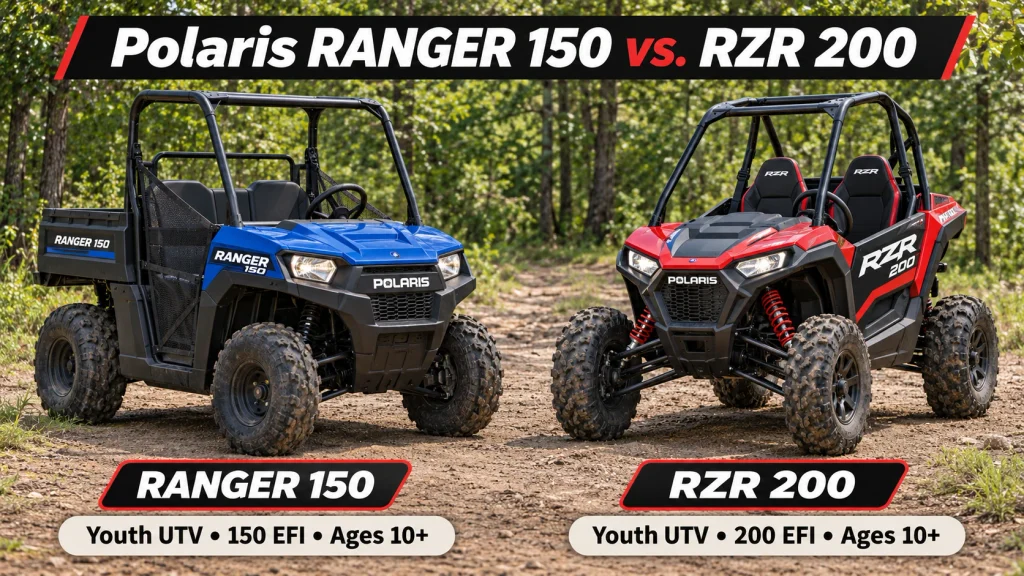
Which would I consider? For a young operator who actually fits, I’d start the dealer conversation with the RANGER 150: its cargo bed and adjustable driving position make sense for controlled recreational riding on appropriate private off-road ground.
The RZR 200 costs $500 more at MSRP and emphasizes sport-style suspension and ground-clearance specifications. Neither one is an adult-powered remote-control toy.
Polaris describes both as shipping speed-restricted to under 16 mph, with an adult-adjustable upper setting and a published unrestricted maximum of 29 mph. Those controls help manage a permitted rider’s progression, not expand the minimum age.
Don’t finalize a RZR 200 purchase on the website payload figure. Polaris’s 2027 Indy Red product specifications state 375 pounds, while its 2027 owner’s manual states 350 pounds, plus a 150-pound maximum per rider. The sources also disagree on ground clearance and dimensions.
Ask the dealer for the applicable VIN-specific rating and safety labels before relying on a load number. Until that is resolved, I wouldn’t give it a firm buying recommendation based on capacity or fit.
An Australian hands-on review of a 2022 RZR 200 reported that its speed limiter and geofence responded as configured during the publication’s test. That does not verify the 2027 US version or justify ignoring its age limit.
In a separate September 2025 owner discussion, one RZR 200 owner said hill-climbing power felt limited, while others praised their vehicles. Neither report establishes a general defect or a measured 2027 performance figure.
For both models, ask the dealer to demonstrate the child’s seated reach to steering, pedals, belt, and passenger handholds; confirm the actual selling price and local inventory; and show how the PIN, speed setting, geofence, and helmet detection are configured. A geofence is a vehicle setting, not a substitute for supervising the riding area.
What if the child is only a passenger?
Don’t borrow the RANGER or RZR youth age limit for an adult-size UTV. Check that adult vehicle’s manual for passenger ages and restraints, along with local rules. University of Iowa Stead Family Children’s Hospital advises against UTV passengers under 12 and says a passenger must fit with their back against the seat, feet flat on the floor, and belt correctly secured; it does not regard car seats or boosters as a workaround.
That clinical recommendation is more conservative than the 10+ minimum published for the two Polaris youth machines. There is no universal passenger age you can transfer from one machine to another.
Can a 10-year-old use an electric side-by-side?
Not on age alone. The specific 12V toy examples above are marketed for ages 3–8, so I would not recommend them as an electric UTV for a 10-year-old simply because the child can squeeze into the seat.
The 2027 RANGER 150 and RZR 200 are genuine youth UTVs that allow qualifying 10-year-old operators, but they’re gasoline-powered.
If you need a battery-powered vehicle for a 10-year-old, find an exact model whose manufacturer expressly supports that age and the child’s size, weight, controls, and intended terrain.
I did not establish a specific electric youth side-by-side meeting those requirements for this comparison. More volts, a larger body, or a remote doesn’t supply missing age approval.
Do kids need helmets for a side-by-side?
For a genuine Polaris youth UTV, yes. The 2027 RANGER 150 manual and 2027 RZR 200 manual require an appropriately fitted approved helmet for each occupant; Polaris identifies the US Department of Transportation label for approved US helmets.
Eye protection, protective clothing, boots, seat belts, and secured nets or doors also matter. That applies to a child driving or riding.
For an electric toy, follow that toy’s instructions and the setting where it is used. Don’t automatically apply a gas UTV’s DOT-helmet rule to a 12V ride-on, or assume a toy is safe without supervision.
The Peg Perego manuals require adult supervision and appropriate shoes and restrict where the toy can be used; I would consider a properly fitted helmet for a child who might fall or strike an obstacle, while checking the actual instructions.
There isn’t one US helmet law covering every toy, UTV, state, and riding location. As one concrete example, Utah’s OHV education FAQ distinguishes side-by-sides from ATV-type vehicles in its helmet rules.
Check your state’s requirements and any applicable trail or land-manager rules. A local legal exception doesn’t override a vehicle maker’s operating instructions.
What I’d check before buying
- The exact ID and manual: Check the model name, year or color variant, manufacturer, and instruction-sheet revision. “Polaris” on a toy may be a license rather than the toy maker.
- Who will actually ride: Confirm the manufacturer’s operator and passenger ages, whether both children fit, and whether the listed weight is shared. For a true UTV, reach to the floor and controls matters as much as birthday.
- Where it will run: Match a toy to its approved play surface; use a genuine UTV only on permitted off-highway terrain with the required training, protective equipment, and supervision.
- Controls and maintenance: Test or demonstrate the gear lockout, brakes, remote behavior if provided, battery care, and replacement-parts support. A used toy may need a battery; a real UTV needs more extensive maintenance.
- Used-vehicle recall status: If shopping for a used RZR 200, check the CPSC’s December 2023 recall covering certain 2021–2024 RZR 200 VINs for a steering-lock hazard and verify that the required repair was completed. Run the actual VIN through Polaris’s recall lookup. That notice does not identify all model years or every RZR 200 as recalled.
If the child is looking for a four-wheeler instead, that’s an ATV decision, not a side-by-side shopping shortcut. Start with my ATV sizes by age and ATV safety guide, then confirm the actual ATV’s manufacturer age and fit rules rather than buying by engine size alone.
My final filter is simple: buy for the child’s permitted age, physical fit, passenger situation, and riding surface—not the vehicle’s styling. If no documented product meets all four, keep looking rather than treating a speed limiter or a familiar brand as permission to compromise.

Calvin Anderson, founder of Off-Road Lord, is a seasoned off-roading enthusiast from Tucson, Arizona. With over a decade of hands-on experience and a deep understanding of off-roading vehicles and trails, Calvin’s insights provide a trusted guide for fellow adventurers.