
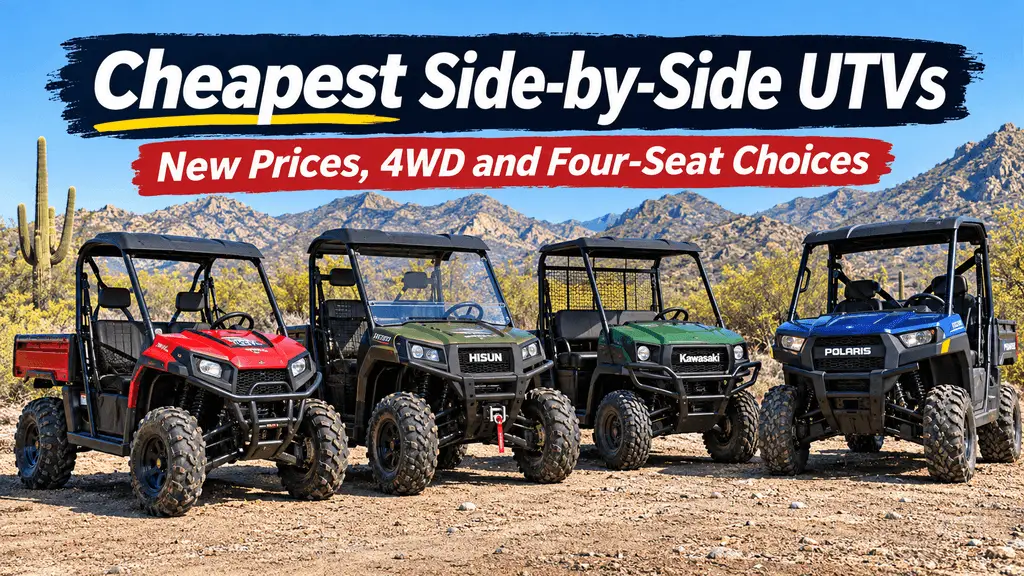
The least expensive adult-oriented utility side-by-side I found in this comparison is the TrailMaster Challenger 200U at a published $4,699 MSRP.
It seats two and drives the rear wheels, so it isn’t a substitute for a four-wheel-drive farm UTV. If 4WD is nonnegotiable, I’d price the HISUN Sector 400 first: its published starting MSRP is $5,999. Those are the lowest prices among the models I compared, not a claim that no cheaper new side-by-side exists anywhere in the United States.
I’m comparing new, adult-capable side-by-sides offered to US buyers, using manufacturer-listed base MSRPs checked November 6, 2026.
Some current manufacturer pages don’t specify a model year; I’ve marked those instead of assigning one.
MSRP isn’t a dealer sale price or an out-the-door quote. Destination, freight, assembly, dealer setup, taxes, and registration can change the order once you get written offers.
Cheapest side-by-side UTVs: new two-seat price comparison
These are comparable manufacturer MSRPs, not offers for vehicles confirmed in stock. The TrailMaster, SSR, and HISUN pages do not identify a model year.
Some dealerships catalog the Sector 400 as a 2026 model. Manufacturer-published destination charges are shown where available; an unpublished amount is unknown, not zero. The linked model pages support the prices and specifications.
| Model and exact version | Seats / drive | Published US base MSRP | One important limitation or charge |
|---|---|---|---|
| TrailMaster Challenger 200U | 2 / rear-wheel drive | $4,699 | 168.9cc engine; 165-lb dump-bed limit. Destination and setup extra. |
| HISUN Sector 400 | 2 / selectable 2WD–4WD | $5,999 | 52 inches wide; cargo bed does not dump. Destination/setup extra. |
| SSR Bison 200U | 2 / rear-wheel drive | $6,259 | 450-lb tow limit; destination and freight surcharges are not included. |
| HISUN Sector 450 | 2 / selectable 2WD–4WD | $6,899 | 61 inches wide; destination, setup and possible CARB-model fee extra. |
| 2027 Kawasaki MULE SX, base | 2 / 2WD | $7,799 | Not 4WD; Kawasaki publishes another $940 destination charge. |
| 2027 Kawasaki MULE SX 4×4 ST | 2 / selectable 2WD–4WD | $8,599 | Work-focused 401cc machine; add Kawasaki’s $940 destination charge. |
| 2026 Polaris RANGER 500, base | 2 / on-demand AWD | $9,999 | $1,095 published destination charge; dealer setup still extra. |
| 2026 Honda Pioneer 520, base | 2 / selectable 2WD–4WD | $10,999 | 50-inch width may matter on restricted trails; add $885 destination. |
What I’d actually buy at these prices
If my only goal were the smallest purchase bill for a two-seat utility machine, I’d call about the Challenger 200U first. BMI Karts lists a 200U at $4,699 and marks it in stock. Before traveling,
I’d ask for its exact model identification, confirmation that a unit is physically available, whether it arrives assembled, the delivered out-the-door total, and who will handle warranty and parts work near me.
The manufacturer’s 500-lb maximum load and 165-lb bed capacity make it a light-duty choice.
The most useful upgrade costs $1,300 in base MSRP: the $4,699 rear-drive TrailMaster Challenger 200U versus the $5,999 selectable-4WD HISUN Sector 400.
The Sector 400 gets you a 393cc EFI engine, front locking differential, shaft drive, 1,200-lb published tow rating and 350-lb cargo capacity.
I’d pay the difference for hills, wet ground or regular towing within its rating. I’d keep the $1,300 for gentle, light-duty property trips if the TrailMaster fits my occupants and I have a realistic repair option.
For another $900 in MSRP, the $6,899 Sector 450 brings a 454cc engine and a gas-assisted dumping bed. It is also 61 inches wide rather than the Sector 400’s 52.
I’d buy the 450 for frequent cargo unloading and use on appropriately wide routes, not simply because it has a higher model number. I’d choose the narrower, cheaper 400 if the fixed cargo bed is sufficient.
The SSR Bison 200U is an instructive exception: its $6,259 rear-drive MSRP is $260 more than the 4WD Sector 400.
The SSR has an assisted dump bed, so I could justify it for nearby parts support and repeated light unloading, but I wouldn’t pay more to give up 4WD when traction and towing are the real priorities. Differences in dealer fees, stock and local service could still reverse an MSRP-only judgment.
If I needed four real seats, a 50-inch trail-width machine, or recreational suspension and speed rather than basic work transport, I’d change the shortlist entirely. Those are different requirements, not reasons to dress up a cheap 2WD UTV as a sport machine.
Where each cheap UTV makes sense
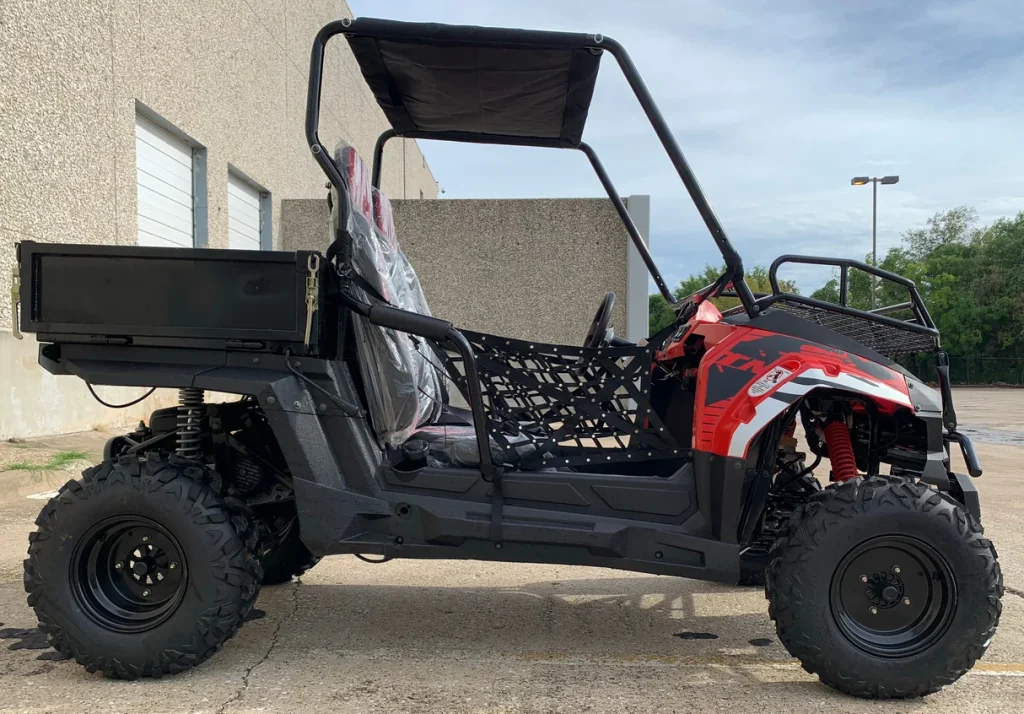
TrailMaster Challenger 200U: buy it for light chores, not difficult trails
The 200U is the small-UTV choice I’d examine for carrying tools around a modest property. Its 53-inch width and chain-driven rear wheels keep it compact, while the small dump bed offers more utility than a simple two-seat buggy.
The tradeoff is a limited work rating and no driven front wheels. For ruts, wet grades or regular towing, I’d price the 4WD Sector 400 before paying for extra accessories on a 200U.
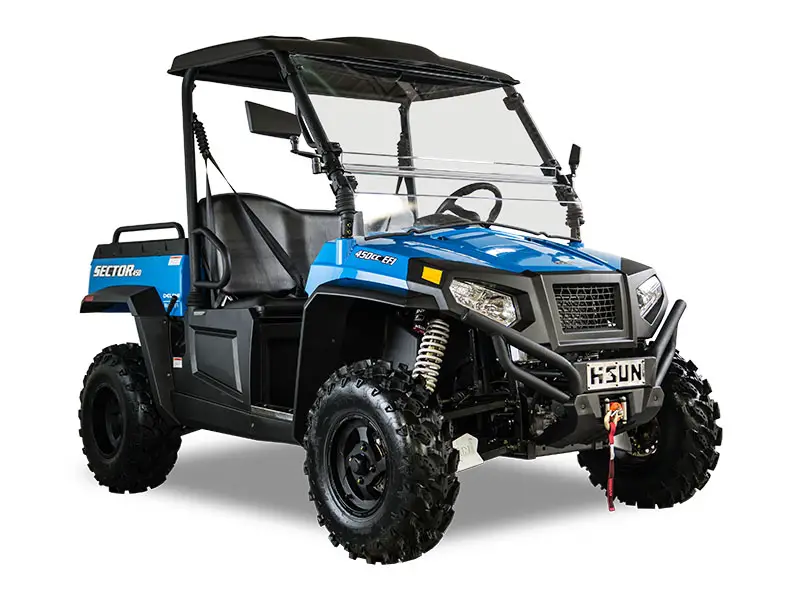
HISUN Sector 400 versus Sector 450: two different 4WD bargains
The Sector 400 is the lower-cost 4WD pick on manufacturer MSRP. It has a 393cc EFI engine, front locking differential, 1,200-lb tow rating and a fixed, non-dumping bed rated for 350 lb.
The Sector 450 costs $900 more and brings a 454cc engine and gas-assisted dump bed, but it’s 9 inches wider. I’d take the 400 if I didn’t need to tip out cargo.
If I did need a dump bed, I’d price the 450 against the rear-drive SSR Bison 200U; SSR’s 450-lb towing limit makes it a different utility proposition. Service and stock at a dealer close to you matter as much as the extra equipment.
Both HISUNs exceed 50 inches in overall width, so my small-UTV comparison is a better starting point for width-restricted trails.
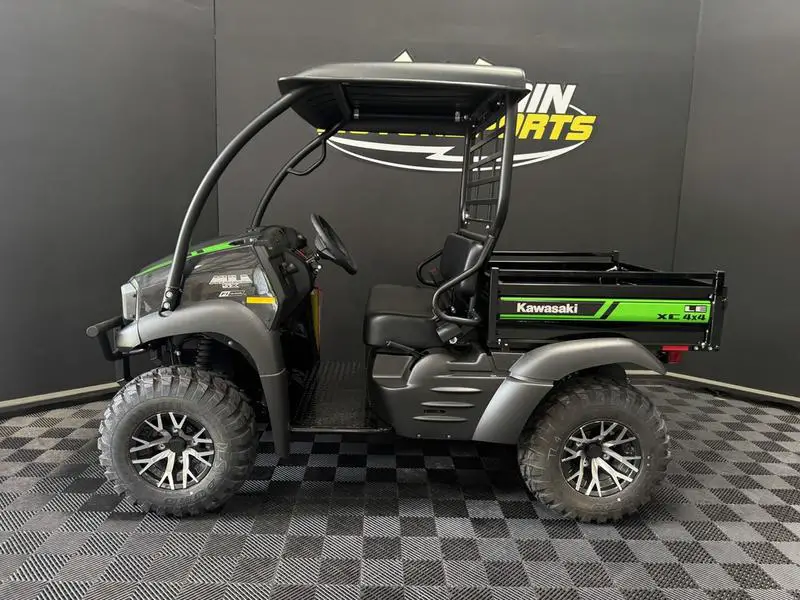
Kawasaki MULE SX: a simple utility alternative with an exact freight figure
The base 2027 MULE SX is a two-wheel-drive utility machine. Kawasaki lists $7,799 MSRP plus $940 destination, or $8,739 before other fees and tax.
I’d compare its dealer quote with the HISUN Sector 400 rather than assuming the Kawasaki is better merely because its sticker costs more. If I wanted a 4WD MULE, I’d ask for the exact 2027 MULE SX 4×4 ST, not a base SX dressed with accessories; its $8,599 MSRP and $940 destination add to $9,539 before other charges.
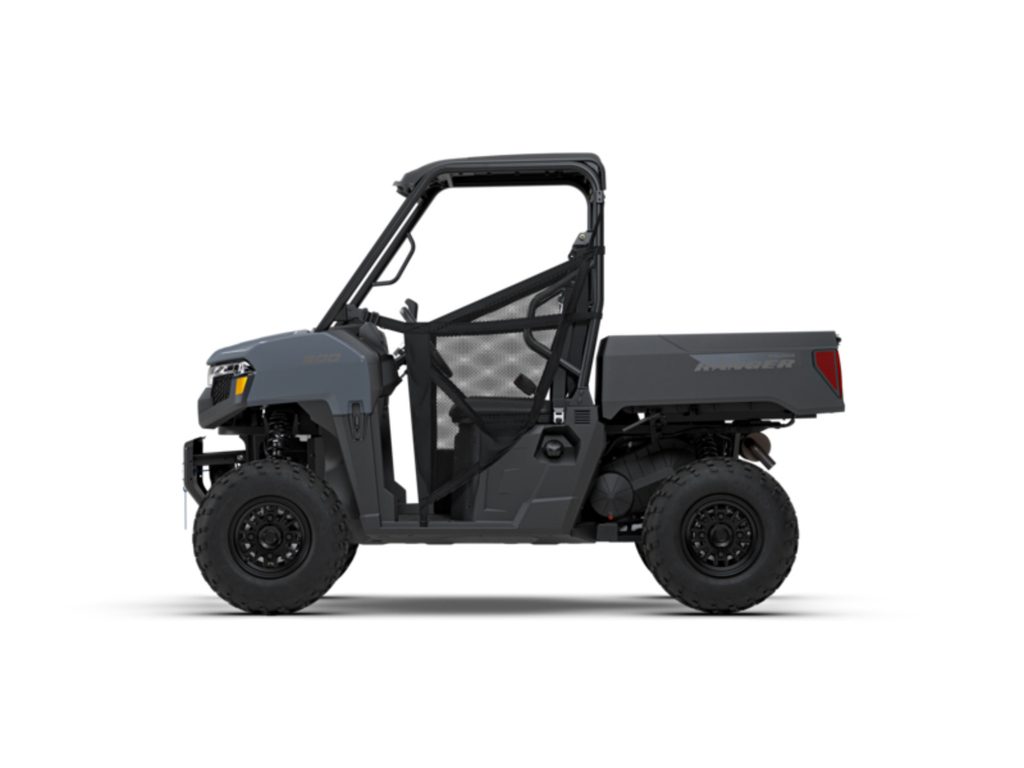
Polaris RANGER 500 and Honda Pioneer 520: spend more for the right constraint
The 2026 RANGER 500 lists on-demand AWD, a 500-lb dump box, 1,500-lb towing and a factory winch.
At $9,999 MSRP plus $1,095 destination, I’d consider it if those work features and a nearby servicing dealer matter more than the lowest sticker.
The 2026 Pioneer 520 costs $10,999 MSRP plus $885 destination, but its 50-inch width, selectable 4WD and five-speed geared automatic are the reasons I’d spend the extra money—particularly for routes with verified 50-inch limits. Neither one is a bargain solely because its name is familiar. For heavier regular farm work, see my farm-UTV buying guide.
What about the $3,000 side-by-sides and cheaper dealer sales?
You’ll see the basic TrailMaster Challenger 200 advertised at $3,299.95. That’s a different vehicle from the Challenger 200U. TrailMaster describes the basic 200 as youth-sized, and the Arlington listing marks that low-price unit out of stock.
BDX lists the basic Challenger 200 as in stock, but the prices I encountered for the same listing differed: an older product-page capture showed $3,499.99, while the more recent dealer catalog shows $3,599.99.
I would confirm the actual cash price before ordering. It’s a legitimate low-priced two-seat buggy to investigate for the appropriate driver and light use, but I wouldn’t rank a youth-oriented model as an equivalent adult work UTV.
The $4,459 MSRP SSR SRU170RS is another compact rear-drive design; its 330-lb total weight capacity is a practical reason to check passenger weight before calling it an adult utility alternative.
Massimo belongs on a budget shopper’s radar, too. Its BUCK 250 page lists a $5,699 direct-store sale price, but the selected red version is marked sold out.
I wouldn’t compare a sold-out sale against an available offer or assume a different color or dealer honors the same price. These examples also show why an advertised dealer sale, a manufacturer’s base MSRP and a financed-payment promotion are three different things.
What’s the cheapest four-seater side-by-side?
The lowest manufacturer four-seat MSRP I found was the TrailMaster Challenger4 200 at $4,899, with four designated seats and rear-wheel drive.
Its 168.9cc engine does not make it the equivalent of a four-seat 4WD crew UTV. The TrailMaster Powersports storefront shows a $4,899 sale but marks it sold out; BDX advertises a $4,899.99 dealer price and marks its own listing in stock, subject to confirmation.
Another dealer lists the Challenger4 200 at $4,999 and asks buyers to call for assembly, preparation and freight charges. None of those prices establishes a national four-seat minimum or a ready-to-drive total; the model year is unspecified.
I’d inspect the four seating positions in person and confirm the rated total load before planning rides with four adults.
The dealer’s published 800-lb maximum load means four 200-lb occupants would use the full allowance before gear. For a much more substantial four-seat utility machine, the 2026 Honda Pioneer 700-4 base has four designated positions and selectable 4WD; Honda lists $14,399 MSRP plus $1,185 destination.
That isn’t a comparable price type to the TrailMaster dealer sale, so I’d compare actual written totals rather than subtracting those stickers. Honda’s inventory page identifies in-stock examples at specific dealers; local availability still needs confirmation.
Is an affordable side-by-side good for recreational riding?
For gentle private-property routes or slow sightseeing, a light rear-drive UTV may be enough. For rough recreational trails, I care about the published width restriction, suspension, ground clearance, power with passengers aboard and the ability to get home if the route turns muddy.
The Challenger 200U’s rear drive and modest capacity would make me cautious. The HISUN Sector 400 is a more plausible inexpensive 4WD starting point, but its 52-inch width still excludes trails with enforced 50-inch limits; the Sector 450 is wider at 61 inches.
If sporty trail riding is the priority, choose a purpose-built recreational model rather than equating the lowest utility MSRP with the best trail machine.
Owner discussions can help me write better questions, not make reliability claims. In a TrailMaster Challenger discussion, a prospective buyer was weighing a Challenger 300EX against four-seat needs and a sub-$10,000 budget. Replies disagreed sharply on value and performance, and they concerned different Challenger variants.
I wouldn’t apply those experiences to the 200U as a failure rate. I would ask the seller whether the exact machine can carry my intended passengers on my intended terrain, which local shop will service it, and what a warranty claim requires.
How I’d find cheap UTVs for sale without getting fooled by the price
- Set the hard constraints first: two or four actual seats, maximum trail width, 2WD versus 4WD, passenger and cargo weight, and whether you’re shopping new or used. A straddle-seat ATV isn’t the same purchase as a side-by-side with a steering wheel and adjacent seats; see UTV versus ATV differences if you’re comparing both.
- Request the exact unit in writing: year, model, trim, color, stock number or VIN if assigned, cash purchase price, and whether the seller physically has it. A model page or an “add to cart” button alone doesn’t prove a unit is ready for delivery.
- Compare out-the-door quotes: itemize destination, freight, dealer setup, assembly, documents, tax, title and registration. Ask whether the advertised price requires financing, a trade-in, rebate eligibility or a deposit. If a fee is unspecified, don’t enter zero in your budget.
- Check the after-sale path: ask the nearby repair shop whether it takes that exact brand and model, what warranty work involves, and how it obtains routine parts. For a used UTV, separately check condition, hours/miles, service records, title or ownership paperwork, and any recalls tied to the VIN.
I’d get two or three written quotes for the same configuration, then decide on the total cash cost and suitability for the work. The lowest advertised price is useful for starting the calls. The lowest workable, serviceable out-the-door offer is the one worth buying.

Calvin Anderson, founder of Off-Road Lord, is a seasoned off-roading enthusiast from Tucson, Arizona. With over a decade of hands-on experience and a deep understanding of off-roading vehicles and trails, Calvin’s insights provide a trusted guide for fellow adventurers.