
If you’re shopping for a 4 wheeler for adults, start with three checks: does the ATV fit your body and the places you ride, can it legally and safely carry your full load, and what will you actually pay? Engine size in cc doesn’t answer those questions on its own.
For a useful price reference, three single-rider, gas-powered 2026 utility ATVs with four-wheel drive have published U.S. base MSRPs of $6,899 to $7,349. A full-size electric option, the 2026 Can-Am Outlander Electric, starts at $12,999 MSRP. Those aren’t out-the-door prices. I’ve compared exact models below so you can narrow the choice before visiting a dealer.
Adult four-wheelers compared: 2026 gas models
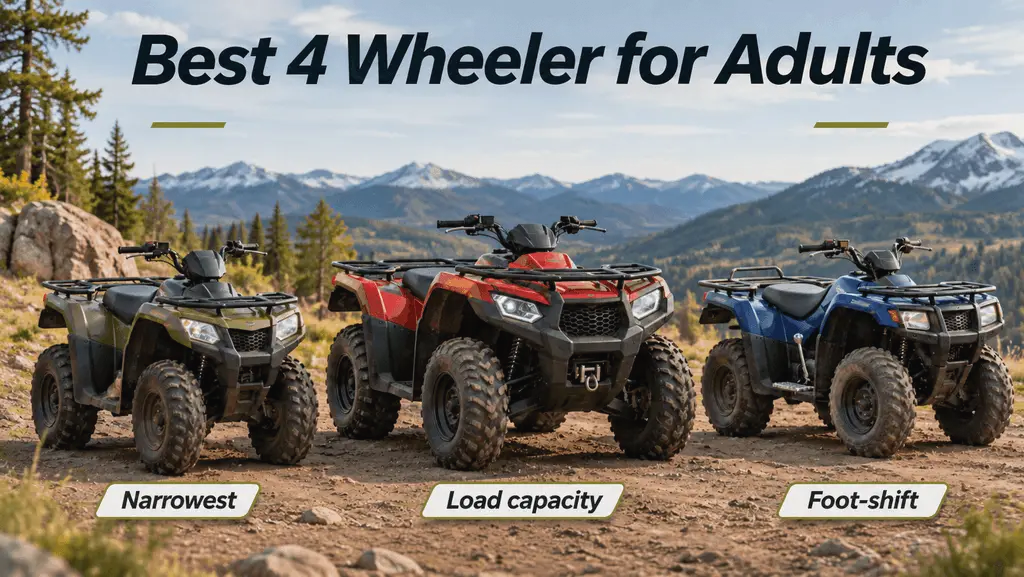
These are three representative, single-rider utility ATVs, not a ranking of every four-wheeler for sale. I picked them to compare a narrow automatic, an automatic with a documented overall load limit, and a foot-shift alternative. All three base trims offer four-wheel traction, but none of these rows includes an optional power-steering upgrade.
| 2026 model and source | U.S. base MSRP | Overall width / seat height | Transmission and reason to compare |
|---|---|---|---|
| Kawasaki Brute Force 450 4×4 (443cc) | $6,899 | 43.3 in. / 34.6 in. | Automatic CVT; the narrowest of these three |
| Polaris Sportsman 450 H.O. (499cc) | $6,999 | 48 in. / 33.25 in. | Automatic PVT, on-demand AWD; published 485-lb total load capacity |
| Honda FourTrax Rancher 4×4 (TRX420FM1, 420cc) | $7,349 | 47.4 in. / 33.6 in. | Five-speed foot-shift; consider it if you prefer selecting gears yourself |
Prices checked November 5, 2026. These are manufacturers’ published U.S. MSRPs for the named 2026 base trims, before destination, dealer preparation, taxes, title, registration, and any additional charges. Dealer inventory and selling prices may differ. Overall width is the factory specification, not a guarantee that wider tires or accessories will fit a particular gate or trail.
2026 Kawasaki Brute Force 450 4×4: best for tight access
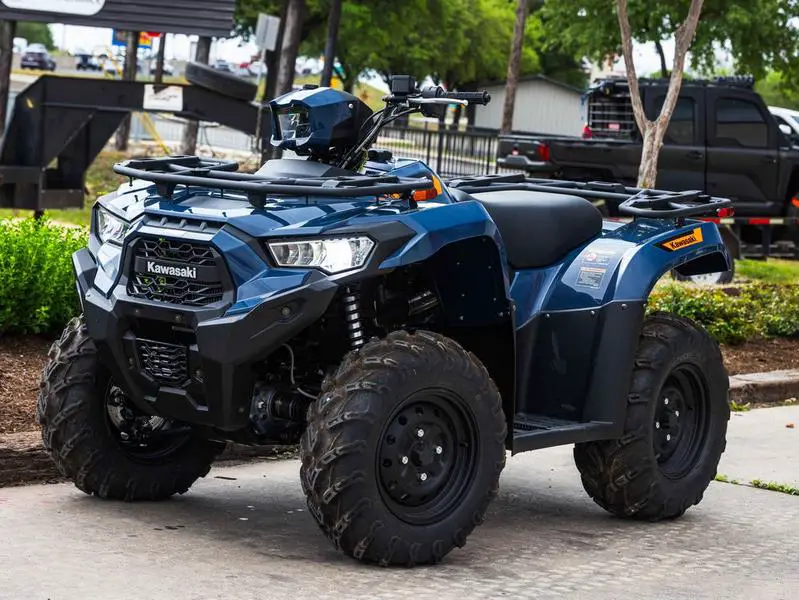
The Kawasaki is the width-first choice in this group. Its 43.3-inch overall width is 4.1 inches narrower than the Honda and 4.7 inches narrower than the Polaris. If your trails, gates, or storage space are the binding constraint, that difference gives the Brute Force a reason to be on your shortlist. Measure the opening and the actual ATV, though; aftermarket tires or fitted accessories can change the widest point.
The 2026 Kawasaki specifications list a 443cc engine, automatic CVT with high and low ranges, on-demand 2WD/4WD, and a dual-mode front differential. The independent front and rear suspension has 7.6 and 7.9 inches of travel, respectively; published ground clearance is 9.3 inches. That is a useful configuration to compare for mixed trails and property use, not proof that it handles bumps better than the others.
What might rule it out? The seat is 34.6 inches high, the tallest in this three-ATV comparison, so don’t assume the narrower body makes it easier for you to reach the ground or reposition yourself. The $6,899 base trim uses conventional steering; Kawasaki lists an EPS version separately at $7,999 MSRP. Its 75-lb front-rack and 150-lb rear-rack ratings are cargo-location limits, not a 225-lb rider allowance. Before buying, check the exact owner’s manual for the combined load limit, then try the seat and controls.
2026 Polaris Sportsman 450 H.O.: best for load planning and ground clearance
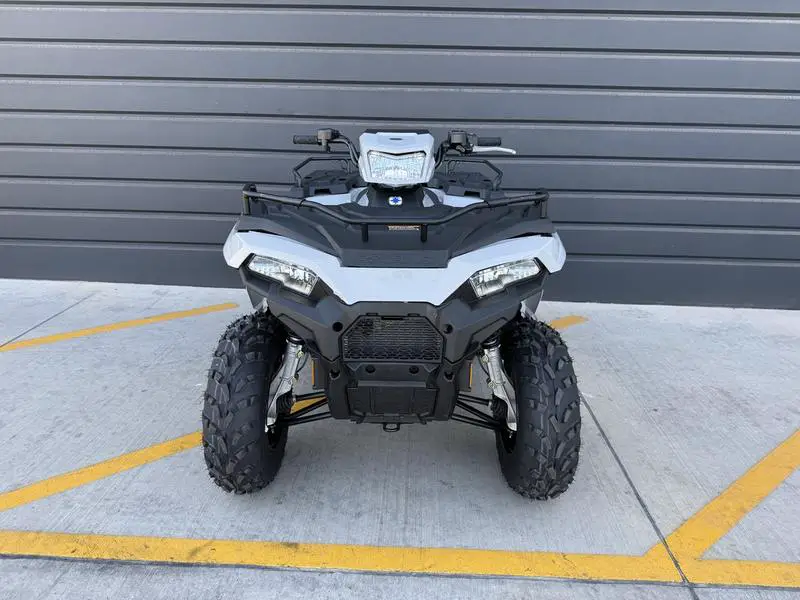
The Polaris costs $6,999 MSRP, only $100 above the base Kawasaki. Its 499cc engine uses an automatic PVT transmission and on-demand AWD. At 11.5 inches of published ground clearance, it has 2.2 inches more than the Kawasaki and 4.4 inches more than the Honda in the stock specifications. For a buyer concerned about ruts and obstacles, that makes the Sportsman worth a closer look, although actual clearance and traction depend on terrain, tires, load, and how you ride.
What distinguishes this model for my comparison is the published 485-lb maximum payload and the matching 2026 owner’s-manual load definition. It lets a 250-lb rider calculate a real allowance for protective gear, accessories, cargo, and hitch tongue weight rather than picking an engine size by guesswork. Polaris also lists 90-lb front and 180-lb rear rack limits; you must satisfy these separately from the combined limit. The worked example later in this guide shows the arithmetic.
What might rule it out? At 48 inches wide, it’s the widest of the three and needs the most room through a narrow gate. The base 450 H.O. does not include electronic power steering or a winch; Polaris lists the 450 H.O. EPS at $8,299 MSRP. Don’t compare that upgraded trim’s steering convenience with the base model’s $6,999 price. If load documentation and automatic operation are your priorities, this is the first one I’d investigate.
2026 Honda FourTrax Rancher 4×4: best for foot-shift control
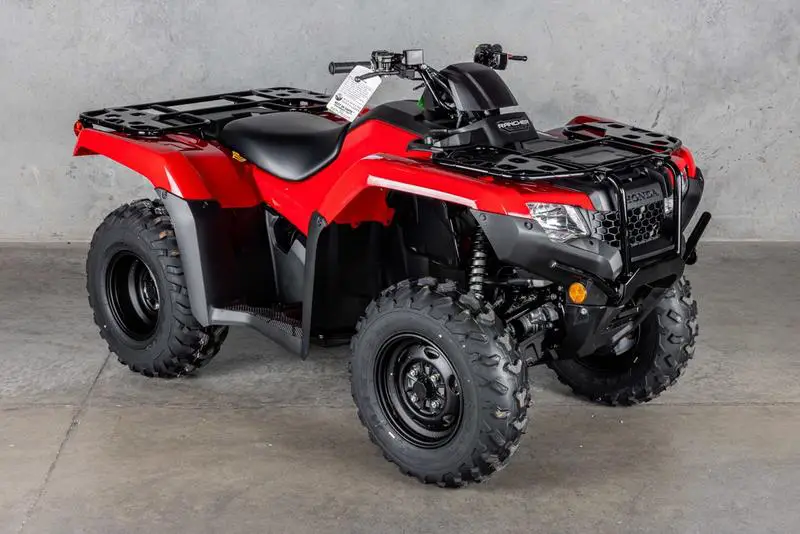
The Honda is the different transmission choice. Its 420cc engine is paired with a five-speed foot-shift transmission with reverse, rather than the Kawasaki’s CVT or Polaris’s automatic PVT. If you prefer deciding when to change gears yourself, that is a meaningful distinction. The 2026 TRX420FM1 specifications also list shaft drive front and rear and a torque-sensitive locking front differential.
Its 47.4-inch width and 33.6-inch seat height sit closer to the Polaris figures than to the narrower, taller-seated Kawasaki. The tradeoff is under the machine: Honda lists 7.1 inches of ground clearance, less than either rival here, and a rear swingarm with a single shock rather than independent rear suspension. That does not make the Rancher unsuitable for trails, but if deep ruts and obstacles define your riding, compare the underside clearance carefully before deciding.
What might rule it out? If you want a fully automatic transmission, this exact $7,349 base trim isn’t the one to buy. Honda sells separate DCT-equipped trims at different prices, so have the dealer put the actual model ID on your quote. Honda lists front and rear rack capacities of 66 lb and 133 lb, but those figures do not establish the permitted combined rider-and-cargo load. Confirm that figure in the specific owner’s manual. I’d choose the Rancher over the automatics only if its shifting method, riding fit, and route clearance suit you.
My short decision rule: Start with the Kawasaki if width is your constraint, Polaris if load accounting and factory ground clearance matter most, or Honda if you want foot shifting. Then rule each candidate in or out using the exact owner’s manual, a sit-on fit check, and an itemized dealer quote—not a brand reputation claim or engine cc alone.
How much does a four-wheeler for adults cost?
The gas examples above start at roughly $6,900 to $7,350 MSRP. That tells you the advertised starting price for these models, not the total cost to take one home. For example, Honda lists the 2026 Rancher 4×4 at $7,349 MSRP plus a $620 destination charge: that’s $7,969 before any applicable tax, title, registration, dealer setup, or other fees.
Ask for a written, itemized out-the-door quote on the exact model year, trim, and color. Compare the total rather than a monthly payment or a promotional sticker. If you’re buying used, look at the specific machine’s age, condition, service history, and market price; a new-model MSRP can’t establish what a used ATV is worth.
What size four-wheeler should an adult buy?
When a listing says “size,” it might mean three different things. I wouldn’t use one number as a shortcut for the others.
- Physical fit: Sit on the ATV in your riding boots. Check that you can reach the handlebars and brakes, operate the throttle comfortably, and move your body on the footrests without being cramped. A 33-inch seat and a 35-inch seat can feel different depending on the saddle and handlebar position.
- Vehicle dimensions: Measure the narrowest gate, trailer opening, storage space, and any signed trail-width limit. The 48-inch-wide Polaris would have just 2 inches of total nominal clearance through a 50-inch opening, before accessories and measurement tolerance. That’s not 2 inches on each side.
- Permitted load: The manual’s total weight capacity is a separate limit from the ATV’s own dry or curb weight. Rider, gear, accessories, and cargo may all count. Don’t use rack capacity or towing capacity as the rider-weight rating.
Displacement—125cc, 450cc, 700cc—is an engine measurement, not a fit chart or a rider-weight rating. For more dimensional examples, see my ATV sizes chart. Use that for footprint comparisons, then use the exact candidate’s manual for what it can carry.
Choosing an ATV if you weigh 250 lb
A 250-lb rider shouldn’t choose an engine size from body weight alone. First check the manufacturer’s permitted rider category, your physical fit, and the exact model’s load definition. Then count everything that applies.
Here’s a worked example using the 2026 Polaris Sportsman 450 H.O.. Its factory specifications list a 485-lb payload capacity, and the 2026 Sportsman owner’s manual explains that the maximum vehicle load includes the operator, accessories, rack cargo, and weight pressing down on the trailer hitch.
| Hypothetical load | Weight |
|---|---|
| Rider wearing all riding gear | 250 lb |
| Packed cargo | 25 lb |
| Installed accessories | 15 lb |
| Trailer tongue weight on hitch | 20 lb |
| Total added load | 310 lb |
| Capacity remaining: 485 − 310 | 175 lb |
This is an arithmetic example, not permission to load the ATV to the last pound. You must also meet the separate front-rack, rear-rack, hitch, and towing restrictions in the manual; the manual specifically says that tongue weight reduces the rear-rack allowance. If your 250-lb body weight doesn’t include helmet, boots, and protective clothing, add those weights too. And when terrain gets steep or rough, follow the manufacturer’s guidance to reduce carried cargo.
For another brand or trim, repeat the check with its owner’s manual. A listing that only shows “1,000-lb towing” or “200-lb rack” hasn’t answered whether it suits a 250-lb rider.
Is a 125cc ATV too small for an adult?
It can be, but the cc label alone doesn’t prove it. One useful warning is the Coleman AT125Y: despite “125” in the name, Coleman specifies a 120cc engine, describes the machine for riders age 10 and up, and lists a 175-lb maximum load. It is not a suitable choice for the 250-lb rider in the example above.
That doesn’t establish a universal load limit for every 125cc ATV. Check the exact vehicle’s manufacturer age classification, maximum load, seat and control fit, and manual. A retailer’s “adult” label is not a substitute for those facts.
What about an electric 4 wheeler for adults?
There are genuine adult electric ATVs in the U.S. market, but you need to keep them separate from children’s battery ride-ons, stand-on off-road mobility platforms, and electric side-by-side UTVs. They can all appear under similar search terms, yet they don’t serve the same rider or riding position.
2026 Can-Am Outlander Electric: The standard one-seat model has a published starting U.S. MSRP of $12,999 before transportation and preparation. Its 2026 manufacturer specification sheet lists selectable 2WD/4WD, a 48.1-inch width, a 38-inch seat height, and an 8.9-kWh battery. Can-Am publishes two different claimed range figures: 50 miles under the World Motorcycle Test Cycle and 31 miles as its average utility range. Neither is an independent real-world range test. The stated Level 2 charging time is as little as 50 minutes from 20% to 80%, under the manufacturer’s conditions.
DRR USA EV Adventure: DRR advertises this adult electric ATV at $13,999 USD, with a claimed range of up to 65 miles. The same specification page labels it 2×4, not four-wheel drive. I wouldn’t treat it as a direct replacement for a 4WD utility ATV if your trails or work require driven front wheels. Its price is the maker’s advertised figure, not a dealer’s final quote, and its range is a manufacturer claim rather than independent testing.
If electric operation is your priority, I’d shortlist the Can-Am first when selectable 4WD is a requirement, then check whether the taller seat, your load, charging access, and the maker’s utility-range estimate work for your route. The Can-Am electric specification sheet lists rack and towing figures, but those figures do not establish the maximum allowable rider weight; ask for the exact owner’s manual load definition before buying.
What to confirm before paying
- Exact model and year: Ask the dealer to identify the trim on the written quote; base models and power-steering or two-seat versions aren’t interchangeable.
- Fit and trail access: Sit on the actual machine, check the controls, and measure overall width including anything fitted by the dealer.
- Weight allowance: Find the manual’s combined operator-and-cargo limit, then check the separate rack and hitch limits.
- Total price: Get MSRP, any discount, destination, preparation, taxes, title, and fees on one itemized sheet.
- Use and safety: Check local trail rules, read the owner’s manual, and don’t carry a passenger on an ATV designed for one rider. My ATV safety guide covers the basic riding precautions.
I’d buy the model that clears all those checks, not the one with the biggest engine number. That short process eliminates more poor purchases than choosing by cc or advertised price alone.

Calvin Anderson, founder of Off-Road Lord, is a seasoned off-roading enthusiast from Tucson, Arizona. With over a decade of hands-on experience and a deep understanding of off-roading vehicles and trails, Calvin’s insights provide a trusted guide for fellow adventurers.