
If you’re choosing between Can-Am and Polaris, start with what the machine must do. For a three-seat work side-by-side, I’d compare the 2027 Can-Am Defender DPS HD9 with the 2027 Polaris Ranger 1000 EPS.
For riding trails and hauling some gear, start with Commander versus General. Narrow trails, high-performance riding, and ATVs need different matchups entirely. The brands don’t have one winner that covers all five jobs.
These are US-market 2027 starting points, not claims that every trim is equal. The model names in the table link to the manufacturers’ specifications. Check the exact engine, seating and equipment on the vehicle you’re pricing.
| Your use | Comparable Can-Am and Polaris models | Difference that could decide it | When I’d choose the alternative |
|---|---|---|---|
| Side-by-side: farm, property or hunting work | Defender DPS HD9 vs. Ranger 1000 EPS; three seats | Both list 2,500-lb towing and 1,000-lb cargo-box ratings in standard US configurations; both list 600-lb box ratings for California models. | I’d take whichever fits my gates, work routine and local service needs at the better equipped, out-the-door price. Neither has a clear towing advantage from these ratings. |
| Side-by-side: trail riding with a usable dump bed | Commander XT 1000R vs. General 1000 Sport; two seats | Both advertise 100 hp and 600-lb cargo boxes. Can-Am lists 2,000 lb of towing versus Polaris’s 1,500 lb. The Commander XT includes a roof and winch; verify added equipment on the General quote. | I’d choose the General if I don’t need the extra rated towing and prefer its seating, controls or total price after matching accessories. |
| Side-by-side: designated narrow trails | Maverick Trail X 1000 vs. RZR Trail Sport; two seats | Both are in the 50-inch trail class and advertise 75 hp in these engine choices. The Maverick Trail X offers a factory roof and winch; the RZR’s equipment differs by package. | I’d choose the RZR if its cockpit and local support fit better, or if the Maverick’s added equipment isn’t worth the quoted difference. |
| Side-by-side: wide-open dunes and demanding sport riding | Maverick R X vs. RZR Pro R; two-seat versions | The 2027 Maverick R X advertises 240 hp and a seven-speed dual-clutch transmission; the RZR Pro R advertises 225 hp and a different driveline. Horsepower alone cannot tell you which rides better or runs faster. | I’d take the Pro R if its suspension package, cabin fit and dealer support suit my terrain better. I’d keep both off a narrow-trail shortlist. |
| ATV: solo trail riding and property chores | Outlander DPS 700 vs. Sportsman 600 EPS; single-rider versions | Both have power-steering configurations, but the rack layout, rider fit, controls and standard equipment deserve a close look. The 2027 Sportsman 600 is the renamed Sportsman 570, not a new 600cc engine. | I’d choose the Sportsman if it fits me and carries my gear better for less money; I’d choose the Outlander if its layout and exact package serve my tasks better. |
My first shortlist would be the Defender DPS HD9 and Ranger 1000 EPS for a property owner who needs three seats and a dump bed. Their published towing and box capacities don’t settle the purchase. A gate measurement, a loaded-bed demonstration and written dealer quotes might.
If one dealer can service the machine promptly and the other can’t, that changes my choice more than a small horsepower difference. If my existing equipment already handles the work, I’d keep the money rather than buy a side-by-side for a task I don’t actually have.
For a closer look at the utility category, I already have a Ranger 1000 vs. Defender HD10 comparison. It covers a different Defender engine and trim, so don’t use its prices or dimensions as substitutes for the 2027 HD9 matchup above.
For work, the Defender–Ranger decision starts with capacity and access
The 2027 Defender DPS HD9 and 2027 Ranger 1000 EPS put you in the same basic category: three seats, a tipping cargo box, power steering and published 2,500-lb towing capacity.
The usual 1,000-lb bed rating makes them worth comparing for mulch, fencing supplies and tools. Both makers specify a lower 600-lb cargo-box limit for California models, so check the label on the exact machine you can buy.
Width can matter before engine power does. Can-Am lists a 62-inch overall width for this Defender configuration and Polaris lists 62.5 inches for the Ranger. I’d measure the tightest gate or trailer opening, then check mirrors, tires and any installed accessories. I wouldn’t treat a half-inch specification difference as a guarantee of real-world clearance.
Neither towing figure tells you how a trailer behaves on a hill. Trailer brakes, tongue weight, payload, hitch limits, terrain and the owner’s manual still govern the actual job. If you’re buying primarily to haul, have the dealer walk you through those limits using the exact model and load you intend to pull.
For a mix of trails and chores, compare Commander 1000R with General 1000
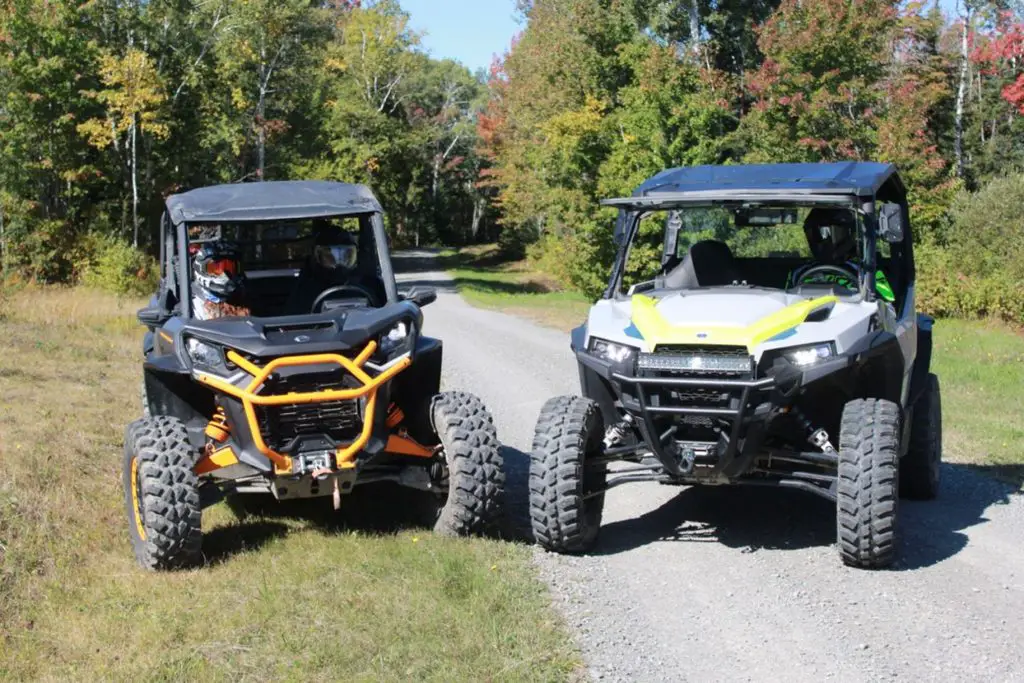
I would not replace either of these with a Ranger or Defender in the comparison just because all four have cargo beds. The Commander XT 1000R and General 1000 Sport aim at riders who want recreational trail ability without leaving a useful dumping bed behind.
These two-seat 2027 configurations each list 100 hp and a 600-lb cargo-box rating. The important published difference is 2,000 lb of towing for the Commander versus 1,500 lb for the General.
If your required trailer load exceeds 1,500 lb but stays within all other applicable limits, that gives the Commander a reason to remain on the shortlist. If you mainly carry coolers and hand tools, that 500-lb rated-towing gap may never affect your riding.
Trim equipment matters, too. The Commander XT lists a factory hard roof and a 4,500-lb winch. Don’t compare its sticker price with a General quote that leaves out the roof or recovery equipment you intend to add. Ask for both quotes with identical must-have accessories, installed.
Choose the right Maverick and RZR before comparing performance
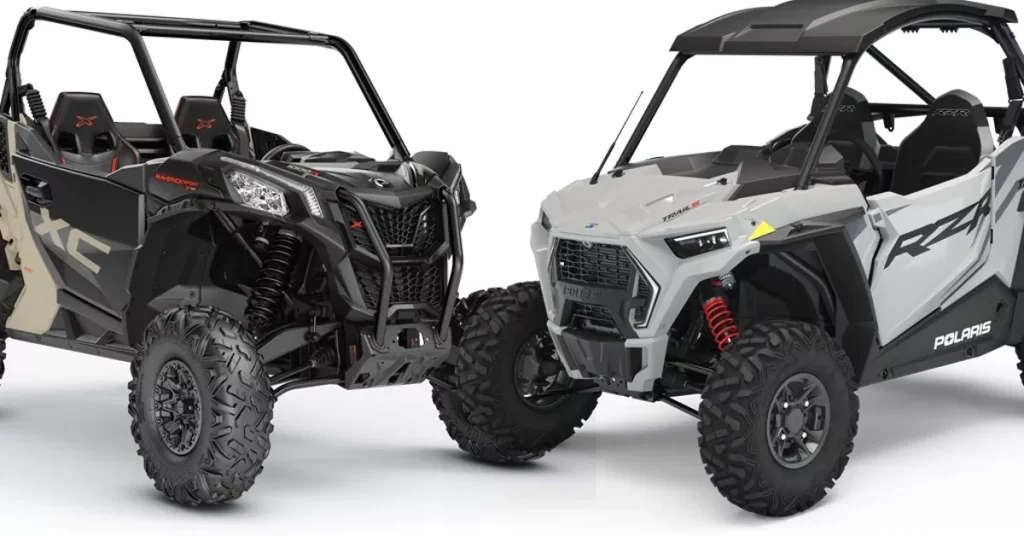
Fifty-inch trails: Maverick Trail versus RZR Trail
If your riding area has a 50-inch vehicle-width limit, begin with the 2027 Maverick Trail X with the 1000 engine and 2027 RZR Trail Sport, both two-seaters.
Their advertised 75-hp engine choices are much closer comparisons than placing the 52-hp Maverick Trail 700 against the 75-hp RZR without saying so. Confirm that the route permits the vehicle and that installed tires or accessories don’t create a width problem.
The Maverick Trail X package lists a hard roof and 4,500-lb winch. If those are things you would buy anyway, include their value when you compare it with the RZR.
If you don’t need them, spend your time checking seating position, visibility and the final price instead. Manufacturer specifications don’t establish a ride-comfort winner.
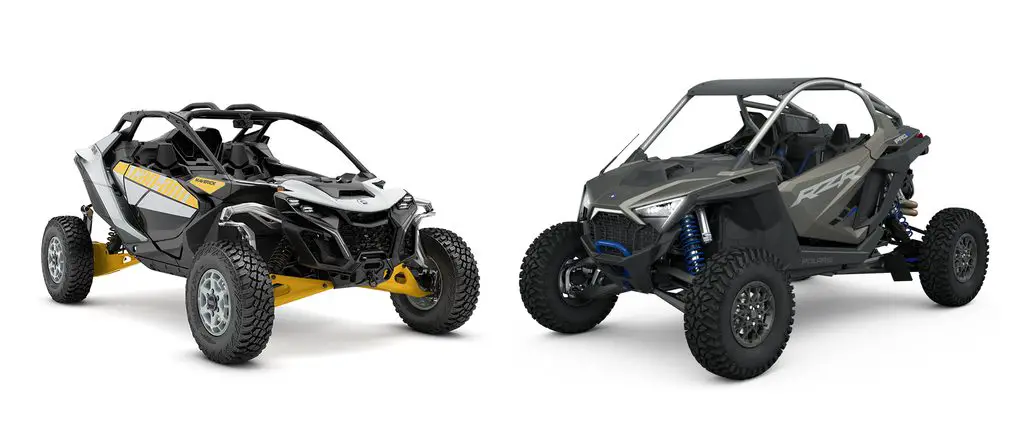
High-performance terrain: Maverick R versus RZR Pro R
For open terrain where these much wider machines are appropriate, compare a two-seat Maverick R X against a two-seat RZR Pro R. The 2027 published power ratings are 240 and 225 hp, respectively.
Can-Am uses a seven-speed dual-clutch transmission; Polaris uses its own automatic belt-drive arrangement. Those differences make a demonstration and maintenance discussion useful. They don’t justify calling one machine faster, more dependable or smoother without comparable testing.
I’d ask about suspension adjustment, cooling, drive-system service, overall vehicle width and the cost of the exact two-seat package. If I only ride tight wooded trails, neither would be the sensible purchase.
Buying an ATV? Outlander versus Sportsman is its own comparison
An ATV isn’t just a smaller Ranger or Maverick. If you want to ride solo and carry modest gear without passenger seats or a steering wheel, compare the 2027 Can-Am Outlander DPS 700 with the 2027 Polaris Sportsman 600 EPS.
Check single-rider versions, not a MAX, Touring or two-up configuration against a one-person machine.
One naming trap is worth clearing up: Polaris says its 2027 Sportsman 600 is largely the same machine previously called the Sportsman 570. The new name does not mean the engine grew to 600 cc.
I’d compare the rack limits, turning space, power-steering feel, available storage and service access before treating the number on either fender as a performance measurement.
Published ATV towing ratings can use different conditions, including whether a trailer is braked. I wouldn’t crown a towing winner until the two dealers show me the relevant owner’s-manual limits for the exact ATVs, including tongue weight and trailer-brake requirements.
If you need to carry a passenger, restart the comparison with two-up Outlander and Sportsman Touring trims.
How I’d get the final decision from two dealers
Once you’ve narrowed your choice to one pair, the useful comparison isn’t a brand-wide reliability score. It’s the same model year, seating capacity, intended job, installed equipment and total purchase cost.
Manufacturer starting MSRPs are not final quotes. For example, Polaris lists a $16,999 starting US MSRP and $1,145 destination charge for the 2027 RZR Trail family, while Can-Am lists a $15,499 starting price for the Maverick Trail X family before transportation and preparation.
The Can-Am figure can be for its 700 engine, so those two starting prices are not a valid price comparison between the 75-hp machines.
- Request two written, itemized out-the-door quotes. Identify the year, engine, exact trim, seat count and included roof, doors, windshield, winch, tires and any installed accessories. Separate MSRP, destination or freight, setup, documentation, tax and registration; ask about rebates and eligibility.
- Bring your actual limits. Tell each dealer your trailer opening, gate width, passenger count, typical cargo weight and trailer weight. Get the owner’s-manual page that sets the relevant rating, not just a headline capacity.
- Ask the service desk, not only the salesperson. What’s the next available service appointment? Do they stock drive belts, filters and common replacement parts for this engine? What are the scheduled service intervals and estimated labor charges? Can they perform warranty and recall work on that exact model?
- Try the controls and access. Sit in both machines, check visibility and entry, test low-speed steering and shifting where demonstrations are allowed, and ask how your must-have attachments fit. For riding impressions, a repeatable same-day drive is more useful than a dealer’s general claim about the brand.
For a used machine, I’d put the service records, hours and miles, belt condition, signs of frame or suspension damage, tire wear and a cold start ahead of a stranger’s claim that one badge is always more reliable. Owner discussions can suggest questions, but they don’t establish brand-wide failure rates.
My rule is simple: choose the pair for the job, then choose the exact machine based on its constraints and quote. If neither quote solves a real problem at a price you’re willing to pay, walking away is a valid result.

Calvin Anderson, founder of Off-Road Lord, is a seasoned off-roading enthusiast from Tucson, Arizona. With over a decade of hands-on experience and a deep understanding of off-roading vehicles and trails, Calvin’s insights provide a trusted guide for fellow adventurers.