
The Honda FourTrax 300 is a 282cc-class utility ATV sold in the United States from 1988 through 2000. Honda offered a two-wheel-drive TRX300 and a four-wheel-drive TRX300FW (FourTrax 300 4×4).
Both use an air-cooled four-stroke single-cylinder engine, a foot-shift transmission with an automatic clutch, reverse, and shaft final drive. If you’re looking at a used one, the most important questions are which version and year it is, whether its driveline and brakes work properly, and how much repair work the asking price leaves you.
I’d start with the factory specifications rather than a claimed top-speed number. A lot of online FourTrax 300 figures mix model years, confuse dry weight with ready-to-ride weight, or treat the 2WD and 4WD machines as identical.
Honda FourTrax 300 specs at a glance
| Specification | Honda TRX300 / TRX300FW | Reference |
|---|---|---|
| U.S. model years | 1988–2000 | Honda ATV history |
| Engine | 281.7cc (commonly rounded to 282cc), air-cooled, single-cylinder, four-stroke; overhead camshaft | Honda 1988–94 service manual, specifications |
| Bore × stroke | 74.0 × 65.5 mm; 9.0:1 compression ratio | Honda service manual |
| Drive | TRX300: 2WD; TRX300FW: full-time 4WD | Honda model history |
| Transmission | Five forward ratios (super-low, then 1–4), reverse, foot shift, automatic centrifugal clutch | Honda service manual, drivetrain |
| Fuel capacity | 3.3 U.S. gallons (12.5 L), including approximately 0.7 gallon reserve | Honda service manual, chassis specifications |
| 1993–94 overall dimensions (L × W × H) | TRX300: 75.2 × 43.9 × 42.8 in.; TRX300FW: 75.2 × 43.7 × 42.7 in. | Honda service manual, “after ’92” figures |
| 1993–94 wheelbase | TRX300: 48.8 in.; TRX300FW: 48.7 in. | Honda service manual |
| Ground clearance | 6.3 in. (160 mm), in the cited 1988–94 specifications | Honda service manual |
| TRX300FW factory tires | AT23×8-11 front; AT24×9-11 rear, in the cited 1988–94 specifications | Honda service manual, tire chart |
| Battery | 12 V, 12 Ah in the cited service manual; verify physical fit and terminals before purchase | Honda service manual, electrical specifications |
| Engine oil with filter | 2.25 L (2.38 U.S. qt) for the documented early service procedure | Honda service manual, lubrication |
Year matters. These are documented U.S.-market facts, but the linked service manual covers early machines, not every revision through 2000. For a late-model part, adjustment, tire fitment, or service procedure, check the manual and parts listing for your exact year. Honda’s owner’s-manual support page explains how to request manuals for older models.

What years was the FourTrax 300 made?
Honda introduced the utility FourTrax 300 in 1988 and kept the line in production through the 2000 model year. Honda’s historical model timeline identifies the TRX300 as the two-wheel-drive model and the TRX300FW as the four-wheel-drive version.
The later FourTrax Rancher replaced this family; a Rancher 350 is not simply another name for a FourTrax 300.
The engine’s basic description stayed recognizable, but that doesn’t mean every carburetor, ignition part, cable, or wheel will swap between a 1988 and a 2000 machine.
The factory 1988–94 service manual itself lists different carburetor identification numbers and several year-dependent settings. I would identify the year and TRX300 versus TRX300FW model before ordering anything.
Honda FourTrax 300 2WD vs. 4×4
The TRX300 sends power to the rear wheels; the TRX300FW drives all four. The FW’s front-drive components add weight and more parts to inspect. Its standard system is full-time four-wheel drive—don’t assume a stock machine has a modern dashboard switch for selecting 2WD.
The 4×4 makes more sense when traction on slippery ground matters, while the simpler 2WD avoids a front differential, front driveshafts, and their associated wear points. Neither version is a high-speed sport ATV. When comparing used examples, I’d rather have a sound 2WD than a damaged 4×4 simply because the latter has two extra driven wheels.
A historical account credited to American Honda quotes an 850-lb towing capacity and rack limits of 66 lb front and 132 lb rear for the FourTrax 300. Those figures describe different loads, not a single combined payload; confirm the correct labels and restrictions for your own model before towing or loading the racks.
How much does a Honda FourTrax 300 weigh?
There’s no one accurate weight for every year and configuration. Honda’s early service manual gives dry weights, which exclude operating fluids. For example:
| Model-year example | TRX300 2WD dry weight | TRX300FW 4WD dry weight | Source |
|---|---|---|---|
| 1988 | 439 lb (199 kg) | 474 lb (215 kg) | Honda service manual |
| 1993–94 | 487 lb (221 kg) | 527 lb (239 kg) | Honda service manual, “after ’92” entry |
Don’t confuse those dry figures with the weight of a fueled ATV carrying racks, tools, or aftermarket tires. If you’re evaluating a trailer’s load rating, use the machine’s actual loaded weight. My separate ATV weight guide explains why weight definitions matter.
Honda FourTrax 300 top speed and horsepower
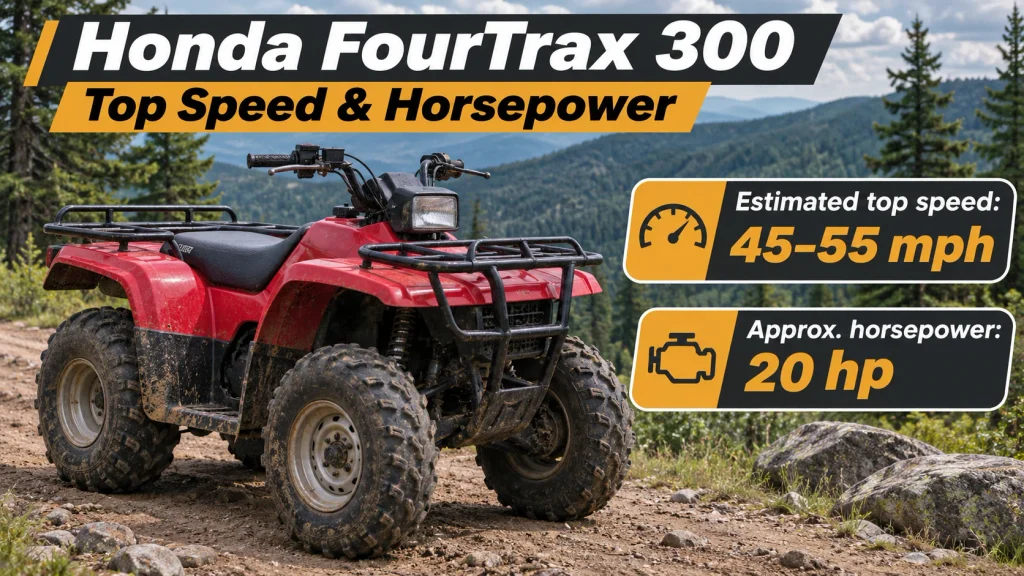
How fast does a Honda FourTrax 300 go? You’ll see roughly 45 mph quoted as a top-speed estimate. Another guide claims 50–55 mph. I couldn’t establish an instrumented, factory-verified maximum for the full 1988–2000 range, so neither figure should be treated as a promise for your ATV. Tire diameter, gearing, machine condition, terrain, and rider load all affect what a particular machine will achieve.
As for horsepower, a historical article credited to American Honda describes the FourTrax 300 with 20 horsepower. That is a historical published engine-power claim, not an independently tested rear-wheel dynamometer reading or confirmation that every model-year configuration produces the same output.
See the Honda-attributed historical account. Its real appeal was tractable work-oriented power, low gearing, and shaft drive rather than a documented speed record.
Honda FourTrax 300 tire sizes
For the early TRX300FW 4×4, Honda specifies AT23×8-11 front and AT24×9-11 rear. That means the first number is nominal tire height in inches, the middle number is nominal width, and the last number is wheel diameter. My guide to ATV tire-size markings walks through the notation.
The 2WD doesn’t necessarily take the FW’s rear tires. Honda’s 1988–94 manual lists a 25×12-9 rear tire for some earlier 2WD years and 25×11-9 after 1991. For a used ATV—especially one with swapped wheels—read the sidewall, verify the rim size, and confirm the correct factory specification for that exact model year before ordering.
Don’t assume bigger tires are harmless: changes in diameter affect effective gearing, clearance, steering effort, and drivetrain load.
How much is a used Honda FourTrax 300 worth?
The useful distinction is between an asking price, a pricing-guide estimate, and a recorded sale. One documented example is a 1995 TRX300FW sold on Bring a Trailer for $2,750 on June 4, 2026. That’s one auction outcome for one machine with its own condition and documentation; it isn’t a national average or a guaranteed value for yours.
For a practical purchase decision, compare recent completed sales for the same drive type and similar condition, then subtract the work your candidate needs.
A clean-running machine with functioning reverse, good brakes, intact frame, service records, and ownership paperwork is a different proposition from a non-runner with a painted-over frame and an unknown title history. I wouldn’t treat a seller’s advertised price as evidence that buyers actually pay it.
Historical MSRP is a separate number again. I haven’t found a sufficiently reliable, year-specific original U.S. MSRP covering both versions, so I won’t attach an invented “new price” to this guide.
Used FourTrax 300 buying checklist
These machines are old enough that inspection matters more than reputation. Before money changes hands, I would work through the following:
- Confirm identity. Match the frame number and model identification against the paperwork. Look for unreadable stamps, unexplained grinding, or numbers that don’t match documents.
- Ask for a cold start. A warmed-up engine can hide cold-start, choke, or idling problems. Watch for smoke, fuel leaks, and persistent engine noises.
- Test every gear and reverse. A machine that starts but won’t shift or pulls poorly under load may need work far beyond an oil change.
- Inspect the drivetrain. On the FW, check the front differential housing, axle joints, and boots for leaks or damage; on both models, check the rear final drive and wheel bearings.
- Test brakes and steering. Look for dragging brakes, damaged cables, sloppy steering, and wheel play. Don’t assume that a machine stopping in the yard will stop reliably on a slope.
- Look for water damage and modifications. Mud inside air-intake components, electrical corrosion, patched wiring, oversized tires, and homemade snorkels deserve closer inspection.
- Price the repairs before buying. Add tires, battery, fluids, brake service, and any diagnosis you cannot complete yourself. Walk away if the likely cost exceeds the value of a sound example.
If you’re buying your first ATV, my ATV safety guide covers the baseline riding precautions. A working engine doesn’t make worn-out brakes or unsafe tires acceptable.
Honda FourTrax 300 oil type and capacity
For the documented 1988–94 TRX300/TRX300FW service procedure, Honda recommends GN4 four-stroke oil or an appropriate equivalent, with SAE 10W-40 as the general viscosity and API SF or SG in that period’s manual.
Check current oil compatibility with the machine’s wet clutch and the exact-year manual rather than selecting automotive oil solely by viscosity.
| Service operation | Oil quantity | Source |
|---|---|---|
| Drain and refill only | 2.2 L (2.3 U.S. qt) | Honda service manual, lubrication section |
| Oil and filter replacement | 2.25 L (2.38 U.S. qt) | Honda service manual, lubrication section |
| Reassembled engine after disassembly | 2.5 L (2.6 U.S. qt) | Honda service manual, lubrication section |
Those three amounts aren’t competing estimates. They’re for different operations. In particular, don’t pour the complete-engine-assembly amount into a routine oil-and-filter change.
Basic oil and filter change
With the ATV securely parked on level ground, warm the engine briefly, turn it off, and drain the old oil into a suitable container. Inspect the drain sealing washer and replace the filter using the arrangement shown in your year-specific manual.
The factory procedure specifically warns that the filter’s “OUTSIDE” mark must face outward; reversed installation can damage the engine. Refill for the actual operation, reinstall the dipstick, idle for a couple of minutes, shut down, and recheck the level and for leaks as described in Honda’s procedure. Recycle the used oil and filter.
Don’t confuse engine oil with the separate fluids used in the rear final drive and, on the 4×4, the front drive components. Their capacities and lubricant requirements are separate service items.
Battery, air filter, and routine upkeep
The early Honda manual lists a 12-volt, 12-amp-hour battery. That doesn’t identify a universal replacement case size, terminal layout, or battery brand for every year. Check the battery tray, cable polarity, and parts listing before ordering; on a no-start machine, measure battery condition and inspect cable connections before condemning the starter.
The air cleaner uses a serviceable foam element in the cited manual. With the engine off, remove the seat and access the airbox, take out the element, check for damage, and follow the service procedure for cleaning, completely drying, and lightly oiling the foam with appropriate filter oil. Replace damaged or crumbling foam rather than washing it back into service. Inspect the intake and airbox seal, particularly if the ATV has been used in dust or deep water.
Routine attention also includes engine-oil and gear-oil levels, throttle and brake operation, wheel bearings, tire condition, and electrical connections. I would use the exact model-year schedule instead of assuming a modern Honda ATV’s service intervals apply to a 1990s FourTrax.
Common Honda FourTrax 300 problems: where to start
There isn’t a reliable model-wide failure-rate dataset here, so these are inspection and diagnostic priorities, not a ranked list of statistically proven defects.
It cranks but won’t start—or doesn’t crank at all
Separate the two conditions first. If the starter won’t turn the engine, check the battery, terminals, ground, fuses, neutral indication, starter circuit, and run switch according to the wiring diagram.
If it cranks but doesn’t fire, check for fresh fuel, correct choke operation, spark, and a clean intake before pulling apart the carburetor. An engine that’s been sitting may have varnish in its carburetor, but the carb isn’t automatically guilty every time an ATV refuses to start.
Don’t bypass or permanently defeat the emergency engine-stop switch. A damaged switch, connector, or wire should be repaired so the stop function remains operational.
It idles poorly, bogs, or leaks fuel
Check stale gasoline, fuel flow, the air filter, and intake leaks first. The original carburetor’s identifiers and settings vary by year in the factory service manual.
That is why a generic jet kit or an internet “turn the screw two times” instruction may not be correct for your machine. A complete carburetor rebuild calls for a separate, year-specific procedure.
It shifts badly or the clutch slips
The FourTrax 300 has an automatic centrifugal clutch arrangement, but that doesn’t make every shifting problem a clutch-adjustment problem.
Verify the correct oil, the foot shifter’s movement, and the condition of the linkage before proceeding to the factory clutch-adjustment method. Incorrect adjustment can make operation worse; use the exact-year workshop procedure rather than an unverified turn count.
The brakes drag or feel weak
The original setup uses hydraulic front drum brakes and a cable-operated rear drum, as described in Honda’s early manual.
Check fluid leakage or damaged hoses at the front and cable movement, lining condition, contamination, and hardware at the rear. If the machine has been submerged, internal corrosion is worth investigating.
Brake disassembly and adjustment involve safety-critical measurements, so I would follow the service manual and test braking at low speed on level ground before normal use.
The rear axle feels loose, or the 4×4 makes noise
First identify whether the movement comes from wheel bearings, hubs, axle components, or the final drive.
On a TRX300FW, also inspect the front driveline and differential. Removing a rear axle or rebuilding a differential is more involved than a general model overview can safely cover; obtain the appropriate service diagram and check part compatibility by year.
Where is the VIN on a Honda FourTrax 300?
The factory service manual’s identification section locates the frame serial number on the front of the frame. It locates the engine serial number separately on the upper right crankcase.
Don’t use the engine number as a substitute for the frame identification when checking ownership. Clean and inspect the stamping without altering it, and compare it with the applicable paperwork and model-year identification information.
Is a FourTrax 300 still a sensible used ATV?
Yes, if you want a relatively simple, older utility machine and can buy one in genuinely sound condition. The 2WD is the less complicated option; the FW gives you full-time 4×4 traction but also adds a front drivetrain to maintain.
Neither should be valued as though it’s a new ATV with modern equipment, current parts availability, or guaranteed performance.
My buying rule is simple: identify the exact model, inspect it cold, test the drivetrain and brakes, and price the work before deciding. The year-specific Honda manual is the final reference for service quantities and procedures, while recent completed sales—not optimistic listings—are the better starting point for negotiating a used price.

Calvin Anderson, founder of Off-Road Lord, is a seasoned off-roading enthusiast from Tucson, Arizona. With over a decade of hands-on experience and a deep understanding of off-roading vehicles and trails, Calvin’s insights provide a trusted guide for fellow adventurers.