
Can a conventional four-wheeler be street legal? Yes, in some parts of the United States—but not simply because it has four wheels, lights, or a license plate. An ordinary ATV may qualify for on-road registration in a state that allows it, may be permitted only on particular public roads, or may be barred from general road registration altogether. The deciding factors are your ATV’s legal classification and the specific road you plan to use.
I would check those two things before buying a street-legal kit. A quad that can legally cross a road or use a signed ATV connector isn’t necessarily licensed for ordinary street driving.
This guide covers conventional, handlebar-steered ATVs in the U.S., with state rules checked on November 11, 2026. The examples aren’t a substitute for checking your exact county, city, and route.
What does “street legal” mean for a 4 wheeler?
There are several different kinds of permission, and they aren’t interchangeable:
| Where you want to ride | What you must establish |
|---|---|
| Private land | Owner permission and any applicable property or local rules. This isn’t public-road registration. |
| Designated ATV trail or OHV route | That your vehicle class is allowed there and that you have any required trail registration, decal, or permit. |
| Public-road crossing or short connector | A specific law or designated route allowing the crossing or connector, including its conditions. |
| Public street or highway | That your ATV is eligible under the state’s rules, the particular road is open, and the required registration, equipment, and operator conditions are met. |
| Interstate or controlled-access highway | Specific legal authorization. Don’t assume an ATV street plate gives you access to freeways or every state highway. |
Registration is another separate issue. Arizona, for example, offers an exclusively off-highway registration category that includes a title, plate, and OHV decal but is not registration for road use.
Pennsylvania, meanwhile, permits some ATV travel on designated and posted roads without turning those machines into ordinary passenger vehicles. Its road-use statute controls where the ATV can go.
First, confirm what type of four-wheeler you own
When I say four-wheeler here, I mean a typical quad with handlebars and a seat you straddle, not a side-by-side with a steering wheel. If you’re uncertain, start with my guide to what counts as an ATV or the different ATV types.
The distinction matters legally. Washington’s wheeled all-terrain vehicle definition includes a particular handlebar-controlled machine with limits on width, seat height, weight, tires, and wheel count, as well as a different utility-type class.
Utah distinguishes a straddle-seat Type I ATV from steering-wheel-equipped vehicles. Don’t use a UTV-specific registration guide as proof that your quad qualifies. For the other vehicle type, see how a UTV differs from an ATV.
Write down your make, model, year, VIN, dimensions, and the exact vehicle description on the title or manufacturer’s certificate of origin. Those details can determine eligibility before equipment even enters the conversation.
Which states let four-wheelers use public roads?
There is no reliable nationwide yes-or-no answer. These official examples show several different legal paths. They’re representative examples, not a 50-state approval chart.
| State | What the rule means for a conventional ATV | Official source |
|---|---|---|
| Utah | Qualifying Type I ATVs can be modified and registered for street-legal operation, subject to equipment, insurance, licensing, and highway restrictions. A street-legal ATV cannot exceed 50 mph on a highway. | Utah Driver License Division |
| Arizona | Eligible OHVs may be registered for on-road use after meeting the highway equipment requirements. An off-highway-only plate and decal do not provide the same access. | Arizona MVD |
| Washington | Qualifying wheeled ATVs can use certain roads posted at 35 mph or less, but county and city authorization and state-highway exclusions matter. On-road equipment and declaration rules apply. | RCW 46.09.455 and RCW 46.09.457 |
| Florida | State law generally prohibits ATV use on public roads, with a daytime exception for unpaved roads posted below 35 mph. Counties can exempt themselves or designate qualifying roads under the statute. | Florida Statutes §316.2123 |
| Pennsylvania | Ordinary street travel is generally prohibited except on designated, posted ATV roads and for specific exceptions such as qualifying crossings and bridge travel. | 75 Pa.C.S. §7721 |
| Oregon | A conventional Class I quad cannot be converted into a street-legal motor vehicle. Some designated roads and routes may still permit OHV use, which is different from road registration. | Oregon Parks and Recreation FAQ |
| Virginia | ATVs may have titling requirements but are not generally registered as highway vehicles. Public-highway operation is restricted, apart from authorized exceptions. | Virginia DMV |
Notice how different the outcomes are: Oregon says you can’t convert your quad for street registration; Pennsylvania lets you use designated ATV roads; and Utah has a defined street-legal registration process. Calling all three simply “legal” or “illegal” would hide the information you actually need.
One more wrinkle: a plate from another state isn’t automatic permission to ride where you’re visiting. Oregon explicitly rejects out-of-state ATV plates as proof of street legality.
Utah also has separate nonresident permit requirements effective September 8, 2026; a permit doesn’t itself decide whether a particular roadway is open to your ATV.
Can you make a 4 wheeler street legal by adding parts?
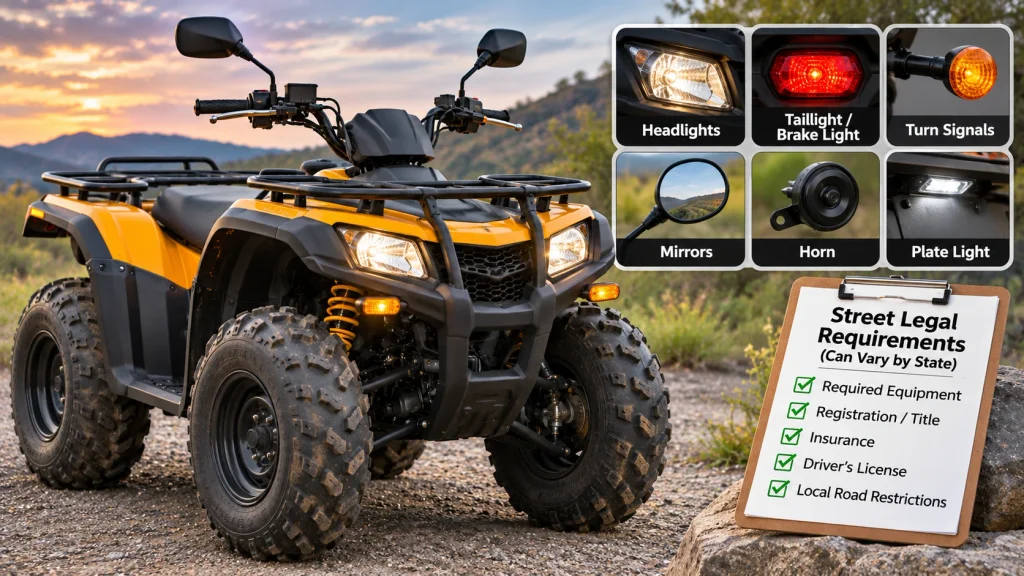
Only if the law provides a path for your type of ATV. A turn-signal kit, mirrors, horn, and road-oriented tires may help you meet equipment rules, but they can’t change a state’s decision to exclude an off-highway quad from highway registration. Oregon’s road-use guidance says so directly.
If your DMV confirms your quad is eligible, ask for the exact equipment list for its classification. Depending on the jurisdiction, it may include:
- Headlights, taillights, brake lights, rear reflectors, and a license-plate light.
- Turn signals, a horn, and rearview mirrors.
- A windshield or approved eye protection, where the rules provide that alternative.
- A working brake system, compliant exhaust, tires meeting applicable rules, and a speedometer.
- An inspection or other registration documentation, when required.
That’s a list of possible requirements, not a universal kit. Utah’s street-legal ATV equipment list, for example, specifies mirrors on both sides, front and rear turn signals, a horn, lighting, tread requirements, and other conditions.
Arizona uses a different on-road equipment checklist. Don’t assume that DOT-marked tires, a parts bundle, or a completed inspection alone establishes eligibility.
How to make a four-wheeler street legal, where conversion is allowed
- Identify the vehicle category. Check the title, manufacturer’s documents, steering type, weight, width, and any state-specific definition. Don’t borrow eligibility rules from a side-by-side or low-speed vehicle.
- Identify the exact route. List the state, county, municipality, road names, posted speed limits, and road owner. A gravel road can still be a public highway, while a designated OHV connector may be open under a different rule.
- Confirm legal road access first. Read the state DMV or OHV agency guidance and the controlling statute. Then verify city or county ordinances and, on public land, the land manager’s route map. Ask specifically whether your conventional ATV can use those roads.
- Ask the DMV about the registration class. Determine whether the law offers on-highway registration, only an OHV permit, or a limited road-use exception. Verify title, VIN inspection, fees, applicable inspections, and any emissions requirement.
- Check operator and insurance rules. Find out whether you need a driver’s license, insurance, an education certificate, a helmet, or other age-specific equipment. Washington, for instance, requires a valid driver’s license for its public-road WATV category (RCW 46.09.444). Utah’s street-legal ATV program requires registration, a license, and insurance; riders under 21 must wear a DOT-approved helmet.
- Price and install only the authorized equipment. Obtain the actual state checklist, confirm the parts are compatible with your model, complete any inspection, and receive the required registration or plate before using an authorized road.
For a Washington example, a 30-mph county road isn’t automatically open just because its speed limit is low. RCW 46.09.455 also makes county population, local ordinances, city boundaries, and state-highway status relevant.
The right question is not merely “Is the speed limit below 35?” but “Is this segment legally open to my registered vehicle?”
What will conversion cost—and is it worthwhile?
I wouldn’t quote a universal price for making a 4 wheeler street legal. The total depends on what your ATV already has, the state’s equipment list, whether your model qualifies at all, and whether inspection, installation, registration, and insurance are required.
In Arizona, for example, off-highway and on-highway registration categories have different fees and tax treatments.
Before spending anything, make two columns: required one-time expenses (parts, installation, initial inspection, title work) and ongoing expenses (registration, permits, insurance, periodic inspections if applicable).
Get a real quote from the DMV, an insurer that covers your intended public-road use, and the installer. A conversion is difficult to justify if the only road you’d use is prohibited or the state won’t register the ATV in the first place.
If your goal is simply to get between trails, it may be less complicated to trailer the machine to a legal trailhead or use a specifically designated connector instead. Confirm the connector is open before riding it.
Before riding: the road-access checklist
- My machine meets the state’s conventional ATV definition, not just a similarly named UTV class.
- The exact road or crossing is authorized for that vehicle category.
- I have the correct title, registration, plate, or OHV permit for that use—not merely a document showing ownership.
- Every equipment and inspection rule that applies to this vehicle and route is satisfied.
- The driver meets the licensing, age, helmet, education, and insurance requirements that actually apply.
- I checked current local rules, land-manager maps where relevant, and any rules for an out-of-state vehicle.
Keep legal requirements separate from riding safety. Public-road permission doesn’t make an off-road ATV handle like a car.
I would follow the manufacturer’s operating guidance, wear appropriate protective gear, and avoid pavement wherever the model or conditions make it unsafe, even on a legally open route. The U.S. Consumer Product Safety Commission’s ATV information explains the vehicle safety framework.
If you still can’t get a definite answer: give your state motor-vehicle agency your VIN and vehicle class, then give the county or city road authority the exact road names.
Ask each for the statute, ordinance, or route designation supporting the answer. Until those two answers line up, don’t buy a conversion kit or treat a plate as permission to ride.

Calvin Anderson, founder of Off-Road Lord, is a seasoned off-roading enthusiast from Tucson, Arizona. With over a decade of hands-on experience and a deep understanding of off-roading vehicles and trails, Calvin’s insights provide a trusted guide for fellow adventurers.