
Four-wheeler speed varies from youth models restricted to 10 mph or less to adult sport ATVs capable of more than 70 mph. For example, a youth Polaris Outlaw 70 is restricted to 10 mph or less when delivered, while three sport quads in a Dirt Wheels comparison topped 70 mph. Full-size utility ATVs fall somewhere in between in many cases, although a high-performance Can-Am Outlander 1000R reached 78 mph in one review.
Those numbers tell you more than a blanket average. Engine size matters, but so do the gearing, speed limiter and type of ATV. A 450cc sport quad can be faster than a bigger utility machine. I’ve put the figures from specific models together below so you can see what the different engine classes actually mean.
ATV top speeds by engine size: real model examples
The following comparison uses manufacturer limits for youth ATVs and speeds reported in independent adult ATV reviews. A factory limit isn’t a speed test, and a reported speed isn’t necessarily a GPS measurement. The figures apply to the named machines, not every four-wheeler with a similar engine size.
| Engine size / class | Example ATV and category | Speed (mph) | What the figure represents |
|---|---|---|---|
| 50cc class (49cc) | 2019 Polaris Outlaw 50, youth | 10 or less / 15 or less | Delivery restriction / unrestricted ceiling. 2019 specifications; Polaris speed controls. |
| 70cc | 2024 Polaris Outlaw 70 EFI, youth | 10 or less / 15 or less | Delivery restriction / unrestricted ceiling. 2024 owner’s manual. |
| 90cc class | 2014 Polaris Outlaw 90 and Sportsman 90, youth | 15 or less / 30 or less | Delivery restriction / unrestricted ceiling. 2014 manual, p. 126. |
| 110 class (112cc) | 2026 Polaris Outlaw 110 EFI, youth | 15 or less / 30 or less | Delivery restriction / unrestricted ceiling. Model specifications and speed limits. |
| 110 class (112cc) | 2023 Can-Am Renegade 110 and 110 X xc, youth | 15 / 30 | Factory-limited / manufacturer-stated unrestricted maximum. 2023 BRP guide, pp. 81–82. |
| 200 class (196cc) | 2024 Polaris Phoenix 200, youth | 20 or less / 30 / 38 or less | Delivery restriction / adjustable throttle-control limit / unrestricted ceiling. 2024 manual. |
| 250 class (249cc) | Denago Daytona 250 FI, adult sport-style quad | About 45 | 72 km/h reached at the 2024 launch; maximum and measurement method not established. Launch report; production specifications. |
| 420cc | 2016 Honda Rancher 420, automatic DCT with EPS, utility | 50 | Reported test top speed, method not stated. Dirt Wheels comparison. |
| 450cc class | Honda TRX450R, Yamaha YFZ450R and Kawasaki KFX450R, sport | 71.7–73.2 | Range across three quads in a 2014 test; measurement method not stated. 450 shootout. |
| 500 class (499cc) | 2021 Polaris Sportsman 450 H.O., utility | 40–50 reached | Reviewer describes reaching these speeds; not a maximum or instrumented result. 2021 ride review; 2021 factory specifications. |
| 675cc | 2016 Honda FourTrax Rincon, utility | 65 | Top speed quoted in a review, measurement method unspecified. Rincon test. |
| 708cc | 2016 Yamaha Kodiak 700 EPS, utility | 67 | Reported test top speed, method not stated. Dirt Wheels comparison. |
| 1000 class (999cc) | 2025 Can-Am Outlander 1000R, performance utility | 78 reached | Reviewer ran out of room; not a confirmed maximum. ATV Illustrated review. |
For a rough sense of scale, these selected adult utility machines reached or topped out at about 40–78 mph, while the three sport 450s in the same historical test exceeded 70 mph. That’s not a market-wide average or a speed you should expect to ride at on a trail. The youth figures are limits, not adult performance figures.
How fast do youth four-wheelers go?
50cc and 70cc ATVs
If you’re looking at a small gas-powered youth quad, the Polaris Outlaw 50 and Outlaw 70 are useful examples. Polaris specifies a delivery restriction of no more than 10 mph (about 16 km/h) and an unrestricted design ceiling of no more than 15 mph (24 km/h) for these Y-6+ models.
The 2024 Outlaw 70 manual covers the fuel-injected 70cc machine with an automatic transmission and chain drive. The factory figures don’t mean that a six-year-old should ride at 15 mph. The age label is a minimum manufacturer recommendation, not a guarantee that a particular child can handle the quad.
90cc and 110cc ATVs
A 90cc quad such as the 2014 Polaris Outlaw 90 or Sportsman 90 is restricted to 15 mph or less at delivery, with an unrestricted ceiling of 30 mph or less. A 110-class youth quad can have the same limits even though the engine is larger.
For example, the 2026 Outlaw 110 EFI has a 112cc engine and an automatic continuously variable transmission (CVT). Polaris lists a 15 mph delivery restriction and a 30 mph unrestricted ceiling.
The 2023 Can-Am Renegade 110 and 110 X xc have the same nominal speed settings, with a built-in throttle limiter. BRP specifies a minimum rider age of 10 for those models.
These are not universal speed ratings for every imported 90cc or 110cc ATV. If you’re buying used, check the exact owner’s manual, age label, vehicle condition and parental speed controls before a child rides it.
A throttle limiter restricts available power; it doesn’t necessarily prevent gravity from increasing speed downhill. BRP specifically warns about this in its 2023 youth ATV operator’s guide.
How fast does a 200cc quad go?
The Polaris Phoenix 200 shows why this class needs more explanation than a single number. It has a 196cc engine and is a youth model intended for riders age 14 or older under adult supervision. Its 2024 manual distinguishes a delivery restriction of 20 mph or less, a 30 mph adjustable throttle-control limit and an unrestricted ceiling of 38 mph or less.
Those are three different specifications for one machine. Don’t assume a 200cc adult quad has the same limits, or that the Phoenix is suitable for a younger child just because the engine looks small compared with a full-size ATV.
The U.S. Consumer Product Safety Commission (CPSC) advises that riders under 16 use only age-appropriate youth models, never adult ATVs. Follow the model’s minimum age, fit and supervision requirements, and keep parental controls in place. All riders need proper training and protective equipment.
How fast are adult utility and sport ATVs?
250cc and smaller recreational adult quads
One 250cc ATV example is the Denago Daytona 250 FI. Dirt Wheels reported reaching 72 km/h at its 2024 launch, or roughly 45 mph. The production machine has a 249cc engine and a four-speed manual transmission.
The launch report doesn’t specify the measuring instrument, and the launch machine differed in tire fitment from the eventual production version, so I wouldn’t treat 45 mph as a guaranteed factory maximum.
If you’re comparing a 250cc quad with a 125cc, 150cc or 300cc machine, ask for the actual model’s speed data instead of extrapolating from that result. Even within the 250 class, an adult sport-style machine and a utility quad can have very different gearing and power delivery.
400cc to 500cc: why sport quads can be faster
In the 2016 Rancher versus Kodiak comparison, the Honda Rancher 420 with DCT and electric power steering topped out at 50 mph. A 2025 Rancher 4×4 Automatic DCT IRS EPS review quotes approximately 45 mph for its example.
Neither report provides a GPS protocol, so the difference isn’t proof that Honda reduced the model’s speed.
Now compare those figures with the 2014 Dirt Wheels sport-quad shootout: Honda TRX450R at 73.2 mph, Yamaha YFZ450R at 72.2 mph and Kawasaki KFX450R at 71.7 mph. These are the speeds published for the test machines, not manufacturer guarantees for every model year.
Utility ATVs are built to deliver useful pulling power, traction and control at low speeds. Sport machines usually prioritize acceleration, lighter handling and performance.
The design differences are why I wouldn’t buy a four-wheeler based on displacement alone. If you’re still narrowing down vehicle types, see my ATV size chart for dimensions and fit.
650cc, 700cc and 1000cc ATVs
The 675cc Honda Rincon and the 708cc 2016 Yamaha Kodiak 700 offer examples of larger utility machines reported at 65 and 67 mph, respectively.
The Kodiak’s result comes from the same comparison in which the smaller Rancher reached 50 mph. The year matters: don’t assume every Kodiak 700 has that exact engine or top speed.
At the higher end, ATV Illustrated reached 78 mph on a 2025 Outlander 1000R before running out of space. That is evidence of a speed attained, not evidence that 78 mph is its absolute maximum.
It also doesn’t establish the top speed of every 850cc or 1000cc quad. Two large-displacement ATVs can have different gearing, electronic restrictions and tire packages.
Popular four-wheeler top speeds: five specific models
| Model and configuration | Supported speed information |
|---|---|
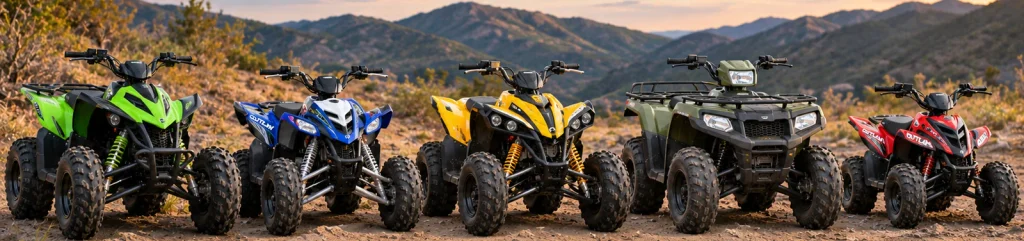
| 2011 Arctic Cat XC 450 / 450i; 443cc EFI, selectable 2WD/4WD crossover | No verified top speed in the original ATV Magazine ride report. Its sporty bodywork doesn’t establish a 450 race-quad speed. |
| 2026 Polaris Outlaw 110 EFI; 112cc, 2WD CVT, age 10+ | 15 mph or less as delivered; 30 mph or less unrestricted. Polaris specifications. |
| 2023 Can-Am Renegade 110 / 110 X xc; 112cc, 2WD CVT, age 10+ | 15 mph factory-limited; 30 mph maximum unrestricted. BRP operator’s guide. The 2025 specifications also list a throttle limiter but don’t publish a numeric maximum. |
| 2021 Polaris Sportsman 450 H.O.; 499cc utility ATV | 40–50 mph described in the 2021 review, not a documented maximum. The 2021 factory specifications list a 499cc single-cylinder engine, automatic PVT and selectable AWD/2WD, but no top speed. |
| 2024 Polaris Outlaw 70 EFI; 70cc, automatic chain-drive youth ATV, age 6+ | 10 mph or less as delivered; 15 mph or less unrestricted. Polaris owner’s manual. |
The Sportsman 450 H.O. and XC 450 are especially easy to confuse with sport 450s if you’re shopping by engine class.
The Polaris model name doesn’t match its actual engine displacement, and the Arctic Cat is a sport-utility crossover rather than a dedicated 2WD racing quad.
I wouldn’t quote an exact factory maximum for either without a year-specific source or a documented speed test.
What is the fastest four-wheeler? Can an ATV go 130 km/h?
130 km/h is about 81 mph. It is not a verified stock ATV speed record. The number on its own doesn’t identify a machine, prove stock performance or establish a record.
For production machines, the 450 sport-quad comparison and the Outlander 1000R review above give useful reference points. I can’t name a universal fastest stock ATV from those tests because they weren’t conducted under a shared protocol across the entire market.
My separate high-horsepower ATV comparison is useful if you’re comparing powerful machines, but horsepower isn’t a top-speed ranking.
Even a GPS reading needs context. Dirt Wheels published a 2017 YFZ450R speed test with a 74 mph GPS result in the baseline run. The quad already had an aftermarket exhaust, so that result isn’t a strictly factory-stock measurement.
For purpose-built record machines, Guinness records a rocket-powered quad at 196.19 mph (315.74 km/h) in 2008 and a separate wheel-driven quad record of 141.079 mph (227.045 km/h) in 2023. See the rocket-powered record and wheel-driven record. Neither is a showroom ATV comparison.
What affects the top speed of an ATV?
Engine displacement, measured in cubic centimeters (cc), describes how much volume the pistons sweep through. It doesn’t directly tell you how fast the wheels will turn or whether the engine can overcome resistance at that speed.
- Transmission and gearing: low range favors pulling power and control rather than maximum speed. A CVT also changes its effective gearing as you accelerate.
- Factory restrictions: throttle travel limits and electronic speed controls can reduce available speed regardless of engine size. Settings can differ by model year and rider category.
- Terrain and traction: sand, mud, hills and loose surfaces can increase resistance or wheel slip. A downhill run can exceed a throttle-limited speed without establishing the ATV’s level-ground capability.
- Rider weight and cargo: extra load affects acceleration and can reduce attainable speed, particularly uphill. Stay within the manufacturer’s load limits.
- Tires: a change in rolling circumference changes the relationship between axle rotation and distance traveled, but heavier tires or more resistance can offset any theoretical increase. Nonstandard sizes may also affect indicated speed. See my guide to ATV tire sizes for how the markings work.
- Mechanical condition and altitude: worn drive belts, engine problems and reduced available power at higher elevation can affect performance. A machine that has unexpectedly lost power needs diagnosis, not a higher speed setting.
When you see a speed quoted online, check whether the vehicle was stock, what tires it had and whether the figure came from GPS, the dashboard or a rider’s estimate.
A speedometer reading is indicated speed; GPS can help establish ground speed, but the test conditions and instrument accuracy still matter.
A manufacturer’s published limiter setting is useful for a different reason: it tells you about the intended restriction rather than proving what every individual machine will attain.
How much ATV speed do you actually need?
I’d start with the job you’re buying the ATV for, not the highest number on the table. If you’re hauling supplies or riding rocky trails, smooth low-speed power, braking, traction and fit are more useful than an extra few miles per hour at the top end.
If you’re comparing adult sport quads for closed-course use, look at suspension, handling, class requirements and the documented performance of the exact model.
For a youth ATV, the starting points are the manufacturer’s age and size requirements, the rider’s ability to reach and operate the controls, proper instruction and adult supervision. Top speed is a restriction to understand, not a target to reach.
On any ATV, adjust your riding speed to visibility, terrain, trail rules and your skill level. Wear a DOT-compliant helmet, eye protection, gloves, boots and protective clothing.
Avoid paved surfaces and public roads; follow the manufacturer’s instructions and applicable access rules. You can read more in my ATV safety guide, and use the CPSC’s ATV safety recommendations for official guidance.
If you need the actual maximum for a particular four-wheeler, identify its year, exact trim and factory configuration first. The owner’s manual is the best starting point for restrictions.
For adult performance, look for a credible test of that same configuration rather than borrowing a figure from a different quad with the same number of cubic centimeters.

Calvin Anderson, founder of Off-Road Lord, is a seasoned off-roading enthusiast from Tucson, Arizona. With over a decade of hands-on experience and a deep understanding of off-roading vehicles and trails, Calvin’s insights provide a trusted guide for fellow adventurers.