
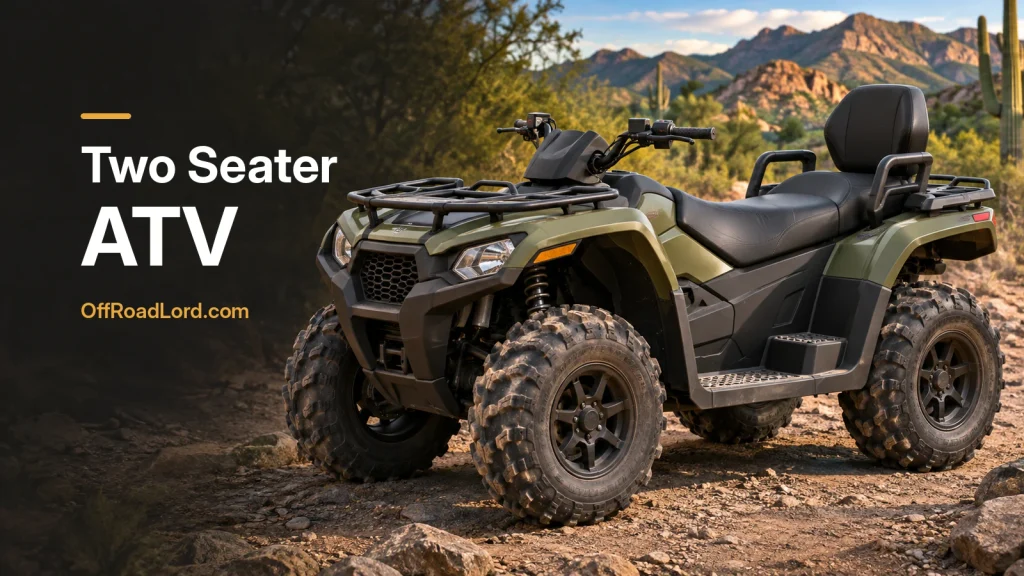
A two-seater ATV is a four-wheeler designed by its manufacturer to carry a driver and one passenger, with the passenger sitting behind the driver. Can-Am Outlander MAX, Polaris Sportsman Touring and X2, CFMOTO CFORCE Touring, Arctic Cat Alterra TRV, HISUN Tactic 2-UP and Guardian L, and ARGO Xplorer XRT are the model families I’d look at first if you want to ride with another adult.
My starting point would be a mid-size model with power steering, a proper passenger backrest, handholds and footrests.
You don’t automatically need a 1,000-class engine just because you’re carrying two people. You do need a machine approved for two, and enough load capacity for both riders and their gear.
There’s a big difference between a genuine two-up ATV and a single-rider quad with a seat attached to the rear rack. The Specialty Vehicle Institute of America distinguishes Type I ATVs (one operator) from Type II ATVs (one operator and one passenger).
A bolt-on seat doesn’t change that designation. Check the owner’s manual and the vehicle’s warning labels before buying.
Two-seater ATV comparison: models worth shortlisting
Here are selected US-market four-wheelers from recent model years and current manufacturer listings, including new-model choices and older models worth looking for at dealers or on the used market.
Each is designed for two occupants. The prices are published US starting MSRPs for the indicated model year or undated US factory listing, not current used prices or out-the-door quotes.
Listings were consulted November 14, 2026; older model-year MSRPs are historical reference points. Where the factory page does not identify a model year, I have marked it as unspecified rather than assigning a year.
| Model (year) | Engine | Starting US MSRP | Why shortlist it? |
|---|---|---|---|
| HISUN Tactic 550 EPS 2-UP | 546 cc | $6,299 | Low published entry price, EPS and winch |
| HISUN Guardian 550L | 550 cc | $6,999 | Passenger backrest, EPS and 7-in. display |
| CFMOTO CFORCE 600 Touring | 580 cc / 44 hp | $7,899 | Value-oriented previous-year two-up with EPS |
| Can-Am Outlander MAX DPS 500/700 (2026) | 650 cc / 40 or 50 hp | $9,649 (package starts at) | Trail and utility use; removable passenger arrangement |
| ARGO Xplorer XRT 600 EPS (2026 dealer listing) | 561 cc | $9,699 | 13.2-in. clearance, EPS and engine braking |
| Arctic Cat Alterra 600 TRV EPS (2027) | 597 cc | $10,499 | Dedicated two-rider chassis and passenger grips |
| Polaris Sportsman Touring 600 Premium (2027) | 567 cc / 44 hp | $11,499 | 48-in. width, removable passenger seat |
| Can-Am Outlander MAX XT 700 (2026) | 650 cc / 50 hp | $11,549 | Winch, bumpers and engine braking |
| Arctic Cat Alterra 600 TRV Limited (2027) | 597 cc | $11,599 | 27-in. tires and upgraded equipment |
| Polaris Sportsman Touring 850 Premium (2027) | 850 class / 78 hp | $13,799 | More power and passenger backrest with integrated grips |
| Polaris Sportsman X2 600 (2027) | 600 class / 44 hp | $14,399 | Convertible passenger seating and cargo bed |
If your budget is below $10,000 before fees, compare the HISUN options, the ARGO XRT and the newer CFMOTO C6 Pro Touring, discussed below. For current Can-Am pricing, see the model-name section below rather than treating the 2026 figures as current quotes.
EPS means electric power steering; Can-Am calls its system Dynamic Power Steering (DPS). The model name doesn’t always match actual displacement.
The 2026 Outlander MAX DPS 500 and 700 both use a 650 cc engine with different power ratings, and Polaris’s Touring 600 retains the 567 cc engine from the Touring 570.
For the 2027 Polaris Touring 600 Premium displacement and equipment, see its trim comparison. For Arctic Cat’s two-up options, its US ATV lineup identifies both TRV versions separately from the ordinary Alterra 600.
Who makes the best two-person ATV?
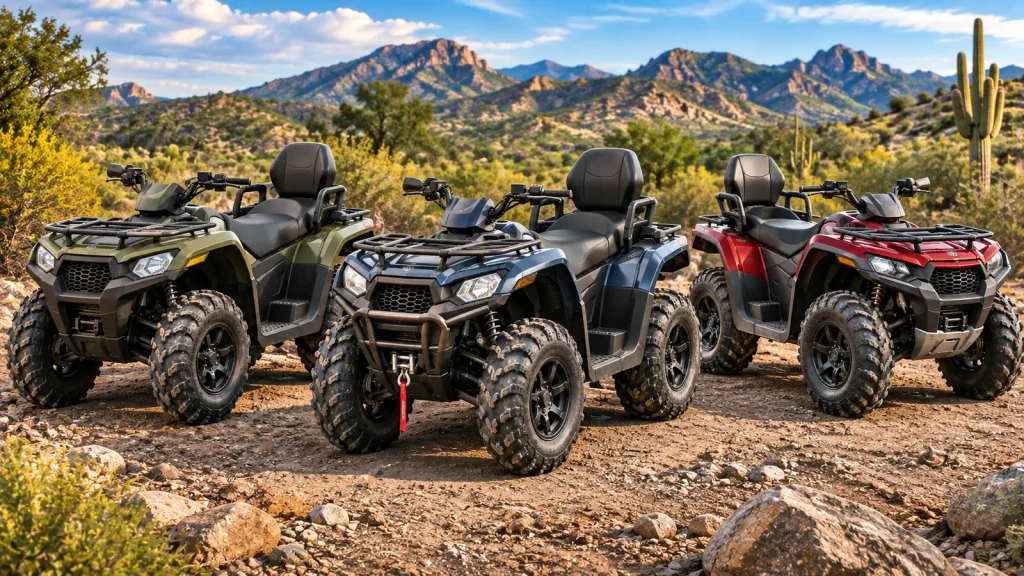
I’d choose by budget, passenger fit, width and what you do with the machine. These are recommendations based on published specifications and equipment, not a head-to-head ride test. Before deciding, compare the actual 2027 models and leftover stock at your local dealers.
For a lower purchase price: HISUN Tactic 550 EPS 2-UP or Guardian 550L
The Tactic 550 is one of the lowest-priced full-size two-passenger models in this comparison. The US factory page specifies two riders, 47 inches of width, selectable two- and four-wheel drive, EPS and a 2,500-lb winch.
The Guardian 550L costs $700 more at the listed starting price and has a passenger backrest and a 7-inch display. Both are worth pricing if a nearby dealer can provide parts and service.
The model pages do not identify the model year, so get the actual year and vehicle documentation in writing. The lower MSRP alone does not establish lower ownership costs.
For general trail riding: Can-Am Outlander MAX DPS or Arctic Cat Alterra 600 TRV EPS
The Outlander MAX DPS is a sensible starting point if you want selectable two- and four-wheel drive, power steering and a full skid plate without buying a recovery winch and upgraded wheels from the factory.
The 2026 model measures 47.6 inches wide and has 12 inches of ground clearance. If you find one in stock, compare its actual price against the newer version.
The 2027 Alterra 600 TRV EPS is another strong mid-size candidate. Arctic Cat describes its second seat as having a backrest, multiple grab positions and separate footrests.
It also lists 8.75 inches of front and rear suspension travel and 10.75 inches of ground clearance. I’d compare the passenger’s reach to the grips and footrests on both machines rather than choose by ground clearance alone.
For long rides and frequent solo use: Polaris Sportsman Touring 600 Premium
The Touring 600 has a removable rear passenger seat, a contoured backrest, power steering, engine braking and independent rear suspension.
Its 48-inch listed width is useful if you ride on restricted-width routes. The Premium trim includes a 3,500-lb winch and guards.
If you don’t need the Ultimate trim’s upgraded display and other equipment, the Premium is the first version I’d price.
For recovery equipment: Can-Am Outlander MAX XT 700
Compared with the 2026 MAX DPS package, the MAX XT 700 brings a 3,500-lb winch, upgraded tires and aluminum wheels, front and rear bumpers, and intelligent engine braking. It makes sense if those are upgrades you’d otherwise buy separately.
The 2026 XT specification sheet lists a 60.4-inch wheelbase and an estimated dry weight of 893 lb. The XT is 47.6 inches wide with 12.5 inches of ground clearance. The 700 engine is rated at 50 hp, so don’t pay for XT expecting a bigger engine than the MAX DPS 700.
For farm work: Polaris Sportsman X2 600
The X2 is especially interesting if you alternate between taking someone along and carrying tools. Its convertible rear seating arrangement allows it to serve as a utility machine when the passenger isn’t aboard. Polaris lists a 400-lb dump-box capacity and 1,350-lb towing rating, with a 49-inch overall width.
Don’t assume the full cargo rating remains available with a passenger seated; follow the manual’s load and seating configuration limits.
Can-Am also offers MAX PRO work-oriented variants. The 2026 Outlander MAX PRO XU used a 650 cc, 50-hp engine with work-calibrated CVT, extra-low range, selectable locking four-wheel drive, a speed limiter and a removable passenger seat.
Its published starting MSRP was $11,399. If towing or slow-speed chores dominate your use, compare the work transmission and actual payload rather than buying on horsepower.
For more power: Polaris Sportsman Touring 850 Premium
If your riding regularly involves demanding terrain or you want additional engine output, the Touring 850 is worth comparing. Polaris lists 78 hp, 48.2 inches of width, 11.25 inches of clearance and 1,500 lb of towing capacity.
Its passenger seat has an integrated backrest and grips. More engine power doesn’t automatically make a machine easier to ride or more comfortable; compare suspension setup, load limits and your experience.
Polaris also lists the 2027 Sportsman Touring XP 1000 Trail at $15,999. Can-Am lists larger-engine MAX packages as well, including the 2027 Outlander MAX DPS 1000 and MAX XT 1000/1000R.
Check the exact engine selection and price before you order; the starting price of a package with multiple engines isn’t necessarily the price of the highest-output version.
Two-up ATV manufacturer and model names to know
Can-Am Outlander MAX
Look for MAX in the exact Outlander designation, not just an Outlander with a long-looking saddle. The 2027 US configurator lists the MAX DPS 500/700 starting at $10,099 and MAX XT 700 at $11,949.
Those are 2027 package starting prices, not the 2026 figures in the table. The US build-and-price page is the place to check the package and engine you want, and the model-specific manual should confirm seating capacity.
Polaris Sportsman Touring and X2
The Touring and X2 names matter. The standard Sportsman 600, 850 and XP 1000 are not the two-passenger Touring models. Polaris calls its mid-size 2027 Touring and X2 models 600 rather than 570; the Touring 600 FAQ explains that the rename didn’t materially change engine displacement or performance.
There are also 2026 Sportsman Touring 570 and X2 570 machines to consider. Check the 2026 lineup if a dealer has one left. Polaris’s two-passenger 6×6 is another utility option, but it has six wheels, so I haven’t included it in the four-wheeler comparison.
CFMOTO CFORCE Touring
CFMOTO’s 2025 US brochure identifies the CFORCE 600 Touring, 800 Touring and 1000 Touring as two-up models.
The 600 Touring is particularly interesting for buyers who want a lower-cost used or leftover machine. Its 580 cc engine, power steering and 46.5-inch published width make it worth a look for narrower trails. The ordinary CFORCE 600 is a different configuration.
For new-model shoppers, the 2027 C6 Pro Touring is the newer model I’d ask a dealer about first. Dirt Wheels’ US launch coverage reports a $9,099 starting price, with the 800 Touring at $9,999 and 1000 Touring at $10,999.
The US dealer’s C6 Pro Touring listing also gives $9,099 MSRP and describes a dedicated two-rider chassis. CFMOTO’s Canadian factory page confirms the C6 Pro Touring’s two-up design, but don’t use Canadian prices, warranty or other market-specific specifications for a US purchase.
Ask for the US model’s owner documentation and written quote. I wouldn’t claim it’s the cheapest new two-person ATV nationally on the strength of those listings alone.
HISUN and ARGO
HISUN lists two riders in the exact Tactic 550 EPS 2-UP and Guardian 550L specifications. Check the model suffix carefully: do not assume an ordinary Guardian 550 has the same passenger rating.
HISUN also lists other Tactic 2-UP and Guardian L configurations; compare their individual passenger ratings and adult fit rather than buying a smaller machine purely for price.
The ARGO Xplorer XRT 600 EPS factory page identifies a two-rider capacity and a 561 cc engine, with a width of 48.6 inches and 1,225-lb towing capacity. The US dealer listing identifies a 2026 model at the same MSRP. ARGO also lists the XRT 600 LE and XRT 1000 LE in its vehicle lineup.
Ask a dealer about model-year availability and parts support; the older Xplorer listings are not evidence of a newly produced 2027 four-wheeler.
Does Honda or Yamaha make a two-seater ATV?
I didn’t find a factory two-passenger quad in Honda’s current US FourTrax ATV range or Yamaha’s US utility ATV lineup. Don’t treat the extended-looking seat on a Rancher, Foreman, Rubicon, Grizzly or Kodiak as evidence that it takes a passenger. Yamaha’s Kodiak safety guidance specifically prohibits passengers.
If you want to stick with one of those manufacturers and carry two people, look at its side-by-sides instead, such as the Honda Pioneer or Yamaha Wolverine.
My compact UTV guide covers smaller alternatives for buyers concerned about tight trails and storage space.
How much does a two-seater ATV cost?
The lowest listed price for a full-size model in this table is $6,299 for the HISUN Tactic 550 EPS 2-UP, with model year unspecified.
Among the selected 2027 models in the table, manufacturer-listed starting prices run from $10,499 for the Alterra TRV EPS to $14,399 for the X2 600. CFMOTO’s newer C6 Pro Touring is another potentially less expensive candidate at a dealer-reported $9,099 MSRP.
The previous-year CFORCE 600 Touring’s $7,899 MSRP is a useful reference for shopping used or leftover stock, not a current guaranteed purchase price.
Freight and setup can materially change your choice. For example, Polaris lists a $700 destination charge on its 2027 lineup. Arctic Cat lists $650 freight and $500 dealer setup for the 2027 TRV EPS.
Ask the dealer for the same written breakdown on every quote: vehicle price, freight, setup, accessories, other fees, sales tax, title and registration. Can-Am excludes transportation and preparation from its starting prices.
ARGO lists $650 destination for the XRT 600 EPS, and HISUN excludes destination, dealer preparation and other applicable charges.
Budget for two sets of protective gear, routine fluids, filters, tires, drive-belt servicing where applicable, insurance if appropriate, and transportation.
A winch or premium suspension may justify a higher trim if you’d buy it anyway, but it shouldn’t come at the expense of proper passenger fit or a nearby service option.
Buying a used two-up ATV
I’d search for a CFORCE 600 Touring, Outlander MAX 500/700, Sportsman Touring 570 or Alterra 600 TRV by exact year and trim. Don’t rely on a seller’s description of an ATV as a two-seater.
Check the VIN/model label, owner’s manual and original passenger equipment. Inspect the backrest, footrests and handholds, frame, steering play, wheel bearings, brakes, tires, four-wheel-drive operation and service history.
A pre-purchase inspection is worthwhile if you aren’t comfortable evaluating those systems yourself.
Ask about missing seat latches or damaged mounting hardware. A factory two-up ATV with the passenger seat removed is not ready to carry a passenger until the proper seating equipment is correctly installed.
How to choose a two-up ATV for two adults
1. Check both riders’ fit
Visit the dealer together. With the ATV stationary, check that the driver can reach and operate all controls and that the passenger can sit in the designated position with both feet supported and hands comfortably reaching the grips.
The passenger shouldn’t interfere with the driver’s movement. For example, the 2027 Sportsman 600 Touring/X2 passenger warning requires the passenger to reach both footrests and securely hold the grips.
Check backrest support, knee angle, space around the driver’s back and ease of getting on and off. A taller backrest or more suspension travel alone doesn’t prove that a machine will be comfortable for you.
An ATV Trail Rider comparison published in 2023 evaluated passenger grip access, footrests and seat room separately from driver ergonomics. The machines tested were older configurations, so its results should not be treated as a ranking of the current models.
2. Calculate the actual load
Two approved seating positions don’t guarantee that the ATV can carry every pair of adults plus a full load of gear.
Add both riders’ weights, protective gear, cargo and any accessories counted under the manufacturer’s maximum load definition. Check the manual for rack limits and trailer tongue-weight rules as well.
For example, two adults weighing 200 and 180 lb, with 30 lb of combined riding equipment and 40 lb of cargo, add up to 450 lb before any additional counted accessories or trailer tongue weight.
Compare that total with the exact vehicle’s allowed load. The rack ratings and tow rating aren’t extra passenger payload. If the manual and the product page disagree, get the manufacturer or dealer to clarify the applicable limit before riding.
3. Measure the machine, trailer and trails
A longer wheelbase gives the manufacturer room for a proper rear seating position, but it also takes up more trailer and garage space. Check overall width, length and wheelbase before putting money down.
A trail marked for vehicles 50 inches wide or less may have other vehicle-class restrictions, so don’t assume every narrow ATV or UTV is admitted. My ATV dimensions guide explains what to measure.
Check your tow vehicle, trailer and ramp weight ratings using the ATV’s actual loaded weight. Published dry weight excludes some items that will be aboard during transport, depending on the manufacturer’s definition. Never compare a dry-weight figure directly against a competing model’s curb weight as if they measured the same thing.
4. Match equipment to the terrain
For ordinary trails and chores, a mid-size engine, low range, four-wheel drive and power steering are useful starting points.
If you ride steep or uneven routes, look closely at engine braking, ground clearance, tire setup and suspension adjustment. A passenger changes how the machine responds; use the manufacturer’s instructions for two-up riding and suspension setup rather than relying on a bigger engine to solve handling problems.
Can you safely and legally carry two people on an ATV?
Only carry a passenger when the manufacturer designed and approved your exact ATV for two riders. The ATV Safety Institute recommends no passengers on single-rider ATVs and no more than one passenger on a machine intended for two.
A rear cargo rack, padded storage box or aftermarket seat isn’t a substitute for a designated passenger position.
Both riders should wear a properly fitted approved helmet, eye protection, gloves, boots, long sleeves and long pants. Follow the exact manual’s passenger age, fit and operating restrictions, ride within your abilities, slow down with a passenger and take an ATV training course.
Check state and trail-specific rules; manufacturer approval alone doesn’t establish that passenger riding is lawful everywhere. California, for example, requires manufacturer-designed passenger accommodation rather than an aftermarket conversion.
Two-up ATV vs. two-seater UTV: which should you buy?
A two-up ATV has handlebars and tandem straddle seating. A two-seat UTV, or side-by-side, has a steering wheel, adjacent seats, occupant restraints and typically a protective structure. They aren’t interchangeable categories.
I’d favor the ATV if you want the straddle-riding experience, a smaller machine for transportation and access to routes that specifically permit ATVs.
I’d look at a UTV if you frequently carry tools or bulky cargo, want a passenger beside you rather than behind you, or want features like doors, a roof or a dump bed.
Some compact side-by-sides are around 50 inches wide, but check the route’s actual vehicle-class rules. The Polaris UTV buying guide explains the different controls, seating and cargo arrangements.
If you’re searching for a Can-Am two-seater, you may also see Maverick and Defender side-by-sides. And if by “razor” you mean a Polaris RZR, that’s a sport side-by-side, not a two-up quad. Razor-branded electric recreational products are a separate category. Neither belongs in this ATV comparison.
My advice before buying: get two or three itemized dealer quotes for exact two-up trims, confirm the passenger rating and load limit in the owner’s manual, and sit on the machine with the person who will ride behind you. Those checks narrow the choice far more effectively than picking whichever quad has the biggest engine.

Calvin Anderson, founder of Off-Road Lord, is a seasoned off-roading enthusiast from Tucson, Arizona. With over a decade of hands-on experience and a deep understanding of off-roading vehicles and trails, Calvin’s insights provide a trusted guide for fellow adventurers.