
If you’re shopping for a 2 seater side by side, I’d pick the type of riding or work first, then check the exact vehicle’s width, cargo rating and final dealer quote.
For a tight 50-inch trail, the 2027 Polaris RZR Trail Sport and 2026 Can-Am Maverick Trail DPS are worth comparing. For property chores, the 2026 Honda Pioneer 520 gives you a 50-inch-wide machine with a 450-pound bed. If you want trail riding and useful hauling from the same vehicle, look at the 2027 Polaris GENERAL 1000 Sport or 2026 Yamaha Wolverine RMAX2 1000 R-Spec.
Those aren’t interchangeable choices just because each has two seats. A $7,799 Kawasaki MULE SX is a compact, rear-wheel-drive utility machine; a $19,999 RZR XP Sport is a wider recreational UTV with a different mission.
I’ve compared selected U.S. 2026 and 2027 model-year configurations below, rather than treating a manufacturer’s entire lineup as one model. The linked specifications and prices identify the actual version.
What counts as a genuine two-seat side-by-side?
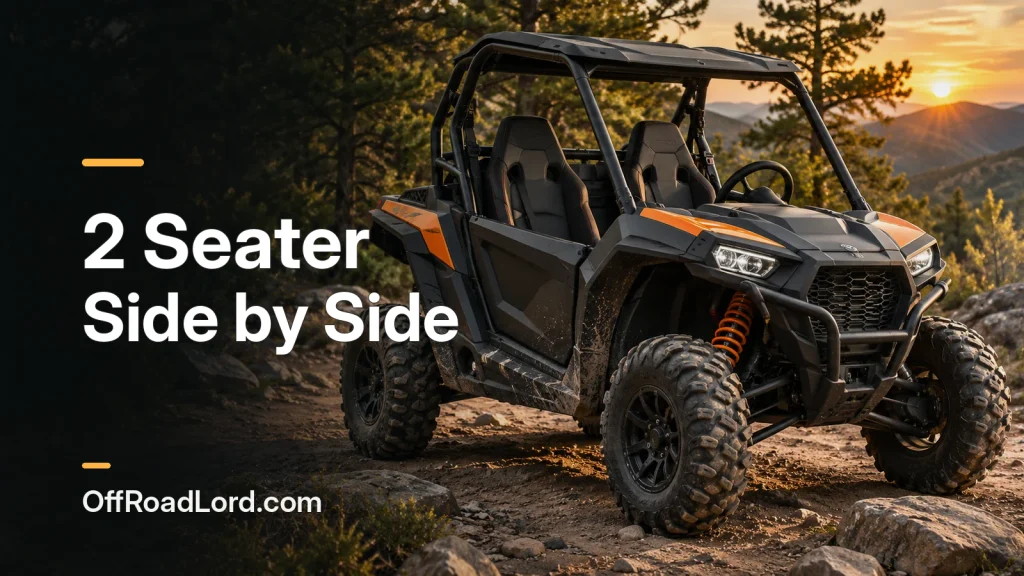
For this guide, a two-seater means two manufacturer-designated seating positions side by side, a steering wheel, occupant restraints and the protective structure specified for that UTV. Two seats can be individual buckets or a two-person bench, as on the Pioneer 520. The advertised seating capacity—not the visual size of a bench—is what counts.
That’s different from a three-person bench-seat work UTV, a four-seat or crew model with a second row, a two-up ATV with straddle seating, or a youth UTV.
In particular, a full-size Polaris RANGER 1000 with a three-seat bench isn’t an exactly two-seat RANGER, and the Polaris RZR sport family shouldn’t be confused with the GENERAL recreation/utility family.
If you are choosing between adjacent seats and a two-person ATV, my two-seater ATV guide explains the other layout.
2 seater side by side comparison: prices, dimensions and weights
All entries below have two factory seating positions. These are useful examples across several vehicle classes, not an exhaustive U.S. market list. Width, length and height are overall factory dimensions in inches.
A weight marked dry or estimated dry is not ready-to-transport weight; curb and wet include operating fluids under the manufacturer’s stated definition. Prices are published U.S. base or starting MSRPs, not out-the-door offers. The Can-Am prices are the starting price for the specified DPS package with its base 700 engine; choosing another engine changes the quote.
| Exact model and source | Type / driven wheels | Width × length × height | Published weight | Starting MSRP |
|---|---|---|---|---|
| 2027 Kawasaki MULE SX (base) | Utility / 2WD | 52.6 × 106.7 × 70.1 in | 967.6 lb curb | $7,799 |
| 2026 Honda Pioneer 520 | Compact utility / selectable 2WD–4WD | 50 × 105 × 71.2 in | 1,060 lb curb | $10,999 |
| 2026 CFMOTO ZFORCE 800 Trail | Trail sport / selectable 2WD–4WD | 50 × 121 × 72 in | 1,290 lb dry | $13,999* |
| 2026 Can-Am Maverick Trail DPS 700 | Trail recreation / selectable 2WD–4WD | 50 × 118 × 69 in | See exact engine spec sheet | $14,999 |
| 2026 Can-Am Commander DPS 700 | Recreation/utility / selectable 2WD–4WD | 62 × 128.5 × 70.5 in | See exact engine spec sheet | $15,399 |
| 2027 Polaris RZR Trail Sport | Trail sport / on-demand AWD | 50 × 110.9 × 67.9 in | 1,255 lb est. dry | $16,999 |
| 2027 Polaris GENERAL 1000 Sport | Recreation/utility / on-demand AWD | 62.5 × 116.4 × 73.8 in | 1,530 lb curb | $16,999 |
| 2026 Yamaha Wolverine RMAX2 1000 R-Spec | Recreation/utility / selectable 4WD | 66.1 × 119.3 × 77.8 in | 1,967 lb wet | $19,999 |
| 2027 Polaris RZR XP 1000 Sport | Sport / on-demand AWD | 64 × 119.5 × 71.1 in | 1,586 lb est. dry (49-state) | $19,999 |
The $13,999 CFMOTO figure is the 2026 U.S. model MSRP shown in a dealer’s factory-model listing, not a verified national out-the-door price. For the 2027 MULE SX, Kawasaki separately lists a $940 destination charge. Can-Am’s historical 2026 model pages show the DPS starting prices but don’t provide a single unambiguous published weight for each base-engine selection in their accessible specification tables, so I’ve left those cells unnumbered rather than guessing.
If your gate or trail has a strict 50-inch limit, start by crossing out every wider machine in the table. If you need a substantial dumping bed, cross out the sport models before comparing horsepower. For an expanded width-first comparison, see my small UTV guide.
Which two-seat side-by-side would I choose?
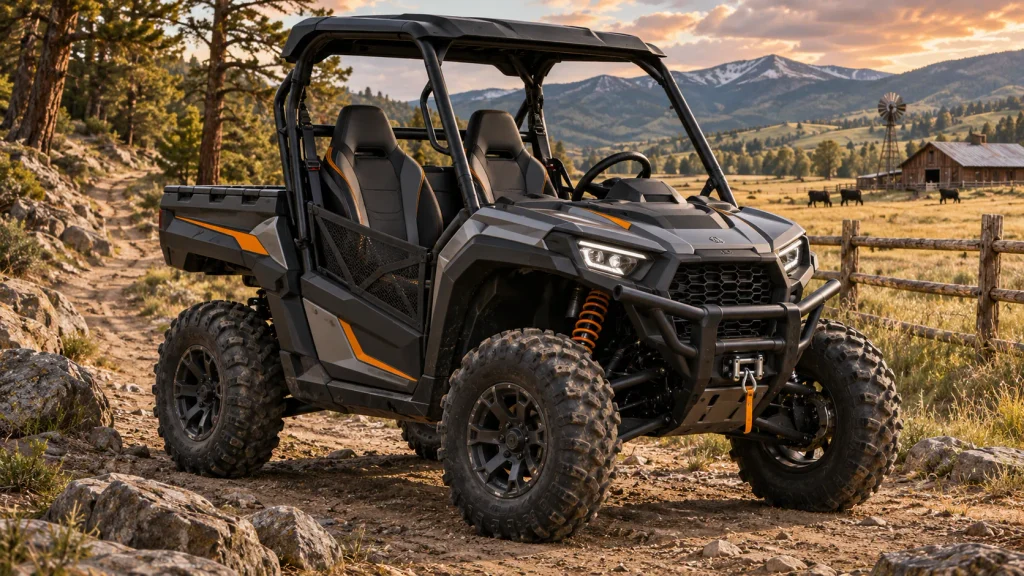
My recommendations are based on the listed configuration and the job you need done, not on a claim that I conducted head-to-head testing. I prioritize a hard constraint—trail width, work load, passenger count or budget—before additional features.
For narrow recreational trails: Polaris RZR Trail Sport or Can-Am Maverick Trail DPS
The 2027 RZR Trail is the straightforward sport-oriented shortlist: 50 inches overall, a 110.9-inch length and a factory two-seat layout. The Sport’s published estimated dry weight is 1,255 pounds. I would start there when recreational trails—not hauling feed or tools—are the main purchase reason.
I’d compare the 2026 Maverick Trail DPS if I wanted the same 50-inch envelope with Can-Am’s available 700/1000 engine choices.
The base 700 package starts at $14,999, but compare a similarly equipped exact engine and trim before deciding it’s cheaper than the Polaris. A 50-inch published width doesn’t override a particular trail’s rules or accessory protrusions.
For compact work, hunting property and gates: Honda Pioneer 520
I like the 2026 Pioneer 520 as a size-constrained utility candidate. Honda lists a 450-pound cargo bed, 1,000-pound towing capacity and a geared five-speed automatic transmission with selectable two- and four-wheel drive.
It’s 105 inches long and 50 inches wide. That combination is more directly useful for carrying tools and moving around a small property than extra sport suspension travel.
The limitation is equally concrete: an 8.5-inch published ground clearance and 450-pound bed rating are not the specs of a full-size heavy-hauling farm vehicle. If regularly towing or hauling heavy loads is the priority, my farm UTV comparison covers a different set of work machines.
For the lowest published purchase price here: Kawasaki MULE SX
At $7,799 MSRP, the 2027 base MULE SX is the least expensive entry in this selected comparison. It has two seats, a 399-pound cargo bed, 401cc engine and 52.6-inch width. But the base vehicle is 2WD.
Its 1,100-pound towing rating requires an optional hitch, and its 6.1-inch ground clearance points toward property transport rather than rough technical trails.
If you actually need four-wheel drive, price the specifically configured 2027 MULE SX 4×4 ST instead. Kawasaki lists $8,599 base MSRP for that model, not for the rear-drive SX. The cheapest useful machine depends on your terrain, not merely the smallest sticker.
For mixed recreation and work: Polaris GENERAL 1000 Sport or Can-Am Commander
The 2027 GENERAL 1000 Sport is the first crossover I’d examine: its factory two seats accompany a 600-pound rear dumping box, 1,500-pound tow rating, 12 inches of clearance and a published 1,100-pound payload rating. It’s 62.5 inches wide, so it isn’t a substitute for a 50-inch trail machine.
The 2026 Can-Am Commander DPS is another crossover. Its 700 engine is the one associated with the $15,399 starting price; Can-Am also offers a 1000R engine in the family.
Commander models combine trail-focused suspension with a cargo box, but don’t apply a spec from a more expensive engine or trim to the entry price. I would compare the actual dealer configurations, not just the family names.
For broader recreation and carrying camping gear: Yamaha Wolverine RMAX2 1000 R-Spec
The 2026 RMAX2 1000 R-Spec is a serious two-seat recreation/utility alternative, with a 999cc engine and a cargo box rated for 600 pounds. The big difference is size: Yamaha lists a 66.1-inch overall width even though its suspension stance is described as 64 inches.
Use 66.1 inches when measuring a gate or trailer. Its 1,967-pound wet weight also changes the hauling conversation substantially compared with the lighter compact machines.
For a wider sport ride: Polaris RZR XP 1000 Sport
When your trails accept a 64-inch UTV and cargo work is secondary, I’d compare the 2027 RZR XP 1000 Sport. It has two seats, a 114-horsepower 999cc twin, a 90-inch wheelbase and a 300-pound cargo box; Polaris doesn’t give this trim a towing rating.
It’s a different purchase from the GENERAL, even though both come from Polaris. For a deeper sport-only shortlist, see my sport UTV guide.
What about Honda Talon, Yamaha YXZ, Kawasaki Teryx and other brands?
The table isn’t a claim that these are the only real two-seat UTVs. Honda’s Talon 1000 two-seat lineup and Yamaha’s YXZ1000R models belong on a sport-focused shopping list if you value their transmission and chassis arrangements.
Kawasaki has two-passenger Teryx and MULE configurations; a particular RIDGE or three-passenger MULE bench must not be treated as exactly two-seat just because it has one row. CFMOTO’s ZFORCE trail models offer another manufacturer option, including the 2026 ZFORCE 800 Trail shown above.
For any of these, I’d select the actual model year, trim and seating configuration before comparing figures. A used older two-seat machine can be a legitimate alternative, but its hours, service history, condition and asking price need their own inspection.
My UTV manufacturer guide is useful if you’re still sorting out brands rather than narrowing specific models.
How much does a 2 seater side by side weigh?
There isn’t one meaningful two-seat UTV weight. Among the exact models in the first table, Kawasaki publishes 967.6 pounds curb for the base 2027 MULE SX; Honda lists 1,060 pounds curb for the 2026 Pioneer 520; and Yamaha lists 1,967 pounds wet for the 2026 RMAX2 R-Spec.
Meanwhile, the 2027 RZR Trail Sport is listed at 1,255 pounds estimated dry—a different measurement basis. These numbers must not be ranked as if the vehicles were weighed under identical conditions.
Dry or estimated dry weight omits some operating fluids and may exclude certain items under the maker’s definition. Curb and wet weights generally include required fluids and fuel as described by the maker; their exact definitions still vary.
Add any accessories, occupants or gear when you calculate the actual load for a trailer or truck. I’ve explained the weight categories further in my side-by-side weight chart.
Dimensions: garage, trail, pickup bed and trailer fit
For physical fit, check overall width × length × height for the exact trim, then measure the narrowest part of your gate, doorway and trailer. Don’t substitute a 64-inch suspension stance for the RMAX2’s 66.1-inch overall width.
Mirrors, a roof, windshields, tires and loaded suspension can alter real clearance; a factory specification is your starting point, not permission to force a tight opening.
For example, a 108-inch usable cargo deck is only three inches longer than the Pioneer 520’s published 105-inch vehicle length, leaving three inches of spare space in total, before accounting for a trailer’s actual loading geometry, gates or tie-down arrangement.
The vehicle might physically occupy that rectangle and still be unsuitable for safe transport. Check the trailer deck and ramps, gross vehicle weight rating, tow vehicle limits, tongue weight, and rated securement points.
Don’t assume a two-seat UTV automatically fits a pickup bed: measure between wheel wells, the available supported bed length and the truck’s payload capacity.
Trail access is a separate question. A nominal 50-inch vehicle is a candidate for a designated 50-inch route, but the responsible land manager’s rules, vehicle class, registration and aftermarket configuration control actual access.
Prices: what does a cheap two-seat UTV really cost?
In this selected group, base MSRP ranges from $7,799 for a 2WD MULE SX to $19,999 for the Yamaha RMAX2 R-Spec or Polaris RZR XP Sport. Those are model-specific examples, not a national price range for every new or used two-seater. The spread buys very different drivetrains, clearance, work capacity and suspension.
Get a written, itemized out-the-door quote that separates MSRP, freight or destination, dealer preparation, documentation charges, taxes, registration and accessories. Kawasaki specifies $940 destination on the base 2027 MULE SX, so its $7,799 MSRP becomes $8,739 before the remaining charges.
A lower MSRP on a machine without 4WD, a necessary hitch or the appropriate cargo capacity can be poor value for your particular work.
If price is your binding constraint, my cheapest UTV comparison examines additional lower-cost two-seat models that fall outside this broader recreational shortlist. Don’t assume a dealer’s advertised sale price is a vehicle in stock until the dealership confirms the exact unit and total.
2 seater vs 4 seater side by side: an exact comparison
A four-seat model earns its place when you routinely need a second row. It shouldn’t be selected just because you might occasionally have an extra passenger. To show how the trade-off changes dimensions and price, here are matching 2027 Polaris RZR XP Sport configurations from the same family—not a generalization about every UTV.
| 2027 RZR XP Sport | 2-seat 1000 | 4-seat 1000 |
|---|---|---|
| Factory seating | 2 | 4 |
| Overall length | 119.5 in | 146.9 in |
| Overall width | 64 in | 64 in |
| Wheelbase | 90 in | 117 in |
| Estimated dry weight, 49-state | 1,586 lb | 1,828 lb |
| Starting U.S. MSRP | $19,999 | $22,999 |
| Original specifications | Polaris 2-seat | Polaris 4-seat |
For that matched pair, the four-seater adds 27.4 inches of length, 27 inches of wheelbase, 242 pounds of published estimated dry weight and $3,000 of MSRP. Their listed overall widths are the same.
That extra length and mass matter for your turning space, garage and trailer; the two additional proper seats matter when you actually carry four people. Another UTV family can produce a different result.
Safety, passenger fit and ownership decisions
Two seats means a driver and one passenger in designated factory positions, not permission to put a third person in the cargo box, on someone’s lap or between seats.
Confirm that each permitted rider meets the operator manual’s age, size and physical-fit rules, can use the required restraints and protective equipment, and can keep their body inside the vehicle as instructed. ROHVA’s safety guidance also warns against exceeding the designed passenger count.
Do not assume a normal automotive child seat or booster can be installed in a side-by-side. Some Polaris RZR manuals expressly prohibit passengers who require those seats; check the applicable RZR Trail operator manual and the instructions for the actual vehicle, rather than attempting a car-seat retrofit.
Before buying, I’d also budget for helmets and other required gear, insurance where appropriate, maintenance parts and an inspection or service source near home.
For a belt-driven UTV, look up the exact model’s clutch and belt service requirements; for a geared transmission such as the Honda’s, check its own service schedule. The real test is whether you can maintain the vehicle you chose, not whether the engine looks impressive in an advertisement.
How I’d narrow your shortlist
- Write down the nonnegotiable limit: designated passenger count, the land manager’s actual trail-width rule, gate dimensions and transport ratings.
- Choose work or sport as the primary job: if you need a usable bed, hitch and slow-speed maneuvering for chores, shortlist utility or crossover models; if you mostly ride recreational trails, compare sport suspension, width and seating comfort.
- Compare exact configurations: look at the model year, engine, driven wheels, overall width, weight definition, bed capacity and towing rating. A 700 engine’s starting price doesn’t buy the 1000R’s specifications.
- Get two complete local quotes and sit in each machine: check passenger knee and shoulder room, seat-belt fit, sight lines, controls, parts support and your actual storage/hauling plan.
If you mainly ride 50-inch trails, I’d start with the RZR Trail Sport, Maverick Trail DPS and ZFORCE 800 Trail. For narrow property work, start with the Pioneer 520; for the lowest initial cost on easy terrain, examine the MULE SX’s 2WD limitation first.
If you need both work capacity and regular recreation with a single passenger, compare the GENERAL, Commander and RMAX2 against your actual gate width and cargo needs. That’s a decision you can make from your constraints, rather than from a generic overall-winner badge.

Calvin Anderson, founder of Off-Road Lord, is a seasoned off-roading enthusiast from Tucson, Arizona. With over a decade of hands-on experience and a deep understanding of off-roading vehicles and trails, Calvin’s insights provide a trusted guide for fellow adventurers.