
If you’re shopping for mudding four wheelers, I’d start with the Can-Am Outlander X mr 700, Arctic Cat Alterra 600 Mud Pro, and Polaris Sportsman 850 Mud Edition. These are factory mud-focused ATVs, so you don’t have to build a standard quad into a mud machine from scratch. For more power and an included winch, look at the Sportsman XP 1000 Mud Edition or Outlander X mr 1000 and 1000R.
But if you mostly ride muddy trails, check fences, or haul supplies around your property, a standard 4×4 such as the Honda FourTrax Rancher may be the better purchase. It costs less to buy, and you can keep its equipment suited to everyday riding instead of paying for a specialized setup you rarely use.
My recommendations are based on factory equipment, published US prices, and suitability for the intended terrain, not a comparative mud-performance test. I’ll also cover what to look for in a used quad, tire choices, modifications, recovery, and the maintenance that comes with mud riding.
Best mudding four wheelers: factory models compared
These are selected US-market factory mud ATVs from the 2027 model year. Prices are published starting MSRPs, not out-the-door quotes or proof of dealer stock. Freight, preparation, taxes, and other charges can add to the total.
| Model and year | Engine | Factory tire diameter / clearance | Starting price |
|---|---|---|---|
| 2027 Can-Am Outlander X mr 700 | 650cc, 50 hp | 28 in. / 13 in. | $10,699 |
| 2027 Arctic Cat Alterra 600 Mud Pro | 597cc | Confirm tires / 12.5 in. | $10,999 |
| 2027 Polaris Sportsman 850 Mud Edition | 850cc, 78 hp | 30 in. / 13.5 in. | $12,499 |
| 2027 Polaris Sportsman XP 1000 Mud Edition | 952cc, 85 hp | 30 in. / 13.5 in. | $15,499 |
| 2027 Can-Am Outlander X mr 1000 | 1001cc, 82 hp | 30 in. / 13.2 in. | $15,549 |
| 2027 Can-Am Outlander X mr 1000R | 1001cc, 101 hp | 30 in. / 13.2 in. | $17,549 |
Clearance is the published ground-clearance figure, not the maximum water depth. Arctic Cat lists selectable 2WD/4WD and a locking front differential, but its 2027 model page does not provide a complete tire specification, so ask the dealer to confirm the actual factory fitment rather than assuming it matches an earlier Mud Pro.
Which factory mud ATV would I buy?
| Your priority | My shortlist and why |
|---|---|
| Lower-cost factory mud setup | Outlander X mr 700: raised radiator and intake protection, selectable locking 4WD, and power steering. Budget separately for a compatible winch. |
| Mid-size mud specialist | Alterra 600 Mud Pro: a close price alternative with raised radiator and snorkels. Confirm the complete equipment list and nearby service support. |
| 30-inch factory mud tires at a lower entry price | Sportsman 850 Mud Edition: lower-range mud gearing and raised radiator, but no standard winch or power steering in the compared trim. |
| Premium mud equipment | Sportsman XP 1000 Mud Edition or Outlander X mr 1000: both include a 3,500-lb-rated winch and power steering. |
| Higher factory engine output | Outlander X mr 1000R: 101 hp and dedicated transmission calibration. Buy for those differences, not an assumed advantage in every mud hole. |
What makes an ATV good for mudding?
Traction, clearance, low-speed control, and keeping mud out of the wrong components matter more to me than a headline horsepower figure.
A big engine is useful when turning heavy tires, but it can’t create traction where the tires have none. And ATV top speed tells you little about controlled pulling at low speed.
- 4WD and differentials: driving the front wheels can improve traction. A selectable front differential lock can help when one front wheel loses grip, but locking also changes steering behavior. On-demand AWD and manually locked 4WD are not identical systems.
- Low-range gearing: lower gearing multiplies torque at the wheels and helps control speed. On a belt-driven continuously variable transmission (CVT), using the appropriate low range in demanding conditions also helps avoid unnecessary belt heating. Some shaft-drive utility ATVs use geared transmissions instead.
- Ground clearance and weight: clearance helps keep the chassis off ruts and obstacles. A heavier ATV can be harder to extract if it sinks; a lighter ATV is not automatically better if its tires and gearing are unsuitable.
- Tires: widely spaced tread lugs help clear mud. The correct diameter, carcass, load capacity, and weight matter just as much as tread aggression.
- Intake and cooling: raised engine and CVT air openings help reduce exposure to mud and water. A relocated radiator is less exposed to some splashes and can be easier to reach for cleaning. None makes the machine waterproof.
- Recovery equipment: a compatible winch, approved mounting and recovery points, and rated gear can make a recovery more manageable. A winch rating does not establish how deep you can safely ride.
The Can-Am mud riding guide explains why correct 4WD selection, low range, tire pressure, and controlled throttle matter. Use the instructions for your particular ATV rather than treating another model’s limits as your own.
Can-Am versus Polaris mudding ATVs
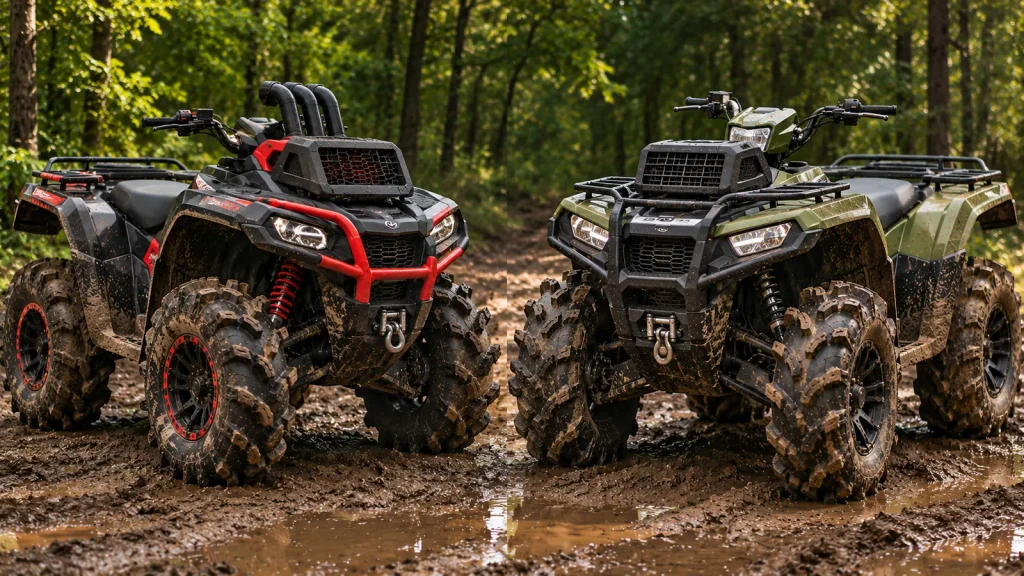
Can-Am Outlander X mr and Renegade X mr
The 2027 Outlander X mr 700 is the least expensive factory mud model in my table. Despite its name, the engine is 650cc.
It has selectable 2WD, 4WD and locked 4WD, an extra-low CVT range, power steering, 28-inch mud tires, and a relocated radiator. The 2027 specification sheet lists no standard winch. Get a fitted price for one before comparing it with a fully equipped quad.
The 2027 X mr 1000 and 1000R share the 1001cc engine displacement, raised cooling and intake equipment, 30-inch tires, selectable locking front differential and included winch.
The 1000R adds higher output and different CVT calibration, among other equipment changes. Their published starting-price difference is $2,000. I’d put that premium toward the R only if the additional performance suits your riding.
If you are shopping for an older X mr 850, don’t use the new 1000’s specifications. The 2026 lineup included the Outlander X mr 850 and 1000R with mud tires, elevated cooling equipment and a winch.
Earlier versions used different engines and tires. The 2026 Renegade X mr 650 and 1000R are also worth considering if you prefer a sport-oriented 4WD mud quad.
The 650 was listed with 28-inch Mega Mayhem tires, while the 1000R had 30-inch Cryptids and an included winch. Check the Renegade model listings for the relevant year and package. I wouldn’t assume a regular Renegade has the same mud equipment.
Polaris Sportsman Mud Edition
Polaris uses an on-demand AWD system rather than the Can-Am selectable front locker setup. The Sportsman Mud Edition specifications for the compared 2027 trims show 30-inch Pro Armor MUD XT 2.0 tires, 13.5 inches of clearance, a rack-mounted radiator, a protected clutch intake, and mud-specific gearing.
The 850 is an attractive choice if you want those large factory tires without paying for the XP 1000 package. But it lacks standard power steering and a winch. The XP 1000 costs $3,000 more at the listed base prices and adds both, along with bumpers and aluminum wheels. Its extra equipment matters more than the difference in horsepower alone.
Used listings may call an older Sportsman a High Lifter Edition. Polaris announced the 850 and XP 1000 Mud Edition models for 2025. Compare any older High Lifter using its own year-specific documentation, not the new Mud Edition table.
Confirm the exact model year before buying, especially if you are comparing a leftover 2026 machine with a 2027 model.
Honda, Arctic Cat, Bennche and other four wheelers for mud
Honda: for mixed work and muddy trails
| 2027 model | Tires (front / rear) | Clearance | Base MSRP |
|---|---|---|---|
| FourTrax Rancher 4×4 (420cc) | 24×8-12 / 24×10-11 | 7.1 in. | $7,399 |
| FourTrax Foreman Rubicon 4×4 EPS (518cc) | 25×8-12 / 25×10-12 | 9.8 in. | $9,799 |
Both Hondas in the table have shaft drive and five-speed geared transmissions. The Rancher is my lower-cost choice for ordinary muddy trails within its operating limits.
The Rubicon EPS gives you independent rear suspension, more clearance and a selectable front differential lock, which makes it worth considering for rougher mixed terrain.
The standard Foreman 4×4 sits between them in the Honda range, with a 518cc engine and swingarm rear suspension; check the exact trim if you want power steering or automatic DCT.
These are utility ATVs, not factory equivalents of an X mr. They don’t come with the same specialized mud packages. The used Honda FourTrax 300 4×4 (TRX300FW) is another potential trail quad, but it’s a much older machine.
My FourTrax 300 guide separates it from the 2WD TRX300 and explains year-specific parts and specifications. A lifted or snorkeled 300 is a custom build, not evidence of stock water capability.
Arctic Cat Alterra 600 Mud Pro
Arctic Cat has not simply left this segment to Can-Am and Polaris. The company announced the return of the Mud Pro for 2027. Its current model page lists a 597cc engine, snorkels, relocated radiator and 12.5 inches of clearance.
The $10,999 MSRP is only $300 more than the X mr 700’s listed starting price, but Arctic Cat separately lists $650 freight and $500 setup. Compare actual delivered quotes.
An independent first ride of the 2023 Alterra 600 Mud Pro described its mud-focused gearing and less settled behavior on rough dry trails.
It was a short first impression, not a durability comparison or an assessment of the 2027 machine. Older MudPro 700 and 1000 models belong on the used-market shortlist only after a condition and parts check.
Does Bennche make mudding four wheelers?
Bennche has sold conventional ATVs as well as side-by-sides. For example, a used 2021 Gray Wolf 400 dealer listing identifies a utility ATV and describes selectable 2WD/4WD, automatic low and high ranges, and 25-inch tires.
The listing has an inconsistent model name in its description, however, so I would not treat those figures as confirmed factory specifications without the VIN and manual. A Gray Wolf 550L listing also describes a conventional 4×4 ATV.
I haven’t found adequate factory documentation for a dedicated Bennche mud ATV comparable to the models in the main table.
If you’re considering a Gray Wolf, ask the seller for the exact year, operator’s manual, original tire sizes, water limits, and proof that a nearby shop can obtain drive, brake and electrical parts. Check that before spending on modifications.
Bennche Cowboy, Bighorn and Spire side-by-sides are a different vehicle category; don’t buy one thinking it is a handlebar-controlled quad.
Other standard 4×4 ATVs
The 2027 Yamaha Grizzly EPS XT-R is a useful middle ground: a 686cc engine, selectable 2WD/4WD/locked 4WD, 27×10-14 Maxxis Zilla tires and 11.8 inches of published maximum clearance.
Yamaha lists an included WARN winch and $11,399 starting MSRP, before fees, and notes the model is not available in California. Unlike the main table’s mud specialists, I’d consider it for a mix of trails and mud rather than assume it has all their intake and radiator modifications.
For a cheaper general-purpose alternative, Polaris lists the 2027 Sportsman 600 starting at $7,999 and explains that it is the renamed Sportsman 570, not a new larger-displacement engine.
It has on-demand AWD. A Suzuki KingQuad, Kawasaki Brute Force or CFMOTO CFORCE 4×4 may also be worth investigating, but compare the exact trim, low-speed gearing, tires and local parts supply before choosing.
Cheap mudding four wheelers: new, used or modified?
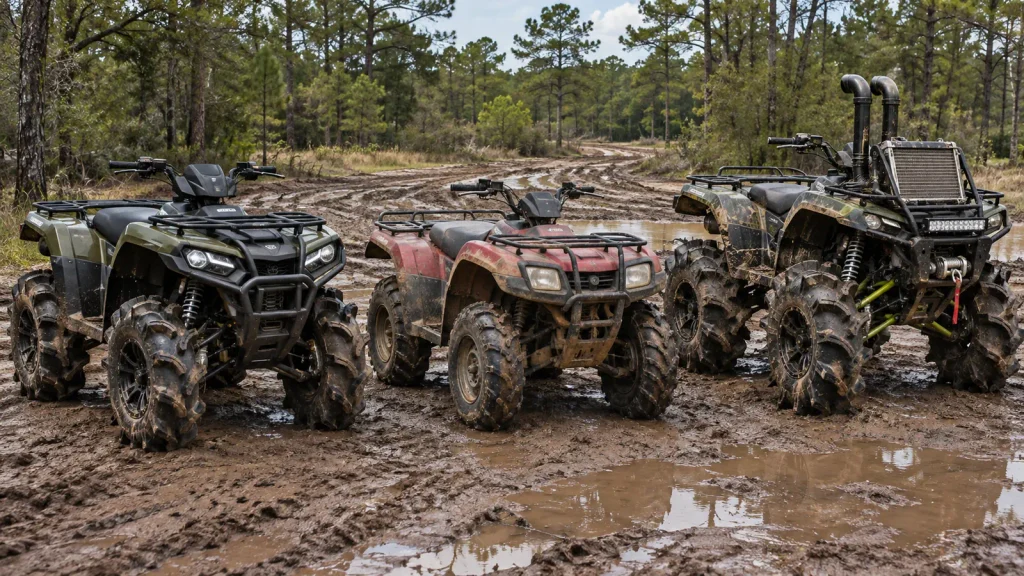
A cheap standard 4×4 and a cheap dedicated mud ATV solve different problems. The $7,399 Rancher costs $3,300 less in base MSRP than the $10,699 X mr 700, but adding tires and a winch won’t give it the same clearance, gearing, cooling or intake design.
For regular mud-pit use, start by pricing a factory package rather than trying to reproduce it piece by piece.
| Buying route | What to account for |
|---|---|
| New factory mud model | Delivered quote, missing recovery equipment, warranty exclusions, and severe-use service. |
| Used factory mud model | Prior immersion, service records, belt and driveline wear, cooling system and winch condition. |
| Standard ATV with suitable upgrades | Compatible tires, possible wheels, installation and recovery equipment; retain suitable trail handling. |
| Already modified ATV | Parts and labor to correct poor fitment, wiring, intake sealing, driveline wear and unknown fabrication. |
Here’s a hypothetical example, not a market-price estimate: a $4,500 used quad with $900 in tires and wheels, $600 in installed recovery equipment and $1,500 in repairs totals $7,500.
A better-condition $6,500 quad needing $500 in maintenance totals $7,000. The lower purchase price doesn’t necessarily produce the lower ownership cost. Neither example includes registration, tax or future maintenance.
Before buying used, inspect a cold machine, look for water or silt in the airbox, check for damaged CV boots, steering play, leaking seals, rough bearings, contaminated fluids, repaired wiring and evidence of frame damage.
Ask a qualified shop to check anything suspicious. A clean exterior doesn’t establish that the engine or driveline has never been flooded. Obtain parts prices and availability before making an offer.
Can you use a sport four wheeler for mudding?
Yes, a sport ATV can handle some ordinary muddy terrain within its intended use, but conventional rear-wheel-drive sport quads are not my first choice for rutted, deep mud.
They generally prioritize light weight, acceleration and handling rather than low-range pulling, front-wheel traction or mud-specific air and cooling equipment.
A sport-utility or recreational 4×4 is different. A Renegade X mr, for example, combines a sport-oriented layout with specific mud equipment. Don’t confuse the word “sport” on a sales page with the actual drivetrain.
My guide to different types of four wheelers explains the broader categories. And if a passenger is part of your plan, use a factory-approved two-seater ATV, not an extra seat added to a single-rider quad.
Best mud tires for four wheelers
For mixed trails, I’d first consider a compatible factory-size all-terrain or moderate mud tire. For frequent sticky mud, a more open tread with deeper lugs can help the tire clear muck as it rotates. Read the actual tire manufacturer’s fitment data, not just the sidewall’s nominal size.
| Tire family | What distinguishes it |
|---|---|
| ITP Mud Lite series | Multiple tread depths and versions. The AT version has 3/4-inch lugs; the XL uses 1-1/8-inch lugs. Consider the appropriate version for mixed or softer terrain. |
| ITP Cryptid | Aggressive mud tread and paddle-like shoulders; one 30×10-14 NHS listing weighs 43.8 lb. Confirm the exact SKU and compatibility. |
| High Lifter Outlaw Max | Deep, aggressive lugs for dedicated mud use; check available wheel sizes, tire weight and clearance. |
| Maxxis Mudzilla | Extreme-mud tread. The linked manufacturer’s Canadian catalog lists 30-inch examples; confirm US availability and fitment. |
These are examples of tire designs, not a measured traction ranking or a universal fitment list. My ATV tire types guide explains the broader tread categories, while the ATV tire size chart explains the size notation. Always check your specific model’s manual before ordering.
A 28×10-14 tire is nominally 28 inches tall and 10 inches wide, and fits a 14-inch rim. Actual mounted diameter and width can differ. Check wheel width, offset, bolt pattern, load rating, steering clearance at full lock, and suspension clearance through its travel.
Retain the manufacturer’s required front-to-rear rolling circumference relationship; mismatches can strain a 4WD drivetrain.
Heavier and taller tires increase the effort required to accelerate and brake. More diameter also raises effective gearing.
A change from a nominal 26-inch to a 28-inch tire adds about one inch of theoretical radius, not two inches of guaranteed vehicle clearance. Actual loaded tire radius, suspension layout and the lowest component determine the result.
Use the vehicle’s specified cold tire pressure and obtain applicable guidance for any approved replacement tires. A tire’s marked load-rating pressure is not automatically the ATV’s recommended operating pressure.
Don’t arbitrarily let air out for mud. The Polaris off-road tire guide explains tread selection and checking cold pressure against the vehicle label or manual.
Lifted and extreme mudding four wheelers: which upgrades are worth it?
Some heavily modified mud quads look impressive online, but they aren’t necessarily better to own or safer to ride. I’d identify the actual limitation first: are you losing traction, grounding the chassis, clogging the radiator, or struggling to recover the machine? Each problem needs a different solution.
| Modification | Purpose and tradeoff |
|---|---|
| Compatible mud tires and wheels | Improve traction or clearance; additional mass, offset and diameter can increase steering, bearing, axle and braking loads. |
| Suspension lift | May raise some chassis components and make room for tires; raises center of gravity and can alter alignment, axle angles, CV-joint travel and rollover resistance. |
| Engine intake snorkel | Raises the intake opening; creates additional sealing and routing requirements. Does not protect every vent, seal or electrical component. |
| CVT ventilation changes | May reduce exposure at air openings on belt-driven machines; incorrect routing or restricted airflow can increase heat and belt wear. |
| Radiator relocation | Reduces some mud exposure and may improve access; requires compatible mounting, hoses, airflow and proper cooling-system service. |
| Clutch or gearing changes | May better match heavier tires; incorrect calibration can compromise drivability, reliability or heat management. |
| Winch and recovery equipment | Helps controlled extraction; requires suitable mounting, electrical capacity, rated accessories and safe operation. |
Modified wheel offset or wider tires can also exceed trail width limits. A lift doesn’t establish a safe water depth, and there is no universal maximum tire size for all quads.
Ask the ATV and component manufacturers about fitment, and have critical steering, suspension, driveline and brake changes assessed by a qualified technician. Obtain written warranty details; don’t assume either that every modification is covered or that one change cancels the entire warranty.
A custom Honda FourTrax build reported by RideApart illustrates how far some show and mud builds depart from the factory machine. I wouldn’t treat its appearance or video performance as a recommendation for your own ATV.
Can mud or water damage an ATV engine even with a snorkel?
Yes. Water entering a cylinder can cause hydraulic lock and severe internal damage. A wet CVT can slip; water or mud can contaminate lubricants, clog a radiator, damage bearings and seals, or interfere with brakes and electronics. A snorkel protects only the air path it is designed and correctly installed to protect.
Never use the height of the snorkel, tires or ground clearance to decide whether a water crossing is safe. For example, the 2025 Sportsman 850 and XP 1000 Mud Edition owner’s manual specifies a maximum recommended water depth at the bottom of the footrests.
That’s an example for those models, not a universal depth limit. Follow your exact owner’s manual and avoid unknown depths, fast currents and crossings with hidden obstacles.
If an ATV stalls in water or you suspect water has entered the engine, don’t attempt to restart it. Arrange safe recovery and follow the applicable immersion inspection and service procedure first. Have the drivetrain fluids and other affected systems checked as directed. Don’t assume drying the outside has removed internal contamination.
How to prepare your ATV for mudding
- Check cold tire pressure, tread damage, wheel security and clearance.
- Inspect the brakes, throttle, steering, suspension, CV boots and 4WD operation. Check fluids, leaks, coolant and radiator airflow with the machine cool.
- Check the air filter, intake and any applicable CVT ducts and hoses.
- Inspect the winch rope, hook, mount and controls. Carry compatible rated recovery equipment and identify approved attachment points before departure.
- Follow the ATV Safety Institute’s riding guidance: wear a DOT-compliant helmet, goggles, gloves, long sleeves and pants, and over-the-ankle boots. Take ATV training, ride with a capable companion and arrange communication.
- Check authorized routes, current weather, park rules and closures. Avoid terrain beyond the vehicle’s or rider’s capability.
Use low range and the correct drive mode when the manual calls for them, and keep throttle inputs controlled. You don’t need a lift or snorkel to ride every muddy trail. You do need a mechanically sound ATV and a route that suits it.
What to do when your four wheeler gets stuck in mud
- Stop digging. Release the throttle if the tires keep spinning without progress. Assess the depth, slope, stability, rising water and whether the chassis is grounded. Don’t put yourself beneath an unstable vehicle.
- Decide if self-recovery is safe. If there is a clear, firm escape route, use only the drive modes and gentle inputs permitted by the manual. Stop if the vehicle is sinking, leaning dangerously, overheating or has suspected water ingestion.
- Prepare a controlled recovery. Follow your specific winch and ATV manuals. Inspect the rope, hook and rated accessories. Select an adequate anchor and approved attachment point; use a rated tree protector where allowed. Do not attach to steering or suspension parts unless explicitly designated for recovery.
- Keep people clear. Establish a safe area away from the tensioned line and possible vehicle movement. Wear appropriate gloves and use the supplied hook strap. Never touch a loaded line, stand in its path, shock-load it or use a winch rope as a tow strap.
- Stop if the recovery is unsafe. Pull slowly according to the equipment instructions; stop if the anchor moves, the machine becomes unstable, or the equipment reaches its limits. Obtain qualified help when safe extraction is beyond your equipment or experience.
Read WARN’s basic winching guide before you need it. Winch pulling capacity changes with the amount of rope on the drum, and the force to extract a buried vehicle can be much greater than its weight. The printed rating alone is not a guarantee of recovery.
After extraction, check the brakes and vehicle condition on safe ground. If the ATV was immersed, stalled in water, or suffered mechanical damage, follow the applicable inspection and service guidance instead of continuing to ride.
How to clean and maintain an ATV after mudding
Clean the machine before packed mud dries and hides damage. Let hot components cool, then use mild soap, a garden hose and suitable brushes as allowed by the manufacturer.
I’d avoid directing concentrated high-pressure water at the radiator, seals, wiring, wheel bearings, brakes, intake openings or control components. Different manuals specify different washing limits.
- Underbody and wheels: clear mud from skid plates, wheel wells and suspension where accessible. Check for impacts, loose fasteners, torn CV boots and leaks. Never work underneath an unsupported ATV.
- Cooling system: remove debris blocking airflow with the approved method. Don’t bend radiator fins or open a hot coolant cap.
- Air intake and CVT: inspect the air filter and applicable ducts for debris and moisture; follow the manual for filter service and suspected contamination.
- Brakes and driveline: check braking operation and look for play or damage in bearings, axles and joints. Investigate unusual noise or slipping rather than riding through it.
- Electrical and recovery gear: inspect exposed connectors, wiring, winch rope and accessories. Dry and store equipment according to its instructions.
- Fluids and lubrication: check the engine, gearbox and differential fluids as appropriate after severe use or immersion. Lubricate specified service points and follow the severe-use maintenance schedule.
The 2025 Sportsman mud-model maintenance manual and Can-Am’s mud riding guide give examples of post-water and post-mud checks. An ordinary mud ride doesn’t automatically require replacing every fluid. Suspected water contamination or immersion is a different situation and may require immediate service.
Where can you ride mudding four wheelers?
Choose a designated mud park, an authorized ATV trail that allows riding in current conditions, or private land where you have permission. Avoid protected wetlands, unauthorized waterways and closed routes.
Check whether an area has vehicle-width rules, seasonal restrictions, insurance requirements or limits on particular mud pits before driving there.
If you’re looking in the Southeast, my Alabama mud park guide can help you identify destinations to investigate. Contact the operator directly for current opening dates, allowed machines and conditions. A park listing is not permission to enter every water crossing or mud hole.
For your final buying decision, match the ATV to the riding you do most often. Get a delivered quote and equipment list for a factory mud model if mud is your main activity.
If you need one ATV for everyday work and occasional wet trails, start with a suitable standard 4×4, compatible tires and recovery preparation. Either way, get the exact manual and confirm local parts and service access before paying.

Calvin Anderson, founder of Off-Road Lord, is a seasoned off-roading enthusiast from Tucson, Arizona. With over a decade of hands-on experience and a deep understanding of off-roading vehicles and trails, Calvin’s insights provide a trusted guide for fellow adventurers.