
A used Bennche side-by-side can be a good buy for light property work, hunting or recreational riding if it’s mechanically sound, priced well and you can get parts for it. I wouldn’t buy one on price alone, though.
The uncertainty surrounding factory support makes the condition of the individual machine and access to a competent repair shop especially important.
For everyday chores, I’d start with a Bighorn 500 or 700. The Cowboy series is another option if you want a recreation-and-utility crossover, while the Spire is more sport-oriented.
A Bighorn 700X Crew is worth a look if you need a second row of seats. This is a researched review of selected historical models, not a firsthand road test or a list of currently manufactured vehicles.
Bennche side-by-side models compared
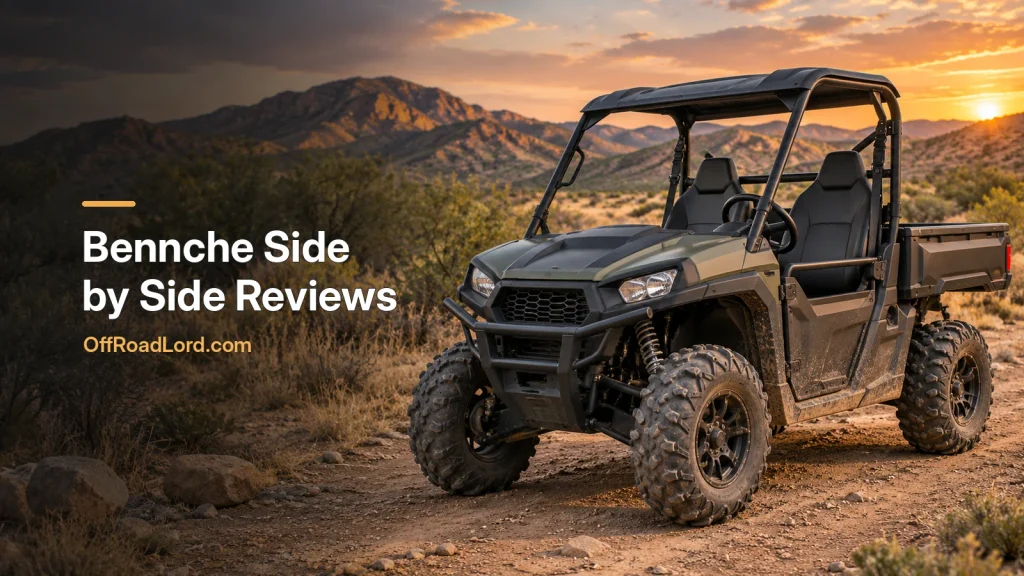
These are historical published specifications and prices, not today’s dealer quotes. EPS means electric power steering. The year or period beside each model identifies the source’s scope; don’t assume these numbers apply to another year or trim.
| Model and source period | Engine | Published dry weight | Historical price | Best use to investigate |
|---|---|---|---|---|
| Bighorn 700X Crew (2011 test) | 686 cc single | 1,540 lb | $9,250 MSRP | Multi-passenger utility |
| Bighorn 700 (2016 guide) | 686 cc single | 1,155 lb | $9,199; EPS $10,049 | Property work and trails |
| Cowboy 500 EPS (2016 guide) | 471 cc single | 1,301 lb | $9,849 | Mixed utility and recreation |
| Cowboy 700 EPS (2016 guide) | 686 cc single | 1,301 lb | $10,649 | Mixed utility and recreation |
| Cowboy 1000 (2016 guide) | 976 cc V-twin | 1,620 lb | $13,499 | Larger recreation/utility crossover |
| Spire 800 (2011 test) | 800 cc V-twin | 1,165 lb | $8,999 MSRP | Recreational riding |
| Spire 1000 EPS (2017 buyer’s guide) | 976 cc V-twin | 1,521 lb | $13,499 | Wider sport-oriented UTV |
| 2015 Cowboy 250 (historical dealer listing) | 229 cc | Not established | $4,799 stated MSRP | Small, youth-oriented utility class |
The weights above are published or claimed dry figures, not independently measured operating weights. The Crew is a four-person configuration in the 2011 multi-passenger comparison.
Check the designated seating capacity and restraint labels on each actual vehicle. I haven’t found a dependable set of stock top-speed measurements across these versions, so I wouldn’t use a speed ranking to decide which to buy.
Who makes Bennche side-by-sides?
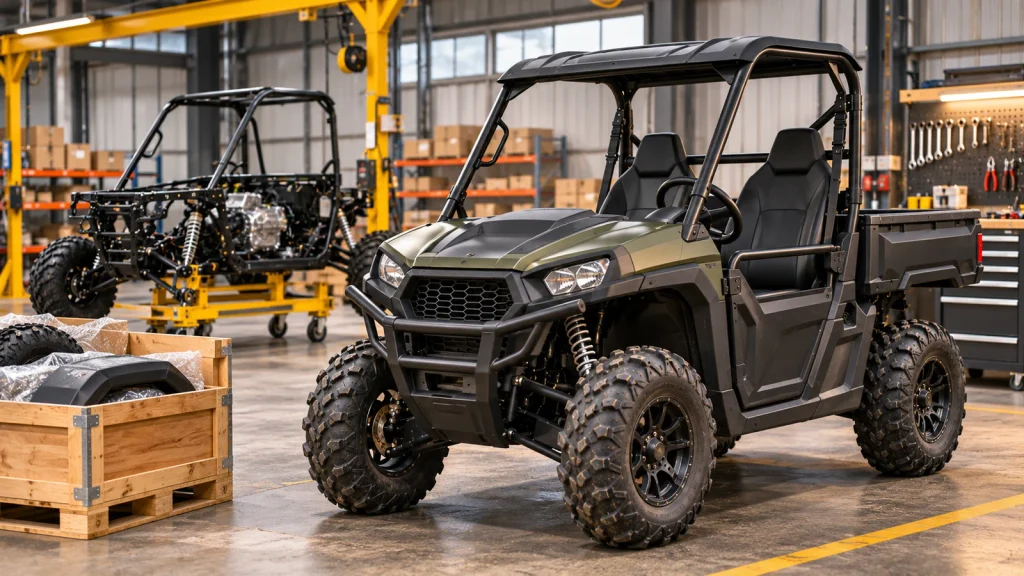
Bennche was a Texas-based powersports brand founded by Johnny Tai. The Better Business Bureau’s business profile records a November 2009 start and incorporation date for Bennche LLC.
Its historical operations included US distribution and assembly, but that doesn’t mean all of the vehicles’ components were manufactured in America.
For a concrete example of the manufacturing relationship, the California Air Resources Board’s 2012 executive order U-M-183-0003-1 names China’s Chongqing Huansong Industries and covers the 686 cc engine configuration used in the Bennche Bighorn 700 and Bighorn 700X Crew.
The same certification includes specified Hisun, Massimo and Coleman vehicles. That’s evidence of a manufacturing connection for those certified engines, not proof that every vehicle or component from those brands is interchangeable.
In January 2017, Powersports Business reported that Bennche and Massimo had formed Sportsman Country to combine aspects of their sales and dealer operations.
By 2018, UTV Action described the group’s Garland, Texas assembly facility receiving partly assembled machines from China and completing assembly locally. The group also distributed Linhai products.
Kandi’s 2018 annual report confirms the acquisition of Sportsman Country, subsequently known as SC Autosports, on July 1, 2018. It establishes ownership of the distributor, not an acquisition of every Bennche trademark, factory or separate corporate entity.
I would not assume that Kandi is responsible for an old Bennche warranty or replacement part.
Is Bennche still in business?
I would treat Bennche as a legacy brand when shopping today. The BBB profile flags Bennche LLC as potentially or actually out of business.
That’s a serious warning for a buyer, but it isn’t a certificate of dissolution. As of November 27, 2026, I couldn’t establish a current factory production program, a reliable authorized Bennche dealer directory, or a current manufacturer warranty program. The exact legal status of the company also remains uncertain.
That doesn’t mean you can’t find a Bennche for sale or buy replacement parts. Used vehicles, old stock and independent suppliers can remain in the market long after a distribution arrangement changes.
Even an unused machine may be old inventory. Ask for its model year, manufacture date, VIN, written warranty and the name of the business responsible for honoring that warranty before paying a deposit.
Bennche Cowboy, Bighorn and Spire reviews
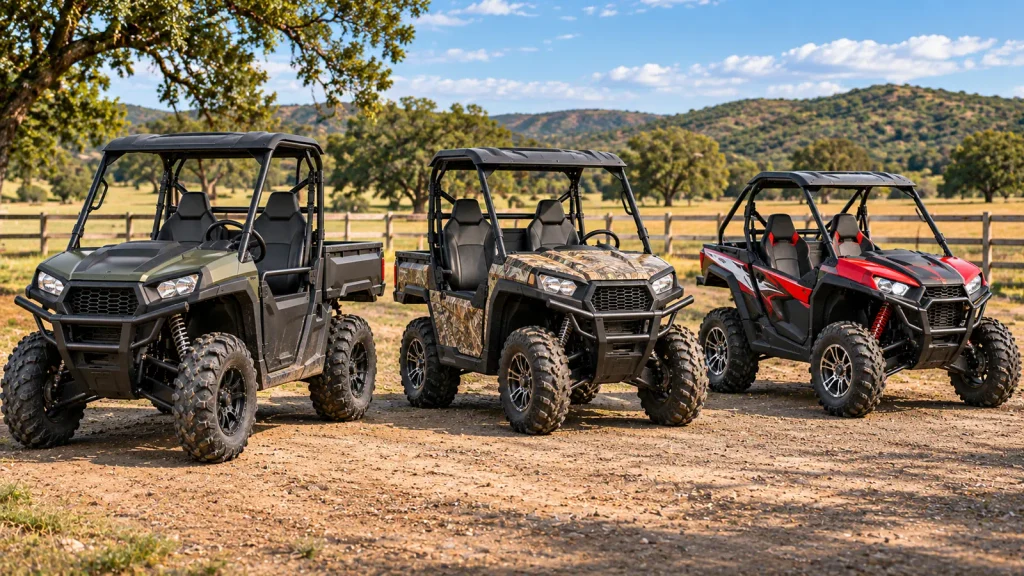
Bighorn 500, 700 and 700X Crew
The Bighorn 500 and 700 make more sense to me for routine hauling than the sport-focused Spire. For the 700, the 2016 buyer’s guide lists selectable four-wheel drive, a low range, a locking front differential, a 400 lb cargo-bed rating and a 1,200 lb towing rating.
That combination is attractive if you’re moving feed, tools or fencing materials, provided the actual vehicle’s manual confirms those capacities.
The longer 700X Crew solves a different problem: carrying more people. In his report from the 2011 Mud Nationals, UTV Guide’s Jon Crowley found the supplied Crew adequate for transporting equipment and passengers, including on sections where four-wheel drive was needed.
He also found its acceleration limited under load. That was a short event-based evaluation, not a long-term durability test.
There’s a reason I wouldn’t rely on a single online spec sheet for the Crew. UTV Guide’s test lists a 52.3-inch width, 330 lb bed capacity and 220 lb towing capacity, while UTVUnderground’s account of the same event lists 56.5 inches, 400 lb and 1,200 lb, respectively.
Both list a dry weight of 1,540 lb. The second report discloses event sponsorship. I can’t resolve the conflicting capacity and width figures from the original factory documents, so measure the vehicle and verify its load labels or applicable manual rather than towing to the higher figure.
The Bighorn 400 is another historical utility model, with a Bennche owner’s manual available. A smaller engine may be adequate for light chores, but neither its name nor its compact appearance proves it can handle your specific trailer or workload.
Newer vehicles bearing the Bighorn name should not automatically be treated as the same machine.
Cowboy 500, 700 and 1000
These are the models I’d compare if you want a utility bed but also enjoy trail riding. In the 2016 guide, the Cowboy 500 and 700 share a 60-inch width and the 1000 is 67.5 inches wide.
The 1000 has a larger twin-cylinder engine and is considerably heavier. Those differences matter if you need to get through gates, load a trailer or ride a width-restricted route.
The same guide lists a 350 lb bed and 1,200 lb tow rating for the three versions. If your main job is hauling, the smaller Bighorn 700’s listed bed capacity is actually higher.
More engine displacement doesn’t necessarily give you more payload or towing ability. Look at the physical rating of the machine, not just the badge.
The 400S was also part of the historical Cowboy family: the 2018 assembly report described it as a full-size, lower-cost recreation/utility model with a roof, windshield and winch. Check whether the particular used machine still has those accessories.
Spire 800 and 1000
The Spire is a better starting point for a recreational rider than for someone buying a dedicated farm vehicle.
The early 800 has an 800 cc V-twin and UTV Guide lists 55 hp. Crowley described its acceleration and low-end response favorably after a few hours of driving, while identifying suspension limitations for more aggressive use.
The 2011 test’s listed cargo bed is only 154 lb. The later buyer’s guide publishes different capacities for the Spire family and doesn’t clearly resolve the exact earlier-versus-later trim differences. Don’t carry or tow a load based on the later table if you own an early Spire.
The Spire 1000 EPS in the 2017 guide is 65 inches wide, with 10 inches of suspension travel at both ends, versus six inches at both ends for that guide’s Spire 800. The 1000 is therefore a different size and suspension package, not simply a faster version of the 800.
I wouldn’t recommend either on the basis of horsepower alone; inspect its steering, suspension and drivetrain closely.
Bennche 250: Cowboy 250 and Spire 250
A historical dealer listing for the 2015 Cowboy 250 identifies a 229 cc engine, automatic transmission and rear-wheel chain drive. The Spire 250 also appears in J.D. Power’s 2015 model record, although the accessible specifications are incomplete.
These are not the same size class as the adult 500–1000 cc machines. A 2015 youth UTV guide describes Bennche as one of the importers offering youth utility machines.
I wouldn’t buy a 250 for an adult simply because it costs less or fits a small trailer. Obtain the specific manual and occupant age, size, restraint and load limitations. Don’t remove a youth speed limiter or assume the age recommendation of a similar-looking Hisun applies to a Bennche.
2012, 2013, 2014 and 2016 Bennche side-by-sides
When you’re looking at older vehicles, the model year is at least as important as the engine size. The following are selected documented examples, not a complete factory lineup. The aftermarket catalog is useful for identification and parts leads, not proof of every factory specification.
| Year | Selected documented models | Evidence |
|---|---|---|
| 2012 | Bighorn 700 and 700X Crew (686 cc) | CARB certification |
| 2013 | Bighorn 500, 700, 700X Crew; Spire 800 | Dayco application catalog |
| 2014 | Bighorn 500/700 including HD versions, 700X Crew/HD; Spire 800 | Dayco application catalog |
| 2016 | Bighorn 700; Cowboy 500 EPS, 700 EPS and 1000 | Contemporary buyer’s guide |
Looking for a 2012 Bennche Cowboy? I found later Cowboy documentation, including the 2015 Cowboy 250 listing, but couldn’t establish that specific 2012 Cowboy designation from a dependable period record.
A 2012 Bighorn is documented. Ask the seller for the model plate and VIN rather than ordering a Cowboy part based on the advertisement. The absence of a model in one catalog isn’t proof it never existed.
Photograph the VIN on the frame or identification plate, the emissions label, engine identification and the original model designation.
Match those to the ownership documents. The exact location of the VIN varies; use the vehicle’s owner’s manual. If the title, plate and seller’s description don’t agree, resolve that before buying.
Bennche side-by-side problems and reliability
I couldn’t find a representative fleet study that establishes Bennche’s failure rate or expected service life.
A handful of owners with problems isn’t a reliable measure of how often the whole brand breaks down. Still, there are useful clues to what you should inspect.
| Issue or symptom | Evidence and what to check |
|---|---|
| Starting or fuel delivery | The Bennche owner forum includes threads about starting and fuel-pump difficulties on Bighorn, Cowboy and T-Boss models. Check battery condition, terminals, charging output, fault codes and fuel delivery with the correct service information. A thread title does not diagnose the cause. |
| Overheating | An editorial Bighorn 700 troubleshooting article describes an individual overheating incident and discusses other possible causes. With the engine cold, inspect coolant level, radiator blockage, leaks and hoses. Have fan operation and overheating diagnosed before putting the machine back to work. |
| Incorrect replacement cooling component | A 2015 Cowboy 500 owner reported that a replacement temperature switch had the wrong thread size. This is one reported fitment problem, not a confirmed universal switch defect. Match the original part number and dimensions. |
| Shifting or loss of drive | Owner forum topics include shifting difficulty and a machine that would not move in gear. Check the correct gear engagement, linkage and belt condition; a damaged clutch, transmission or other driveline component requires proper diagnosis. |
I would not bypass a cooling fan control, alter an electrical safety interlock or replace a head gasket on the strength of an online complaint.
A failed belt and a damaged transmission can produce similar symptoms, and a replacement part won’t fix an underlying electrical or cooling fault.
Beyond those reports, worn bearings, torn CV boots, leaking brakes, damaged steering joints, poor charging and neglected wiring are general used-UTV inspection risks, not established Bennche-specific defects.
For safety notices, search the CPSC recall database using the brand, exact model and any identified manufacturer or importer.
My brand-name search didn’t establish an applicable recall for the selected machines; that is not proof that every Bennche is recall-free. Ask the seller for remedy documentation if a recall applies, and don’t operate a vehicle with unresolved safety-critical defects.
How much does a Bennche side-by-side weigh?
Among the adult examples in the early comparison table, published dry weights run from 1,155 lb for the Bighorn 700 in the 2016 guide to 1,620 lb for the Cowboy 1000 in that guide. That is a selected historical sample, not the lightest and heaviest Bennche ever made.
Dry weight excludes some operating fluids under the source’s definition. Curb or operating weight includes fluids under the applicable manufacturer’s definition, and neither necessarily includes your aftermarket equipment, mud or cargo. Gross vehicle weight ratings and payload are separate figures.
When you’re selecting a trailer, use the actual loaded weight of the UTV, trailer and gear, and stay within the applicable trailer, tow vehicle, hitch and axle ratings. Weigh the machine if the margin is tight.
How fast does a Bennche side-by-side go?
There’s no single Bennche top speed. The 250, Bighorn 700, Spire 800 and Cowboy 1000 have different engines, drivetrains, gearing and intended uses.
I couldn’t establish comparable factory speed limits or documented GPS top speeds for these exact versions. A horsepower figure or an owner video is not a verified stock top speed.
If speed matters, ask for the original model-specific specifications and whether the vehicle has been modified.
Don’t attempt a high-speed test on an unfamiliar used vehicle or remove its speed limiter. Also, a published width of about 52 inches for an older Spire 800 doesn’t make it eligible for a 50-inch trail.
My compact UTV comparison gives you other width-focused options to investigate; recheck current specifications before purchasing.
What bolt pattern does a Bennche side-by-side have?
Don’t assume a universal Bennche bolt pattern. I couldn’t establish an exact front-and-rear factory bolt-pattern chart for the selected model years. Do not order wheels until you have the correct model-specific fitment.
On a four-stud hub, the pitch circle diameter is the center-to-center distance between opposite studs. A 4×110 pattern, for example, means four studs on a 110 mm circle.
Check both axles, the center bore, wheel width, offset, lug thread and seat type, brake clearance and load rating with your wheel supplier. Matching the bolt pattern is only one part of wheel fitment.
For an example of documented tire size, the 2011 Spire 800 review and the 2016 Bighorn 700 guide each list 25×8-12 fronts and 25×10-12 rears for those specific versions.
These sizes indicate nominal tire height, width and rim diameter in inches, not the bolt pattern. Larger tires or different wheel offsets can cause rubbing or change steering and driveline loads.
How to check oil on a Bennche side-by-side
Here’s the procedure for the Bighorn 400 covered by the available owner’s manual, not a universal method for every Bennche engine. Read page 8-11 and page 8-12 (viewer pages 111 and 112).
- Park on level ground, secure the vehicle and remove the console to reach the engine oil filler.
- Check the oil with the engine cold. If you already started it, the manual specifies warming it sufficiently, then shutting it off and allowing at least ten minutes for the oil to settle.
- Take out the filler cap and clean the dipstick.
- Reinsert the dipstick without threading it into the filler, then withdraw it to read the level.
- The reading should fall between the lower and upper marks. Add the specified oil as necessary without overfilling.
- Secure the cap and reinstall the console.
Other Bennche engines may require a different access point, temperature or dipstick method.
Confirm the oil grade, oil capacity with or without filter replacement, service interval and tightening specifications in your actual manual. Engine, final-drive and differential fluids are different service items. Don’t pour an assumed capacity into an engine based on its badge alone.
For ongoing maintenance, keep a dated record of oil and filter changes, air-filter cleaning, coolant checks, brake inspection and belt service.
If the battery needs replacing, match its dimensions, terminal orientation, voltage, capacity and starting-current requirements to the original specification.
Avoid treating an old manufacturer’s schedule as applicable to a different engine or a modified vehicle.
Where to find Bennche parts and service
There are still useful online parts references for old Bennche UTVs. A catalog entry doesn’t guarantee that a part is stocked, but it gives you a way to start a specific fitment inquiry instead of searching the badge alone.
| Resource | What it can help with |
|---|---|
| PartsBoss Bighorn 700 catalog | Mechanical assemblies including air-filter, braking, clutch, electrical, cooling, differential and transmission groups. Check exact year, part number and actual availability. |
| Dayco powersports application catalog | Model/year-specific CVT belt cross-references for selected Bighorn, Cowboy and Spire vehicles. |
| UTV Parts and Accessories | Model-family navigation for Cowboy, Bighorn and Spire, including accessory categories for Bighorn 500/700. |
| KFI application chart for mount 106010 | A specific accessory mount shared by listed Bennche and Massimo T-Boss 550/750 applications through 2022, subject to the chart’s notes. |
For a concrete belt example, Dayco lists XTX2241 for the 2016 Bighorn 700, referencing original part 25300-004-2241. It lists XTX2236 for the 2016 Cowboy 1000, referencing original part 25300-004-2236.
The difference is why I check the model and part number before buying even a routine wear item. Confirm the catalog entry with the supplier and the original belt, particularly if the clutch or engine has been changed.
Before paying for a vehicle, price and confirm availability of the belt, filters, brake components, wheel bearings, axles, starter, fuel-system components and cooling parts appropriate to that VIN.
For expensive electronic modules, engine or transmission components, get a written quote or a confirmed repair option. Used or salvage parts may help with discontinued components, but don’t substitute an unidentified used brake or steering part.
Are Bennche, Hisun and Massimo parts interchangeable?
Some are, but you have to establish the fitment of the specific component. The 2012 emissions certificate shows a shared engine manufacturing connection, and KFI’s mount chart provides an example of confirmed cross-brand accessory fitment.
Neither establishes universal electrical, brake, suspension or transmission compatibility.
Match the year, trim, VIN, engine code and original part number. Compare connector pinouts, dimensions and mounting details where appropriate.
Use an applicable manufacturer’s cross-reference or written supplier confirmation, rather than assuming a Yamaha Rhino, Hisun or Massimo part will fit because it looks similar.
Finding a dealer or independent service shop
I couldn’t establish a dependable current authorized Bennche dealer list. A dealer advertising a used Bennche may not be able to obtain factory warranty parts.
Call independent powersports repair shops and former dealers before purchasing, and ask whether they accept your exact model, have diagnostic information for its fuel system, can source parts, and can carry out cooling, electrical and CVT work.
If the shop won’t take the machine and you can’t repair it safely yourself, I’d cross that particular Bennche off my list. Parts availability online does not help much if you cannot obtain the correct component or get it installed.
How much does a Bennche side-by-side cost used?
The historical adult models in the first table were advertised at roughly $9,000 to $13,500 when new, depending on version. Those prices are context for the original market, not current values.
There is at least one documented resale example: a 2014 Bennche Bighorn 700 listed as a crew cab with an indicated 114 hours sold at auction on March 18, 2022 for $5,750 plus $172.50 buyer’s premium, or $5,922.50 before other charges.
The auctioneer does not guarantee model year or condition. This is an older transaction, not a current asking price or a national valuation.
I couldn’t establish a sufficiently reliable current asking-price or transaction sample to quote a 2026 used-price range. Get several recent local offers for similar condition and capacity, rather than using an old MSRP as a negotiating target. Mileage, hours, paperwork, maintenance, corrosion, modifications and the actual availability of repair parts matter more than the original purchase price.
My rule is to compare the purchase price plus transport, fees, inspection and immediate repairs with the equivalent all-in price of a better-supported used UTV. For example, if a Bennche is $3,500 and your written initial repair estimate is $1,500, you’re already at $5,000 before other expenses.
If a suitable $5,500 alternative has no equivalent immediate repair bill, the initial $2,000 price advantage is only $500. That’s a hypothetical comparison, not a market estimate. Decide whether the remaining savings justify your future parts and downtime risk.
Used Bennche buying checklist
I’d want a cold start, a careful inspection and a short, safe low-speed demonstration before committing to any older Bennche. Ask the seller not to warm it up beforehand. Here’s what I would check or have a mechanic check.
- Identity and paperwork: Confirm the VIN, model designation, title or transferable ownership documents, and maintenance records. Verify your state’s title and registration requirements.
- Engine and cooling: Look for hard starting, smoke, unusual knocks, uneven idle, warning lights, leaks and evidence of overheating. Inspect oil and coolant when safe; never open a hot cooling system.
- Drivetrain: Check forward and reverse, low and high ranges if fitted, parking position or brake and selectable 4WD according to the manual. Have the belt and clutch inspected if engagement is erratic.
- Steering and suspension: Check wheel play, bearings, ball joints, tie rods, shocks, CV boots and axle condition. Have a qualified shop inspect underneath using safe lifting equipment.
- Brakes and protective structure: Inspect braking response, fluid leaks, tire condition, frame corrosion, cage attachment points, restraints and doors or nets. Walk away from unresolved structural or safety-critical damage.
- Electrical system: Look at battery terminals, harness repairs, fuses, charging operation, lights, fan operation and any fault indicators. Be cautious with improvised bypasses and spliced wiring.
- Mud or water exposure: Look for silt, corrosion, contaminated fluids, wet air-filter housing and neglected connectors. Deep-water use can create problems that aren’t visible in a quick drive.
- Parts and downtime: Identify existing faults and confirm the correct replacement parts, lead times and local repair costs. Budget for neglected maintenance even on a running machine.
If the seller refuses a cold start or a pre-purchase inspection, I wouldn’t base my decision on the asking price. A vehicle with an unresolved no-start or transmission fault is a repair project, not a ready-to-work UTV.
Bennche vs. Hisun, Massimo and other affordable UTVs
Compare actual machines that meet the same job and budget, not whole brands based on reputation. A well-maintained older Bennche and a neglected used vehicle from a more established brand aren’t equivalent purchases.
| Alternative | Why investigate it | What to confirm |
|---|---|---|
| Hisun | Comparable utility and recreation categories; an official US dealer/service locator is available. | Local shop acceptance, exact model, parts and warranty eligibility. Hisun support for its own vehicles does not automatically extend to Bennche. |
| Massimo or Coleman | Comparable budget-oriented historical models and some documented manufacturing connections. | Responsible distributor, current service route, model-specific capacity and written warranty. Don’t assume a shared badge history means shared coverage. |
| CFMOTO | Another brand to include when comparing similarly priced utility or recreational vehicles. | Local dealer, age, condition, actual quote and applicable parts availability. |
| Used Honda, Kawasaki, Polaris or Can-Am | Useful alternatives when a local shop has established model-specific service knowledge. | Comparable condition, suitable cargo and towing ratings, service history and total cost. Brand alone doesn’t guarantee reliability. |
My UTV brand overview is a starting point for identifying other manufacturers; its model and price examples are historical, so verify current support and pricing independently. If you’re buying specifically to work every day, prioritize service turnaround and the availability of safety-critical components over extra accessories.
Which Bennche side-by-side should you buy?
For routine property work, I’d shortlist the Bighorn 500 or 700, based on the condition of the actual machine, the available replacement components and its verified load ratings.
If you need four designated seats, look at a properly identified 700X Crew. For recreational riding, compare a Spire 800 or 1000 with a similarly priced sport UTV, checking the width and suspension package. A Cowboy 700 or 1000 may be a reasonable crossover if your use really calls for it. None is a proven reliability winner.
A Bennche makes the most sense if you have a limited budget, moderate work requirements, a reliable repair option and time to source model-specific parts. It makes much less sense if you need a dependable manufacturer-backed warranty, cannot tolerate downtime, or have no local service option.
My buying decision comes down to three things: a correctly identified and mechanically sound UTV, a confirmed route to the parts it needs, and a meaningful price advantage after the immediate repair bill. If any of those is missing, I’d spend the money on an alternative that I can keep running.

Calvin Anderson, founder of Off-Road Lord, is a seasoned off-roading enthusiast from Tucson, Arizona. With over a decade of hands-on experience and a deep understanding of off-roading vehicles and trails, Calvin’s insights provide a trusted guide for fellow adventurers.