
Hybrid UTVs are real, but your choices in the United States are far narrower than the name suggests. HuntVe currently advertises a gas-generator-equipped Switchback Crew 4×4 with US pricing and dealer contacts.
SWM lists several gas-electric Nomader hybrids in its 2026 global lineup, but I could not establish a US retail offer for those exact models. The Segway Super Villain hybrid you may remember from earlier announcements isn’t the same as the gasoline-only Super Villain SX20T that reached US dealerships in 2026.
If you need a hybrid side-by-side for hunting, ranch work, or property maintenance, I’d start by checking the actual drive system, dealer support, and the exact vehicle you can take delivery of—not a concept’s horsepower figure. Here’s how I’d separate real buying options from attractive announcements.
Hybrid UTVs you can buy—or investigate—in the US
The first table is deliberately short. It contains a genuine gas-electric design that is actively marketed in the US with a manufacturer price and US dealer listings. A listing is not proof that a unit is in stock. I would confirm a specific new unit, its battery, and its service coverage before placing a deposit.
| US-listed hybrid | How it works | Published work and passenger details | Price and purchase status |
|---|---|---|---|
| HuntVe Switchback Crew Hybrid-Electric 4×4 | Electric traction through dual direct-drive motors; gasoline generator charges the drive batteries | Four seats; power dump bed; 57-inch published width; 1,200-lb vehicle capacity (not a verified towing rating) | $25,739 base MSRP plus equipment/destination. A US dealer listing shows the same price but says “Call for Availability.” |
HuntVe describes the Switchback as an electric-drive machine with an onboard gasoline range-assist generator, rather than a conventional engine-driven transmission.
Its product page lists a 72-volt electrical system, dual direct-drive motors, a 460cc generator, a 25-mph maximum speed, and a 137 × 57 × 82-inch overall size.
Its 2-inch receiver hitch is not a published towing capacity. Don’t treat the 1,200-lb vehicle-capacity number as permission to tow a 1,200-lb trailer or load that much into the bed.
There is a specification wrinkle worth resolving before purchase. The HuntVe homepage describes a 15.3-kWh lithium battery and roughly 30-plus miles of electric driving followed by roughly 30-plus miles of generator-supported range, assuming moderate off-road conditions.
Its separate FAQ has an older-looking 15-mile electric and 50-plus-mile generator description. Meanwhile, the Switchback product listing uses the wording “Max Ranger batteries” rather than identifying that lithium pack.
I would ask for a written build sheet showing battery chemistry, usable capacity, generator version, and the range claim for the exact machine. Those are not interchangeable specifications.
Other hybrid UTV names: real powertrains, uncertain availability, and concepts
Don’t interpret the following table as a US dealer inventory. These vehicles and projects belong in different market-status categories.
| Model or project | What the evidence establishes | US buying status |
|---|---|---|
| HuntVe Onrange Hybrid-Electric 4×2 Crew | HuntVe titles the page “Hybrid-Electric” and lists $31,895 base MSRP, but the description calls the vehicle all-electric and doesn’t specify a gasoline generator. A dealer’s $22,999 listing also says call for availability. | Status unresolved: advertised name and prices, but the hybrid hardware and current configuration need written confirmation. |
| SWM Nomader Hybrid PRO and Crew Hybrid PRO (2026 catalog) | 650cc engine plus electric motor, stated 160-hp hybrid system, 2-seat and 4-seat versions, selectable 2WD/4WD. | 2026 global catalog offering; US retail unconfirmed. No established US delivered-unit price or dealership stock for these trims. |
| SWM Nomader Hybrid ULT and Crew Hybrid ULT (2026 catalog) | 999cc engine plus electric motor; advertised 210-hp hybrid system, with 3-seat and 6-seat configurations shown. | 2026 global catalog offering; US retail unconfirmed. No verified US MSRP for the exact trims. |
| Segway Super Villain SX20T Hybrid | A 2024 CES prototype with gas engine and electric assist; announced power figures concerned that hybrid prototype. | Prototype/announced configuration; US hybrid retail unconfirmed. Do not confuse it with the production gasoline model. |
| Toyota Scion 01 Concept (unveiled 2025) | Toyota calls it an engineering exercise with hybrid power and electric-only Silent Mode. | Concept only. No retail price or orderable US model established. |
| Bad Boy Buggies Ambush iS (2014-era) | Separate gasoline rear drive and electric front drive that can work together. | Historical. Used-vehicle considerations only, not a new-model recommendation. |
| ASW Landmaster Crew Hybrid (2011-era) | Reported gas rear-drive and electric front-drive systems. | Historical. No current new-US-retail offering established. |
What about the 2026 Segway Super Villain?
This is one of the most costly confusions a buyer can make. Older hybrid announcements described a more powerful electric-assisted machine. But Segway’s May 15, 2026 US retail announcement identifies the delivered SX20T as a 235-hp, 2.0-liter turbocharged gasoline side-by-side, priced at $33,999.99. The press release does not establish an electric traction motor on the production model. That price is for the gasoline SX20T, not a hybrid.
What SWM’s specifications do—and don’t—tell you
SWM’s published Nomader Hybrid PRO data list an 830-kg (1,830-lb) towing capacity and a 450-kg (about 992-lb) cargo-box capacity for its 650cc two-seat and four-seat variants.
The brand’s 999cc Hybrid ULT page is internally inconsistent: its promotional copy promises 2,500 lb towing, while its detailed table lists 1,830 lb. The same page displays differing warranty periods between configurations. I’d obtain a US-applicable, signed spec sheet and warranty before using either ULT figure to choose a trailer.
Both SWM pages list a 12V/20Ah battery. That is not adequate evidence for the capacity of the hybrid’s traction battery. The pages also leave fuel capacity or other range-critical fields blank, so a trustworthy combined range or plug-in capability cannot be calculated from their online tables.
An international catalog page, even one listing a year and warranty, is not proof of US stock, parts availability, or homologation.
What is a hybrid UTV, exactly?
A hybrid UTV uses both a combustion power source and an electric propulsion system. But the way those two systems work together changes everything: how you drive, whether you plug in, what makes noise, and what needs service.
- Gasoline UTV: the engine provides the power to move the vehicle. A starter battery, alternator, power steering motor, or “Hybrid White” paint color doesn’t make it a propulsion hybrid.
- Battery-electric UTV: electric traction motors move the vehicle using energy stored in a battery; there is no onboard combustion engine powering the trip.
- Series hybrid/range extender: electric motors provide traction, while an engine-driven generator produces electricity. The HuntVe Switchback is an example of this generator-supported electric-drive arrangement.
- Parallel or dual-drive hybrid: a combustion engine and electric propulsion both contribute to moving the vehicle. The historical Ambush iS could run gasoline rear-wheel drive, electric front-wheel drive, or both axles together. Other parallel architectures may combine power mechanically.
- Plug-in hybrid: a hybrid that also accepts external electricity to charge its traction battery. Not every hybrid has a plug, and not every hybrid offers meaningful electric-only travel.
One terminology trap: people also call a utility/recreation UTV a “hybrid” because it mixes work and sport features. A gasoline Polaris General, Honda Pioneer, or Can-Am Commander doesn’t become gas-electric just because it handles both chores and trails. For the general vehicle categories, see my explanation of what a UTV is.
Hybrid UTV vs electric UTV vs gas UTV
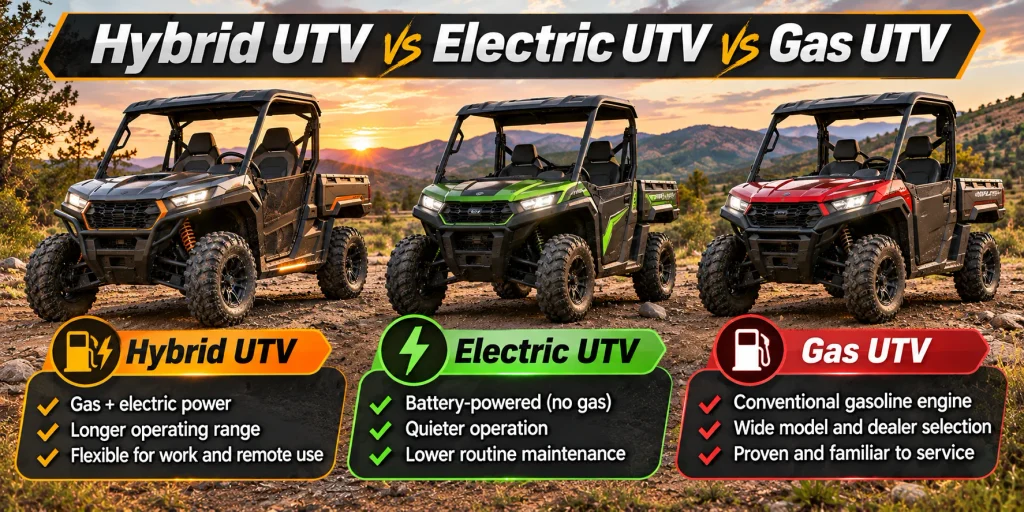
To me, the right question isn’t which powertrain sounds most advanced. It’s which one can finish your job and be repaired near you.
| Buying factor | Gas-electric hybrid | Battery-electric | Gasoline |
|---|---|---|---|
| Energy on a remote property | Gasoline available for a range extender on applicable models; some also plug in | Reliable charging supply required, or planned off-grid generation | Refuel from an approved gasoline supply |
| Quiet operation | Can be quieter in genuine electric-only mode; generator or engine makes noise when running | No combustion-engine sound while driving; tires/drivetrain still audible | Engine operates during propulsion |
| Work torque | Electric traction can aid low-speed control; ratings are model-specific | Electric traction torque; tow/bed ratings vary widely | Engine plus gearing/CVT; tow/bed ratings vary widely |
| Energy efficiency | Depends on architecture, generator losses and usage; savings not assured | No onboard gasoline consumption; charging and upstream generation still cost money | Fuel is consumed throughout engine operation |
| Range and downtime | Can combine stored electricity with gasoline-supported operation; manufacturer range claims differ | Check usable battery capacity, charger and your duty cycle | Check tank, actual fuel use and access to fuel |
| Maintenance | Engine/generator plus battery, controllers and electrical traction components | Battery, motors, controls, brakes and chassis; no engine oil changes | Engine, driveline, filters, fluids, brakes and chassis |
| Service and repair | Potentially specialized hybrid diagnostics and more limited model support | High-voltage/electric expertise may be necessary | Often broader established service choices, depending on make |
| Purchase cost | Quote exact hybrid model; no defensible market-wide average | Broad range; compare same-capacity machines | Broad range; compare same-capacity machines |
For a battery-only alternative, I keep a separate electric UTV buying guide. Don’t compare a four-seat hybrid crew machine with a basic two-seat electric turf vehicle and treat the price difference as the cost of going hybrid. Compare seats, 4WD, towing, bed capacity, battery, and service support before comparing price.
When a hybrid side-by-side makes sense
Hunting and wildlife work
If you want electric traction near a stand or field, followed by the option to replenish a battery without grid power, a generator-equipped hybrid is worth investigating.
The Switchback’s electric-drive arrangement directly addresses that requirement. But “quiet” isn’t the same as silent: once its generator runs, you’ll have engine noise and exhaust. Confirm electric-only distance on your terrain and where you can safely operate the generator.
Farms, ranches, and large properties
A hybrid can fit frequent short errands followed by occasional remote work, especially when electric charging is available at the barn. Before deciding, add up people, tools, feed, trailer weight, grades, and daily distance.
I’d reject a hybrid whose manufacturer won’t give me a clear trailer rating or a nearby authorized service path. My separate farm UTV guide covers conventional work-vehicle choices if you don’t need an electric drive mode.
Off-grid and commercial properties
An onboard generator may reduce dependence on a fixed charging point, but gasoline still has to reach the property, and generator charging converts fuel into electricity with losses.
If you mainly transport materials all day, a conventional gas UTV with a documented tow rating and local service might be the more dependable purchase. For a fleet, ask who can diagnose the controller or traction battery and how much downtime replacement parts could cause.
Recreation and tight trails
Don’t assume a hybrid fits every route. The Switchback’s listed 57-inch width is too wide for trails signed with a 50-inch limit. If width is your binding constraint, start with my compact UTV comparison rather than forcing a hybrid onto a trail it cannot legally or physically use.
Reasons not to buy a hybrid UTV
There are several rational reasons to choose gas or a full EV instead.
- Your local support is weak. A sophisticated drivetrain is little use when the nearest qualified technician is hours away or parts aren’t stocked.
- You tow frequently. A 2-inch hitch, motor output, or total vehicle capacity isn’t a certified tow rating; missing or conflicting data are purchasing red flags.
- You need continuous quiet operation. A pure battery-electric UTV avoids the noise of a running onboard generator. It may be the better fit if charging and range are sufficient.
- You want a simple, inexpensive workhorse. A common gasoline utility UTV may offer more available dealer support and fewer specialized components.
- You expect automatic fuel savings. There are no comparable, independent hybrid-versus-gas UTV fuel-economy tests here that justify a universal savings claim.
- You need immediate delivery. Announced models and dealer listings marked “Call for Availability” are not interchangeable with a confirmed in-stock vehicle.
Hybrid UTV prices and what ownership may cost
The Switchback’s $25,739 figure is a base manufacturer MSRP, not an out-the-door quote. Destination, setup, tax, accessories, and registration costs may change the amount.
The HuntVe Onrange hybrid-titled page’s $31,895 base MSRP conflicts with a dealer’s $22,999 listing and its own all-electric description; I’d verify which configuration is actually being priced.
SWM doesn’t provide a comparable confirmed US retail price for the specific Nomader hybrid variants on the cited product pages. Segway’s $33,999.99 is for a gasoline production machine, not a hybrid benchmark.
Your total cost is purchase price + fees + gasoline + grid electricity + planned maintenance + repairs + depreciation. On a generator-electric machine, record both fuels rather than reporting electricity use alone.
Here’s an accounting illustration, not a vehicle efficiency estimate: suppose your own annual records show 50 gallons purchased at $3.50 per gallon and 300 kWh drawn from your outlet at $0.18 per kWh.
That’s $175 for gasoline and $54 for electricity, or $229 in purchased energy before servicing, fees, and battery replacement. The same inputs say nothing about how far that UTV traveled, whether another UTV did equivalent work, or whether the hybrid saved money.
For charging-cost arithmetic using your own electricity rate and measured pack energy, my electric UTV charging-cost calculator can help with the plug-in portion. It does not model generator fuel burn or certify a hybrid’s total operating cost.
Hybrid UTV range, fueling, and charging
Three numbers often get blended in advertisements: electric-only miles from a charged traction battery, generator-supported miles while consuming gasoline, and total operational range under one stated test. These aren’t interchangeable.
HuntVe’s homepage estimates 30-plus electric miles and another 30-plus generator-supported miles for the Switchback Crew in moderate off-road conditions. Its separate FAQ presents a materially different 15-mile/50-plus-mile split.
Neither is a verified range measurement for your trailer, hills, mud, cold-weather trip, or driving speed. I wouldn’t add different pages’ figures together or use them to plan a remote return route without a real-world margin established for your route.
The Switchback uses an onboard 110/120-volt charger according to its charging FAQ; the generator is a backup or range extender, not an excuse to ignore external charging when available.
A hybrid with mechanical electric assist may have different charging needs entirely. For a plug-in system, confirm compatible outlet voltage, charger output, battery chemistry, safe storage temperatures, and who can service the charging equipment.
You can estimate wall-charging time with my UTV charging-time calculator after obtaining the traction battery capacity and actual charger power.
SWM’s online Nomader hybrid tables don’t establish usable traction-battery kWh, electric-only range, combined driving range, or external charging capability.
The listed 12V/20Ah figure should not be repurposed as a propulsion-battery specification. Likewise, a generator’s fuel-tank size does not establish range without applicable fuel-consumption and operating conditions.
Maintenance, reliability, warranty, and repair support
Hybrid doesn’t automatically mean unreliable, and it doesn’t mean maintenance-free. The tasks depend on whether gasoline drives the wheels directly or runs only a generator.
With a generator-supported electric-drive UTV, plan for the generator’s engine oil, intake filter, fuel system, exhaust, and safe ventilation plus the vehicle’s traction battery, charger, controllers, electric motors, brakes, suspension, and tires.
If both gas and electric systems propel the vehicle, mechanical drive components may add further service. Use the exact vehicle’s maintenance manual for intervals; don’t borrow a schedule from another architecture or model year.
HuntVe’s 2026 owner-document collection includes hybrid generator and battery guidance, and the company directs owners to authorized HuntVe service representatives.
The manufacturer also describes an estimated lithium battery replacement cost on its site, but that’s not a fixed repair quote for your pack or year. Request a written battery replacement price, installation labor estimate, and warranty exclusions before buying.
SWM’s Nomader tables display warranty language, but the Hybrid ULT page is inconsistent between standard and Crew versions, and neither establishes that a nearby US dealer will honor it for an imported vehicle.
A technical support contact, parts lead time, warranty labor coverage, and an authorized repair location matter more than a generic statement that a hybrid is “low maintenance.”
If you’re considering an older Bad Boy Ambush iS, check its serial number against the 2014 US Consumer Product Safety Commission brake-related recall and confirm completion of the remedy. That specific recall is not evidence that today’s HuntVe or SWM models share the same issue.
My hybrid UTV buying checklist
- Ask for the VIN and exact build sheet. Confirm manufacturer, model year, trim, seats, real gas-electric traction architecture, and battery chemistry.
- Confirm US retail delivery. Request an actual unit or factory order, an out-the-door price, estimated freight, and written cancellation terms.
- Get capacity ratings in writing. Check certified towing rating, cargo-box capacity, total payload/vehicle capacity, tongue-weight limit, and combined passenger/cargo limits. Don’t substitute one for another.
- Match the work. Check 4WD configuration, hill performance, physical width, trailer load, and how far you must travel before refueling or charging.
- Separate range claims. Ask for electric-only, generator-supported, and total range along with test conditions; check fuel-tank capacity and accessible usable traction kWh.
- Plan charging and generator use. Confirm whether it plugs in, what AC connection it needs, whether the generator charges while moving, and safe ventilation instructions.
- Lock down support. Obtain an authorized service location, diagnostic capability, parts lead times, traction-battery replacement estimate, and written hybrid-component warranty.
- Quote a comparable gas and electric alternative. Compare the full price and ownership tasks, not the label or advertised horsepower alone.
Is a hybrid UTV worth buying?
Yes, when its particular hybrid function solves a problem you actually have. If you need electric driving for part of a property route and a gasoline-supported way to replenish charge in remote areas, I’d investigate the HuntVe Switchback first.
Its active US manufacturer listing gives you a real starting point, but I wouldn’t order until the exact battery build, delivery, capacity and service arrangements are confirmed.
If you need higher towing ratings, readily available parts, and straightforward daily work, compare conventional gasoline models. If low-noise driving is the entire goal and charging is practical, compare full-electric machines.
And if you want a SWM, Segway hybrid, or Scion concept specifically, confirm that the hybrid configuration itself exists as a deliverable vehicle in your market before treating an announcement as a shopping option.

Calvin Anderson, founder of Off-Road Lord, is a seasoned off-roading enthusiast from Tucson, Arizona. With over a decade of hands-on experience and a deep understanding of off-roading vehicles and trails, Calvin’s insights provide a trusted guide for fellow adventurers.