
The Honda FourTrax Rancher 4×4 is my pick for the best Honda 4 wheeler for most adults who want one ATV for property chores, hunting and weekend rides. It gives you selectable four-wheel drive, a 420cc engine and a five-speed foot-shift transmission without the price of a premium automatic model.
If you want automatic shifting and power steering, I’d move up to the Rancher Automatic DCT EPS. For regular muddy trails, heavier towing or snow removal, I’d choose the Foreman Rubicon 4×4 Automatic DCT EPS instead.
The compact Recon makes more sense for light work on firm ground, while the TRX250X is the new Honda I’d consider for recreational sport riding.
These are buying recommendations based on equipment, dimensions, capacities and published prices, not a claim that I rode every model. Honda’s 2027 utility ATV announcement and US ATV lineup establish the new-model scope; dealers may also have earlier model years in stock.
Best Honda four-wheelers compared
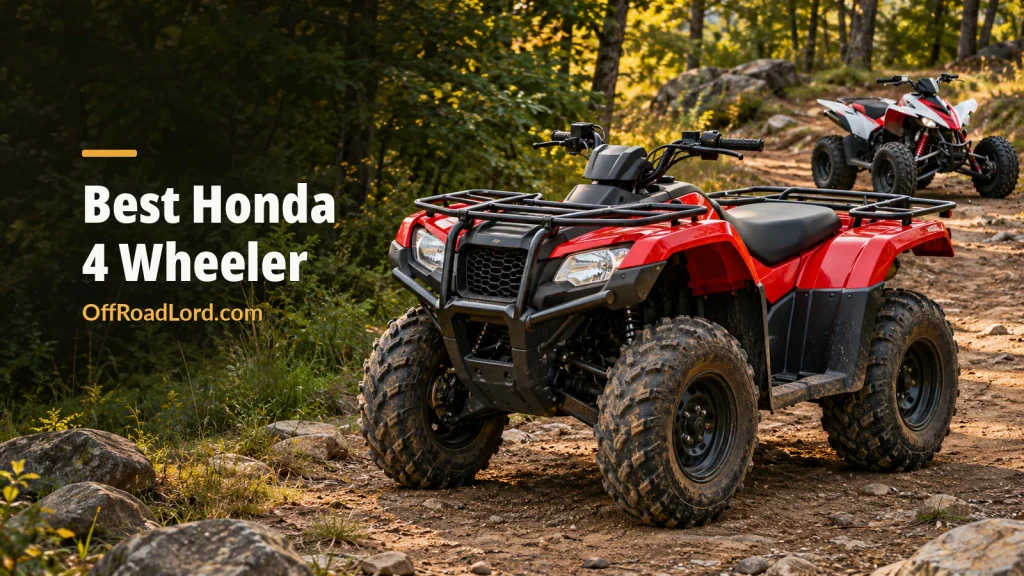
The following table covers the 2027 US adult-sized ATV configurations, including Honda’s newly announced sport model. Prices are starting US MSRPs, before freight, setup, taxes, accessories and other fees.
I use standard non-California weights where Honda gives a separate California figure. Prices come from the 2027 FourTrax announcement and updated US lineup; linked model names take you to exact-year specifications.
| 2027 model (FourTrax unless noted) | Engine (cc) | Drive and transmission | US MSRP | Best fit |
|---|---|---|---|---|
| Recon | 229 | 2WD; 5-speed foot shift | $4,899 | Light work |
| Recon ES | 229 | 2WD; 5-speed electric shift | $5,149 | Thumb shifting |
| Rancher (TRX420TM1) | 420 | 2WD; 5-speed foot shift | $6,299 | Firm-ground utility |
| Rancher 4×4 (TRX420FM1) | 420 | 4WD; 5-speed foot shift | $7,399 | Best general value |
| Rancher 4×4 DCT EPS (TRX420FA2) | 420 | 4WD; automatic DCT | $8,649 | Automatic work and trails |
| Rancher 4×4 DCT IRS EPS (TRX420FA6) | 420 | 4WD; automatic DCT | $9,149 | Uneven trails |
| Foreman 4×4 (TRX520FM1) | 518 | 4WD; 5-speed manual | $8,249 | Work and mud |
| Foreman 4×4 EPS (TRX520FM2) | 518 | 4WD; 5-speed manual | $9,099 | Work with steering assist |
| Foreman Rubicon 4×4 EPS (TRX520FM6) | 518 | 4WD; 5-speed manual | $9,799 | Heavy utility, IRS |
| Foreman Rubicon 4×4 DCT EPS (TRX520FA6) | 518 | 4WD; automatic DCT, high/low | $10,499 | Mud, plowing, towing |
| Foreman Rubicon 4×4 DCT EPS Deluxe (TRX520FA7) | 518 | 4WD; automatic DCT, high/low | $10,999 | Premium equipment |
| Rubicon 700 4×4 Automatic | 675 | 4WD; 3-speed torque converter | $9,999 | Large-engine automatic |
| TRX250X | 229 | 2WD; 5-speed SportClutch | $5,549 | Recreational sport |
DCT means dual-clutch transmission; EPS means electric power steering; IRS means independent rear suspension. A 4×4 designation here means selectable four-wheel drive, not that every model has a selectable full front differential lock.
The Recon ES has a button-operated gearbox, not a fully automatic gearbox. Honda lists the Rubicon 700’s starting price separately from the original announcement, which had not yet specified one.
Honda ATV weight, clearance and work capacity
Engine size only tells you so much. I’d use these figures to rule out a machine that is too heavy for your trailer, too wide for your gate, or too lightly rated for your tools and trailer. Curb weight includes standard equipment, fluids and a full fuel tank.
| 2027 trim | Width (in.) | Curb wt. (lb) | Clearance (in.) | Front/rear rack (lb) | Tow (lb) |
|---|---|---|---|---|---|
| Recon | 40.7 | 437 | 6.0 | 33 / 66 | 500 |
| Rancher 2WD | 47.4 | 580 | 7.1 | 66 / 133 | 848 |
| Rancher 4×4 | 47.4 | 615 | 7.1 | 66 / 133 | 848 |
| Rancher DCT EPS | 47.4 | 642 | 7.1 | 66 / 133 | 848 |
| Rancher DCT IRS EPS | 47.4 | 686 | 9.6 | 66 / 133 | 848 |
| Foreman 4×4 EPS | 47.4 | 648 | 7.5 | 88 / 176 | 848 |
| Foreman Rubicon EPS | 47.4 | 697 | 9.8 | 99 / 187 | 1,322 |
| Foreman Rubicon DCT EPS | 47.4 | 725 | 9.7 | 99 / 187 | 1,322 |
| Rubicon 700 Automatic | 47.5 | 701 | 9.5 | 99 / 187 | 848 |
| TRX250X | 41.8 | 385 | 5.7 | Not rated here | Not rated here |
The front and rear limits are not a combined vehicle payload rating. Your weight, accessories, cargo and trailer tongue load must also comply with the exact owner’s manual. A rated towing capacity does not mean you can safely tow that weight on every slope or surface.
Best Honda ATV overall: FourTrax Rancher 4×4
The base Rancher 4×4 is where I’d start if you need an ATV rather than a specialized machine. It costs $7,399 in the 2027 lineup, has fuel injection, and uses a geared transmission with an automatic clutch. You still shift with your foot, but there’s no hand clutch to manage for ordinary gear changes.
The 2WD Rancher saves $1,100 at MSRP. That is a reasonable saving for dry, relatively level property, but not if you regularly deal with loose soil, snow or slick creek-side trails. Both have the same published towing rating, so the choice is traction rather than a bigger hitch rating.
If you would rather concentrate on steering and throttle, the DCT EPS costs $1,250 more than the foot-shift 4×4. For another $500, the IRS version adds independent rear suspension, a rear disc brake and higher ground clearance. It also adds 44 lb of curb weight and increases the published turning radius from 9.2 to 11.5 feet.
Those are real tradeoffs, not just a trim badge. I’d pay for the IRS version if much of my riding was over rough trails; otherwise the regular DCT EPS or foot-shift Rancher might be the better value.
See the Rancher trim specifications for the differences. If you’re open to brands other than Honda, my adult four-wheeler comparison covers comparable utility ATVs.
Best Honda 4 wheeler for mudding
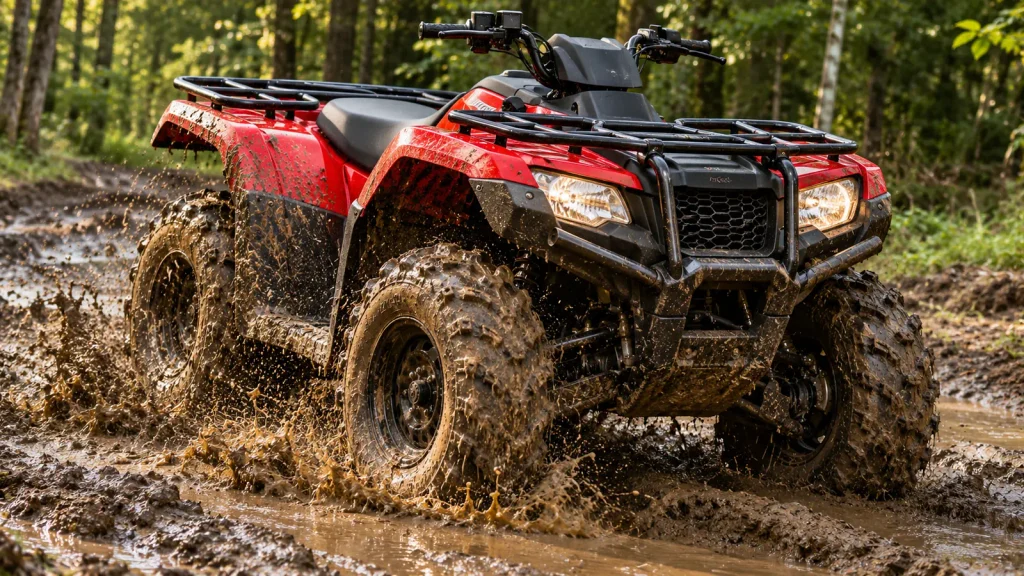
For regular muddy trails, I’d choose the Foreman Rubicon 4×4 Automatic DCT EPS. Its selectable locking front differential, low-range gearing, independent rear suspension, 9.7-inch clearance and 25-inch tires make it the Honda configuration I’d shortlist for slow, uneven, slippery ground.
The Foreman 4×4 EPS is the cheaper choice if you prefer foot shifting and ride shallower mud. You retain a selectable front differential lock, but get a swingarm rear end and less ground clearance.
The Rancher 4×4 is fine for moderate muddy conditions within its limits, but uses a torque-sensing front differential rather than the Foreman’s selectable locking mode.
The Rubicon 700 has the larger engine and 26-inch radial tires, but the 700 specifications list a torque-sensitive front differential and a three-speed torque-converter automatic, not the 520 DCT’s high/low gearbox. I would not choose it just because the number on the side is bigger.
Ordinary mud versus a dedicated mud ATV
Honda’s 2027 utility lineup does not list a purpose-built deep-mud package comparable to the 2026 Can-Am Outlander X mr 700. That Can-Am started at $10,549 for the 2026 model year and has 28-inch mud tires, elevated intake and exhaust ventilation arrangements, a relocated radiator and a mud-focused differential.
The 2027 Polaris Sportsman 850 Mud Edition also comes with 30-inch mud tires. These are specialized machines rather than standard utility quads with bigger engines.
Honda’s geared DCT does not use a CVT drive belt, but that does not make the engine, electrical system, bearings or differentials waterproof. Stay within the water-depth and recovery instructions in the owner’s manual.
Check the airbox and cooling system after wet or dusty rides, and avoid blocked radiators and aggressive tire sizes that exceed factory fitment or load recommendations. A properly rated winch and compatible mounting system are worth budgeting for; they don’t make an unsafe crossing acceptable.
If your regular riding really is deep mud, a factory mud package may make more sense than spending money converting a general-purpose Honda. Check the trail rules and avoid damaging wet ground or riding in prohibited areas.
Best Honda ATV for farming and utility work
For fence inspections, checking livestock, carrying hand tools or occasional light trailer work, I’d choose according to the actual loads rather than acreage alone.
- Recon: light tasks on firm ground, particularly if gates or storage space are narrow. Its 40.7-inch width and 8.5-foot turning radius are useful where a larger quad is inconvenient.
- Rancher 4×4: mixed property maintenance and recreation, especially when wet soil makes four-wheel drive worthwhile.
- Foreman 4×4 EPS: repeated work over slippery ground, with greater rack limits than the Rancher and a selectable locking front differential.
- Foreman Rubicon DCT EPS: heavier approved trailer work, uneven terrain or frequent low-speed maneuvers where high/low gearing and automatic shifting matter.
The 2027 Foreman 4×4 specifications show an 848-lb towing rating, the same as the Rancher, so don’t pay more expecting extra rated towing capacity.
The Foreman Rubicon is different: its 1,322-lb rating is 474 lb higher, and the individual rack limits are higher as well. The Rubicon 700 returns to an 848-lb towing rating despite its larger engine.
Imagine that your loaded trailer weighs 1,000 lb. That is already above the listed tow ratings for the Rancher, Foreman and Rubicon 700, but below the Foreman Rubicon’s stated maximum.
You still have to check tongue load, total vehicle load, hitch, trailer brakes if required, gradients and surface conditions before towing it.
If you routinely carry bulky feed bags, fence posts or another adult, a utility side-by-side with a cargo bed and approved seating may be a better purchase than an ATV. Honda’s Pioneer is a separate type of vehicle, not a FourTrax with extra seats.
Best Honda four-wheeler for snow and snow plowing
I’d start with the Foreman 4×4 EPS for a property owner who wants a foot-shift plow ATV. If you prefer automatic shifting, the Foreman Rubicon DCT EPS is the stronger shortlist: it adds high/low range and a higher towing rating, although the latter does not establish how much snow it can push.
Power steering is useful when maneuvering repeatedly with a front-mounted implement. Four-wheel drive helps with traction, but does not guarantee control or braking on ice. For occasional recreational snow riding without a plow, a Rancher 4×4 EPS-equipped automatic may be enough.
Before ordering a plow, check the exact model year and model ID against the accessory manufacturer’s fitment chart.
A mount advertised for Rancher, Foreman and Rubicon families is not proof of compatibility with a particular 2027 trim. Confirm the mount, blade, push tube, lift or winch and all required hardware together; I would not buy a specific kit until the supplier confirms the exact ATV.
Use the Honda owner’s manual for cold starting, loading and operation. Check the battery and charging system, condition of the tires, accessory loads and the electrical requirements for the chosen winch. Keep the blade and its weight within the approved limits, and avoid steep or icy surfaces where you cannot maintain control.
Best Honda ATV for trail riding, hunting and recreation
The Rancher DCT IRS EPS is my preferred Honda for mixed woodland trails and property use if you want automatic shifting. Its independent rear suspension lets the two rear wheels move separately.
That provides useful articulation on uneven terrain, although tire pressure, rider fit, spring settings and speed also influence comfort.
On narrow, relatively dry paths, the lighter Recon deserves a look: it is 6.7 inches narrower than the Rancher and easier to accommodate in a small trailer.
Its rear-wheel drive and 6 inches of clearance are real limits in rutted, rocky or muddy terrain. For longer rides the Rancher’s 3.9-gallon tank is larger than the Recon’s 2.4-gallon tank, but tank size alone does not tell you riding range.
For hunting, I would choose a Rancher 4×4 or Foreman EPS according to trail width, typical ground conditions and the weight of gear. Verify public-land access rules and secure gear so it does not interfere with steering or your ability to shift body position.
If you want a sport riding experience instead of racks and towing, the TRX250X is a very different machine: 385 lb curb weight, 41.8 inches wide and a five-speed SportClutch gearbox.
Honda’s clutch arrangement allows manual clutch use without the usual need to manage a clutch lever to prevent stalling. It is not a fully automatic ATV, and it is not designed to replace a farm quad.
The 2027 US product page also excludes California sale or use. My guide to the different types of four-wheelers explains the categories in more detail.
Best Honda racing ATV and fastest Honda four-wheeler
If you want a Honda specifically for adult recreational sport riding and are buying new, look at the TRX250X. If you want a Honda competition quad, look to the used market. The TRX250X is an entry-level sport ATV, not a new equivalent of Honda’s discontinued TRX450R.
The TRX450R arrived in 2004 as a race-oriented platform, as described in ATV Rider’s historical overview. The later electric-start 450ER is another used candidate.
The TRX250R was a two-stroke sport and competition platform; the same historical overview dates its production to 1986–1989. The TRX400EX, introduced for 1999, and later TRX400X are more recreational alternatives.
The TRX700XX was a 686cc sport machine with independent rear suspension and a five-speed manual gearbox; see this period 700XX comparison for its design and handling tradeoffs.
If you want a newly produced competition-oriented quad rather than a used Honda, the Yamaha YFZ450R is a much closer fit.
It has a 449cc engine and a race-oriented chassis. Match the machine to the rules of the event you intend to enter, and ride only at authorized facilities or on permitted routes.
How fast can a Honda quad go?
The TRX450R is one of the strongest documented fast Honda candidates, but I wouldn’t call any Honda the absolute fastest of all time without comparable tests across the relevant stock models.
| Tested Honda | Reported speed | Scope |
|---|---|---|
| 2014 TRX450R | 73.2 mph | Dirt Wheels three-quad sport comparison; measurement protocol not specified |
| 2016 Rancher 420 DCT | 50 mph | Dirt Wheels Rancher/Kodiak comparison; measurement protocol not specified |
Those are historical published test results, not speed guarantees for other years or trims. The 2016 Kodiak reached 67 mph in the same Rancher test. Honda does not give a top-speed number in the 2027 specifications linked above.
Engine displacement, gearing, tires, terrain, load and electronic limits can all affect speed. See my four-wheeler top speed guide and high-performance ATV comparison by power for the broader picture. Power rankings are not measured speed rankings.
Best Honda ATV for beginners and budget buyers
The Recon is the least expensive adult utility Honda in the 2027 announcement, at $4,899 MSRP. The 229cc carbureted engine, compact chassis and modest rack capacities suit light property work on dry terrain.
The ES costs $250 more and allows button-operated gear changes. Both are two-wheel drive.
I would not buy the Recon just because it is cheaper if the buyer needs to tackle snow, mud or loose ground regularly. For those conditions, the base Rancher 4×4 may be worth the extra purchase price.
Conversely, you don’t need to pay for a Rubicon if your work is light and the Recon fits you comfortably.
The TRX250X is the recreational sport alternative for riders who don’t need utility equipment. Honda recommends these adult models for riders aged 16 and older; that age label is a minimum, not proof of physical fit or skill.
Take a rider training course, try the seating position and controls, and use appropriate protective gear. The youth TRX90X is not an adult budget substitute.
Honda’s ATV buyer’s guide explains the light utility and sport categories, though older model-year trim counts should not be used for current ordering.
Rancher vs. Foreman vs. Rubicon vs. Recon: what are you paying for?
The Recon is the smaller light-duty option. The Rancher is the middle ground, with the broadest choice of drive and automatic/manual combinations in the 2027 utility family.
The Foreman adds the 518cc engine, higher rack limits, larger factory tires and a selectable differential lock, but retains a manual gearbox and swingarm rear suspension in both 2027 trims.
The Foreman Rubicon brings independent rear suspension and power steering to every 2027 version. You can choose the manual EPS model or either of the DCT trims.
The manual version is $700 less than the DCT EPS; the DCT adds automatic operation and a dual-range transmission. The Deluxe adds premium equipment including aluminum wheels, rather than a higher published towing rating.
The 700 is a separate powertrain, not a bored-out 520 with the same transmission. Its factory specifications identify a 675cc engine, a three-speed hydraulic torque-converter automatic with electronic shift controls, IRS and a torque-sensitive front differential.
It has a 4.4-gallon fuel tank; the 520 Rubicon has 3.9 gallons. Don’t assume the 700 has the 520’s EPS or selectable lock based on the shared Rubicon name.
For automatic shifting, I would compare a Rancher DCT, Foreman Rubicon DCT and Rubicon 700 on their respective controls rather than assuming every Honda automatic is identical.
For older Hondas, verify the model code: earlier Rancher and Foreman versions offered different electric-shift and suspension combinations.
Honda vs. Polaris, Can-Am, Yamaha and Kawasaki ATVs
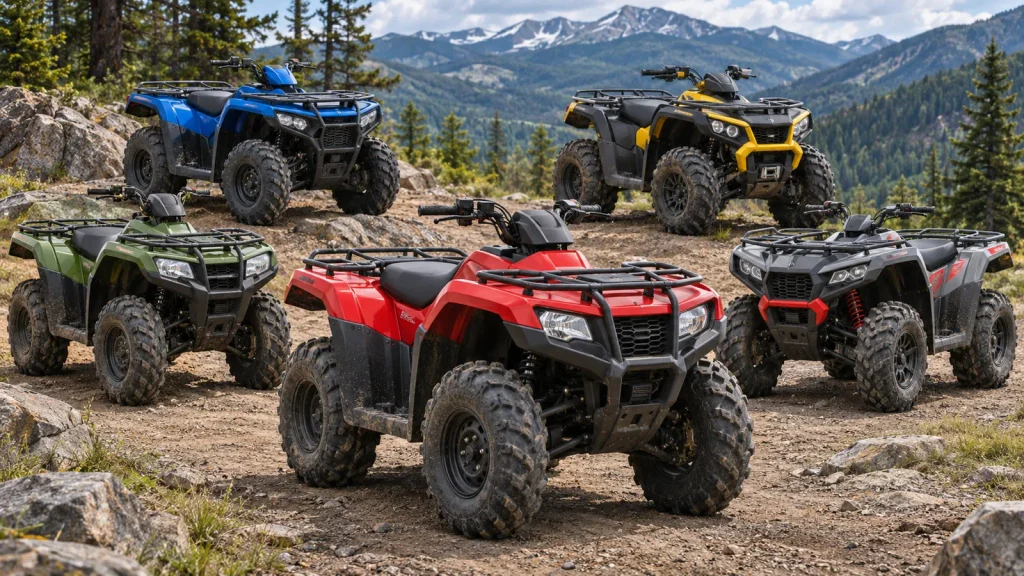
Honda’s biggest differentiator for many buyers is the choice of a conventional geared foot-shift transmission or geared automatic DCT.
Many competing recreational utility ATVs instead use a continuously variable transmission (CVT). Neither design alone proves that one machine will outlast the other.
For a realistic comparison, here are selected 2026 US alternative trims against the 2027 Rancher 4×4. The older model-year prices are reference MSRPs for leftover stock or used-shopping comparisons, not a guarantee of current inventory or current-year price parity.
| Model and model year | US base MSRP | Engine / transmission | Clearance / practical distinction |
|---|---|---|---|
| 2027 Honda Rancher 4×4 | $7,399 | 420cc / foot shift | 7.1 in.; 848-lb tow |
| 2026 Polaris Sportsman 450 H.O. | $6,999 | 499cc / automatic PVT | 11.5 in.; 1,350-lb tow |
| 2026 Yamaha Kodiak 450 | $6,899 | 421cc / Ultramatic CVT | 9.6 in.; independent rear suspension |
| 2026 Kawasaki Brute Force 450 4×4 | $6,899 | 443cc / automatic CVT | 9.3 in.; 43.3-in. width; 1,050-lb tow |
| 2026 Suzuki KingQuad 400ASi | $7,099 | 376cc / automatic CVT | 9.8 in.; 45.1-in. width; 24-month limited warranty |
These are general-purpose four-wheel-drive candidates rather than premium EPS versions. The Kawasaki is a particularly interesting alternative if a gate is your hard constraint.
The Yamaha is worth considering if you want an automatic with independent rear suspension without jumping to the premium Rancher. The Polaris gives you more published clearance and towing capacity than the base Rancher.
The Honda is the choice I’d make if I specifically want foot-shift control. Compare the actual total price and approved loads before buying.
Can-Am’s 2026 Outlander 500/700 family uses a CVT, with different equipment across the base, DPS and XT packages; the X mr 700 is the specialized mud alternative.
For a same-model-year comparison, the 2027 Outlander DPS 500/700 US configurator lists the package from $8,749, with power steering, an automatically locking front differential, 25-inch tires and a full skid plate.
That is $100 above the 2027 Rancher DCT EPS base MSRP; get a quote for the exact Outlander engine and color instead of treating the package starting price as the price of every configuration. Compare the Outlander’s equipment and CVT controls with the Honda’s geared DCT. See my Can-Am vs. Polaris guide for their separate ATV and side-by-side matchups.
The KingQuad 400ASi also has selectable 4WD, a swingarm rear suspension and a longer listed limited warranty than the 2027 FourTrax models. CFMOTO CFORCE models are also worth a dealer visit if price, equipment or local service support matters more than Honda’s gearbox design.
The 2025 Dirt Wheels rec-utility buying guide is a useful historical starting point for model families, but get a current US quote and specification sheet before using it to compare prices or equipment.
I would not rank manufacturers by reliability on the basis of anecdotes, or compare the Polaris’s estimated dry weight directly with Honda’s full-fuel curb weight.
Ask about warranty coverage, scheduled maintenance, availability of parts and service appointments for the specific model. If you are choosing an older machine, actual condition matters more than the badge.
Are Honda four-wheelers reliable and worth the money?
Honda has a long history in the ATV market, and a shaft-drive, geared utility ATV can make sense if its controls and maintenance requirements suit you. That is not proof that Honda has a lower failure rate than every competitor. I have not found comparable fleet failure-rate data that would establish a universal most reliable Honda model.
Honda’s 2027 FourTrax specification sheets list a one-year warranty. Read the applicable warranty terms and owner’s manual before buying. A foot-shift model still needs oil and filter service, air-filter cleaning, final-drive fluid checks, brakes and other scheduled work.
An ES model adds electrical shift controls; a DCT uses electronically controlled clutches and needs the specified oil and service procedures. Don’t assume the two automatic designs take identical parts or fluids.
Recalls are also model-specific. The CPSC’s 2013 Foreman recall concerns steering shafts on certain 2012–2013 TRX500 FE/FM models. A separate 2012 Rancher recall concerns a front suspension-arm weld on specified TRX420TE/TM units.
These are reasons to check the VIN, not evidence that every Foreman or Rancher is defective. Search the CPSC recall database and have a dealer confirm completed recall work before using an affected ATV.
Ask the dealer what a routine service costs and what parts it keeps in stock. If you ride in dust or mud, inspect the air intake, radiator where fitted, CV boots, seals and brakes regularly, following the severe-use guidance in the exact manual.
A good maintenance history is worth more to me than a seller simply claiming that Hondas never break.
How much does a new Honda four-wheeler cost?
In the 2027 adult lineup, prices start at $4,899 for the Recon, $6,299 for the 2WD Rancher, $8,249 for the Foreman 4×4, $9,799 for the manual Foreman Rubicon EPS, and $9,999 for the Rubicon 700.
The TRX250X sport model starts at $5,549. The Foreman Rubicon DCT EPS Deluxe lists $10,999 before fees. Those are base prices; some colors or camouflage packages cost more.
For example, the Honda US lineup shows the model families, while the Foreman Rubicon’s specifications help distinguish the versions. Get separate quotes for destination, preparation, taxes, title, registration, winch, plow, protective gear and any other equipment. Don’t compare an equipped Honda against a bare rival using the base MSRP alone.
If you want value, identify the least expensive configuration that satisfies your hard requirements. A $500 suspension upgrade may be worth buying if it solves a real trail problem; a larger engine with the same or lower published towing capacity may not solve your work problem.
Best used Honda four-wheelers to consider
An older Honda can be a sensible purchase, but I’d separate work machines from sport machines and compare actual condition rather than the reputation of the model.
| Used model | Why I would shortlist it | What to check first |
|---|---|---|
| FourTrax 300 / 300 4×4 (TRX300 / TRX300FW) | 1988–2000 utility family; simple foot-shift controls | Drive version, carburetor, brakes, frame, parts and paperwork |
| Older Rancher / Foreman | General utility; multiple years and drive/shift configurations | Exact model ID, front drive, shifting, cooling and recall status |
| TRX400EX / later TRX400X | Recreational sport platform; 400EX introduced for 1999 | Engine condition, chain, sprockets, suspension, evidence of modifications |
| TRX450R / electric-start 450ER | Historical competition-oriented sport family | Engine hours/rebuild history, clutch, frame and race modifications |
| TRX250R | Historical 1986–1989 two-stroke sport platform | Engine rebuild quality, frame and replacement-parts supply |
| TRX700XX | Historical 686cc independent-rear-suspension sport ATV | Chain drivetrain, rear suspension components and parts availability |
Before buying any used ATV, ask to see a cold start and service records. Match the frame VIN to ownership paperwork, and check for outstanding recalls, odometer and hour-meter readings where available, cracks or repairs in the frame, wheel play, damaged boots, brake function and leaks.
Check that reverse, every gear and four-wheel drive (if fitted) operate correctly in a safe setting. Water lines, silt inside the airbox, contaminated fluids and corroded electrical connectors deserve extra scrutiny.
Look up availability of the actual parts you may need before agreeing to a price. Compare recent completed sales for similar condition and year rather than relying on advertised asking prices.
I would budget for the repairs identified by a pre-purchase inspection instead of guessing a national average used Honda price.
Does Honda make a two-seater ATV?
I did not find a factory two-passenger ATV in the 2027 US Honda range. Treat the FourTrax models and TRX250X here as single-rider machines; check their safety labels and manuals.
A longer seat or a backrest attached to the rear rack does not create a manufacturer-approved passenger position. If carrying another adult is a requirement, my two-seater ATV buying guide covers factory two-up alternatives such as Outlander MAX and Sportsman Touring.
Honda’s Pioneer side-by-side is another type of option if you want approved seating and a cargo bed.
How to choose the right Honda 4 wheeler
- Write down your most demanding regular job or riding condition, not the rare trip you might take.
- Set a total purchase budget including freight, setup, accessories and protective equipment.
- Decide whether selectable 4WD and a front differential lock are necessary for your terrain.
- Choose foot shift, electric shift or fully automatic controls according to the exact trim.
- Decide if you need EPS and independent rear suspension; sit on the actual machine before committing.
- Check the separate rack, hitch, towing and total-load limits against your intended loads.
- Measure your gate, garage, trailer and permitted trail widths with any installed accessories included.
- Rule out single-rider ATVs if you need to transport a passenger.
- Compare nearby dealer service, parts, warranty terms and the condition of any used candidate.
For most solo buyers who mix work with recreation, I’d get quotes for the Rancher 4×4 and Rancher DCT EPS first. If heavier towing, rough ground or a selectable differential lock is what actually matters, compare the Foreman and the Foreman Rubicon instead.
If you need a dedicated factory mud machine, a true two-up quad or a new competition ATV, I’d broaden the search beyond Honda. Buy the configuration that fits your work and terrain rather than paying for the largest engine by default.

Calvin Anderson, founder of Off-Road Lord, is a seasoned off-roading enthusiast from Tucson, Arizona. With over a decade of hands-on experience and a deep understanding of off-roading vehicles and trails, Calvin’s insights provide a trusted guide for fellow adventurers.